








The death of Supreme Court Justice Antonin Scalia and the renewed attention on superdelegates will likely thrust electability back into the forefront in the Democratic presidential primary, a development Hillary Clinton’s campaign hopes will boost their candidate heading into a more nationalized nominating contest beyond the early states.
With control of the high court now essentially on the ballot in November, Clinton is hoping to subtly remind Democratic voters currently enthralled with Bernie Sanders of the dire stakes in this election, aware that most currently perceive her as the stronger general election candidate.
“This election is important for many reasons — it just got even more important yesterday because of the death of Supreme Court Justice Scalia,” Clinton said while campaigning in Nevada Sunday, a comment she’s echoed on almost every stop in the state ahead of its first-in-the-West caucuses on Saturday.
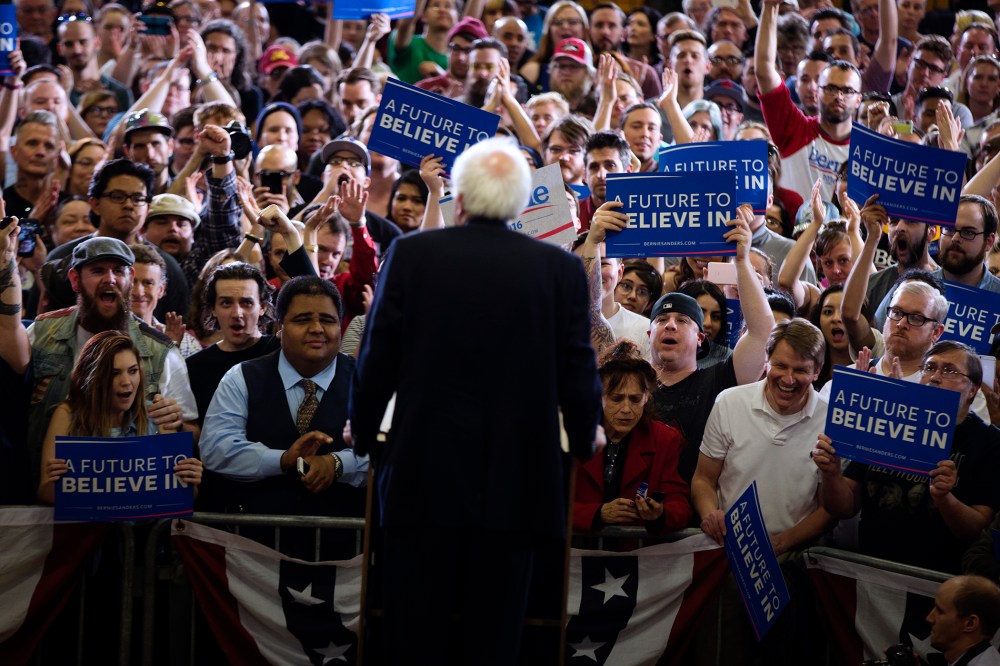
Meanwhile, Sanders and his allies believe he has a strong case to make on electability and say they are eager to make it, especially to the party leaders known as superdelegates, most of whom currently back Clinton. The 712 superdelegates represent 15 percent of total nominating delegates, making it extremely difficult for Sanders to win the nomination without at least some support from the group.

“I think if we continue to do well around the country and if superdelegates, whose main interest in life is to make sure that we do not have a Republican in the White House, if they understand that I am the candidate, and I believe that I am, who is best suited to defeat the Republican nominee, I think they will start coming over to us,” Sanders said on CBS’ “Face the Nation” Sunday.
The twin dynamics, along with the natural shift in focus toward the general election as the primary moves later into the calendar, mean both candidates will likely start playing up their general election prospects.
For now, at least, Democrats clearly seem to believe that Clinton is better positioned to face off against Republicans in the fall.
A CNN/ORC International Poll from late January found that Democrats nationwide picked Clinton over Sanders 71 percent to 23 percent when asked to name the stronger general election candidate. In a Washington Post/ABC News poll around the same time, Democrats by a 65 percent to 26 percent margin said Clinton has a better chance of winning the general election than Sanders. And a Monmouth University poll from January found Democrats thought Clinton has a better chance than Sanders against Donald Trump (44 percent to 16 percent), Marco Rubio (37 percent to 17 percent) and Ted Cruz (39 percent to 17 percent).
All three polls were taken before Sanders narrowly lost Iowa and won New Hampshire, so it’s possible those outcomes have altered voters’ feelings, and they already showed some movement in Sanders’ favor. All three of the January polls were of national audiences, who have generally had less exposure to Sanders’ message than voters in the early states.
Still, any day when Clinton gets to battle Republicans blocking Obama’s appointment to the Supreme Court is likely better than one when she has to battle Sanders. And pro-Clinton forces feel any focus on electability helps their candidate.
RELATED: Superdelegates at center of Democratic nomination fight again
Ed Rendell, the former governor of Pennsylvania and Democratic National Committee chair who is backing Clinton, said, “Sophisticated Democrats who might thinking about voting for Bernie might be charged into voting for her on the electability argument … [The Supreme Court vacancy] just brings it home more graphically.”
Sanders and his allies naturally disagree.
As Sanders often notes on the stump, almost every poll testing hypothetical general election matchups shows Sanders beating Republican candidates by a larger margin than Clinton. Sanders has not received anywhere the near the criticism from Republicans as Clinton, so the polling is likely not predictive, but it could still be an effective talking point.
And pro-Sanders forces argue that getting voters excited is now more important than winning over undecided voters, whose numbers have dramatically dwindled in recent years. RELATED: Obama for Supreme Court? Clinton is open to the idea “The last two election cycles have made it clear that general elections are all about turnout,” said Ben Wikler, the Washington director of MoveOn.org, which has endorsed Sanders and is encouraging superdelegates to support whomever voters in their state support. “For a party inside, if you look where the energy is, it’s going to be more and more clear that the energy is in the Sanders movement, and we need all of those people to be working day and night in all the months leading up to the general election.” Sanders is unlikely to make a major push on superdelegates until he has a few more primary and caucus wins under his belt, at which point he could make the case that voters are not just casting a protest vote. Clinton made the electability argument more directly and aggressively at the beginning of the year. “Think hard about the people who are presenting themselves to you, their experience, their qualifications, their positions. And particularly for those of us who are Democrats, their electability,” Clinton said while campaigning in Iowa last month ahead of the caucus there. But she backed off making a direct appeal on the issue and has since then refrained from using the “E” word. Instead, she’s focused on almost subliminally reminding voters by emphasizing how disastrous a Republican White House — and now Supreme Court appointment — would be. That will likely hold true now, when the Supreme Court will serve as prism through which she can focus the stakes of the election, with a special attention to Obama. She’ll likely accuse Republicans of disrespecting the president and defend his prerogative to pick a nominee, while also pointing to Obama legacy items currently before the court, such as his sweeping executive actions on immigration and climate change. “One of the things they have to worry about if she decided to push the electability argument is that it could backfire on her,” said Patrick Murray, the polling director at Monmouth University. “You’re basically telling voters who have been drifting towards Bernie Sanders that they’re wrong.”
Alex Seitz-Wald Recommended


