








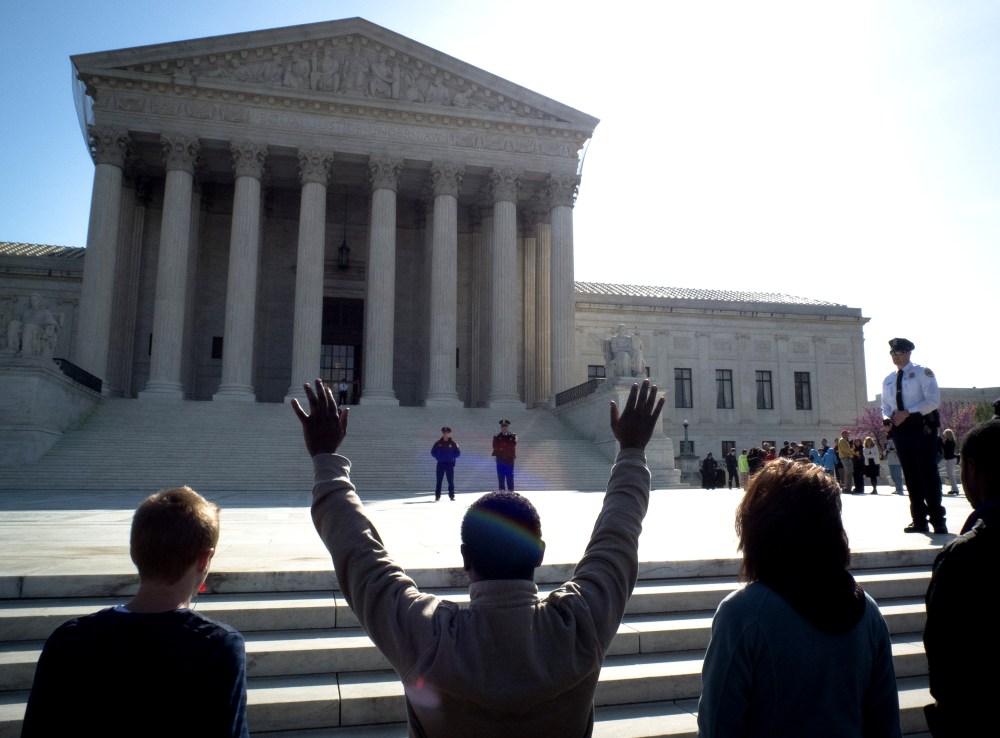
Can American legislatures open their sessions with a prayer? What if those prayers are Christian, week in and week out?
The Supreme Court wades into that fractious debate Wednesday for the first time in a generation. And as with so many constitutional cases the Court hears, the argument will be something of an anachronism: Those in attendance can expect to hear little about modern legislative prayer, and a whole lot more about what James Madison and his friends were up to in 1789.
In the end, Madison & Co. are likely to win the day.
The case, Town of Greece v. Galloway, involves a challenge by two residents to the prayers that open every meeting of the Greece, N.Y. town board. The town says its practice is inclusive, and that it has invited Jewish, Baha’I, and other guest clergy to deliver the prayers.
The two residents beg to differ. They say the town expanded its tent only after it caught whiff of their lawsuit. Before that, they say, the town invited only Christian clergy. And those clergy gave prayers that were often overtly doctrinal.
They say, for example, that the guest clergy “regularly assume that everyone present is Christian. They speak of ‘our Christian faith,’ ‘us as Christian people,’ and ‘the role of the Holy Spirit in our lives.’” The clergy also often “request that all present ‘join’ in the prayer.” According to the plaintiffs’ brief to the Supreme Court, “[c]haplains have disparaged those who question [the town’s] prayer practice, or who are not ‘Godfearing.’”
The question for the Supreme Court is whether the town’s prayer practice violates the First Amendment’s Establishment Clause – “Congress shall make no law respecting an establishment of religion.”
Looking only at the court’s formal test, you’d think the answer is yes. That test – called the Lemon test, after an earlier case – asks three questions to determine whether government involvement with religion violates the Establishment Clause: Does the government practice have a religious purpose? Is its primary effect religious? Does it entangle the government with religion? If so, it has to be struck down.
Legislative prayer arguably fails that test on every front. And yet when the legislative-prayer question came to the Supreme Court in a 1983 case called Marsh v. Chambers, the Court ruled 6-3 that a the practice is constitutional, carving out what the dissent called “an exception to the Establishment Clause.” Legislative prayer passes muster, the court said, for one reason and one reason only: the nation’s Founders endorsed it at the very same time they were writing the Constitution.
“On September 25, 1789, three days after Congress authorized the appointment of paid chaplains, final agreement was reached on the language of the Bill of Rights,” Chief Justice Burger wrote for the majority. “Clearly the men who wrote the First Amendment Religion Clauses did not view paid legislative chaplains and opening prayers as a violation of that Amendment.” He wrote that so long as there is no proof that the choice of clergy stems “from an impermissible motive” to promote a particular religion, and no indication that the prayer is being “exploited” to endorse one religion or disparage another, legislative prayer is constitutional. But 30 years have passed, and not one justice who was on the court in 1983 remains. Will the Marsh exception stand the test of time? The town says it should; it wrote in its briefs that “[t]his case can begin and end with Marsh.” And the Obama administration – perhaps trying to protect legislative prayer in Congress – agrees. It told the court in its brief that a legislative-prayer practice that doesn’t proselytize or disparage a particular religion “does not amount to an unconstitutional establishment of religion merely because most prayer-givers are Christian and many or most of their prayers contain sectarian references.” Facing an uphill battle, the two residents who sued are now trying to duck the Marsh question. They say this case is very different because Marsh involved a state legislative session – rarely visited by anyone but reporters – whereas residents of their town have no choice but to attend the board’s meetings if they want zoning exceptions or other town action. Thus, they say, they are being “coerced” to participate in public prayer, much like public school children forced to listen to prayers at school graduation. The Supreme Court has said that sort of coercion violates the Constitution. The town struck back in its brief, accusing the two residents of trying to “twist” the concept of coercion “beyond all recognition.” They probably have the better of that argument. Expect the Founding Fathers to prevail and legislative prayer to stick around, at least for another generation.
Dominic Perella Recommended


