








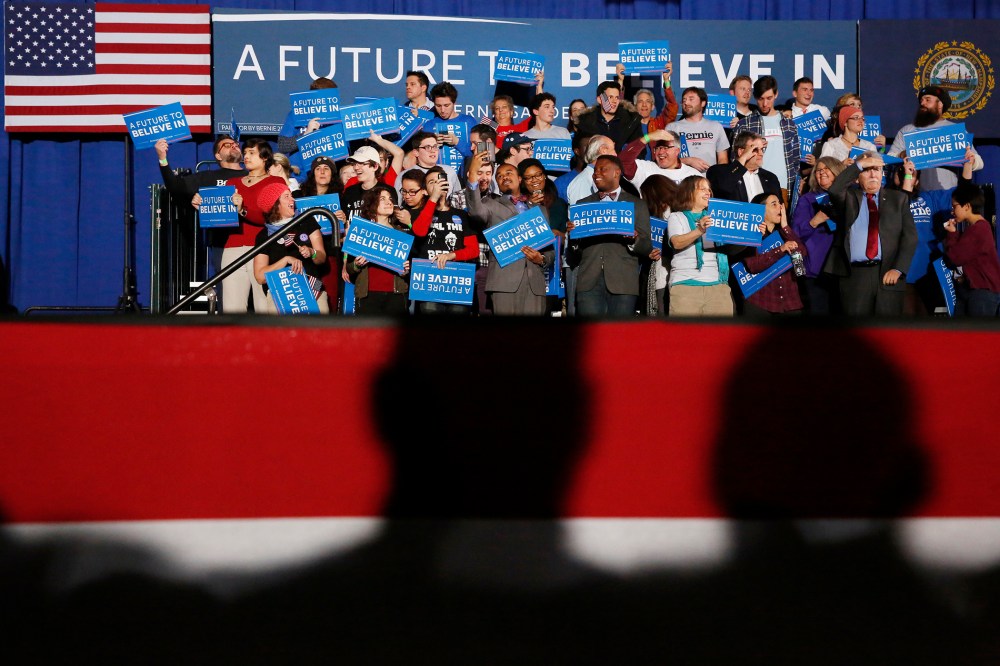
After Vermont Sen. Bernie Sanders beat former Secretary of State Hillary Clinton in New Hampshire by 22 percent and emerged with the exact same number of delegates, some of Sanders’ supporters cried foul and accused the Democratic Party’s establishment of going against the will of the people.
Liberal group MoveOn started a petition protesting the Democrat’s primary process.

“Democracy only works when the votes of the people – not the decision of a small number of elites – are what determines the outcome of elections,” the petition says.
This is also an instance of history repeating itself. But first, an explanation:
The primary process is a race for delegates and — on the Democratic side — superdelegates. Of the 2,382 delegates needed to win the nomination, most are obtained in the primary voting or caucus process. But 712 of the delegates are superdelegates, and they are from the party establishment. They consist of governors, senators, members of the House, members of the Democratic National Committee and former presidents. They can choose whichever candidate they like.
RELATED: What’s a superdelegate and why did Clinton win them?
Clinton has done her due diligence and racked up nearly half of the superdelegates in many states that have yet to cast votes. She has 359 to Sanders’ eight superdelegates, according to NBC News estimates.
Liberal Russ Belville wrote about the process. “In other words, one vote from these one-percenters for the Wall Street candidate is worth 10,105 votes from the 99-percenters for the Democratic Socialist candidate,” he wrote in the blog post.
“This process is undemocratic and fundamentally unfair to Democratic primary voters,” the MoveOn petition said.
Hours after the petition’s release, MoveOn reached their goal of collecting 75,000 signatures and are approaching 145,000 signatories as of 6:00 p.m. EST.
MoveOn launched a similar petition in 2008 when Clinton also ran up the score on superdelegates before any votes were cast.
Clinton, who was expected to win the nomination early in that race, had won the support of 169 of 796 superdelegates available in December of 2007, more than any other candidate in the race. Then-Senator Barack Obama had the second most with 63, according to the Associated Press.
Obama complained of the process in 2008 when he was losing the superdelegate race.
“My strong belief is that if we end up with the most states and the most pledged delegates from the most voters in the country, that it would be problematic for the political insiders to overturn the judgment of the voters,” he said, according to the New York Times. The superdelegates became part of the Democratic nominating process in 1982 to ensure the Democratic party has input on who the nominee is. They wanted to prevent another election like 1972’s when George McGovern won the Democratic nomination, but lost every state minus one. Ironically, Tad Devine, Sanders’ top adviser, who was instrumental in the creation of the superdelegate process, defended their existance. “It’s pretty hard to win a nomination in a contested race and almost impossible to win without the superdelegeates,” Devine said in 2008 in an interview on NPR. Now, Devine’s boss, who is running on an anti-establishment message, is losing the superdelegate race. Of course, superdelegates are not bound and can switch their allegiance like many did in 2008 once it became clear that Obama was going to be the Democratic nominee. Ben Wikler, Washington Director of MoveOn said that the next stage of the protest is to start petitions targeting each individual superdelegate. “Superdelegates should support the people’s choice,” he told NBC News. This story first appeared on NBCNews.com.Recommended



Leigh Ann Caldwell