








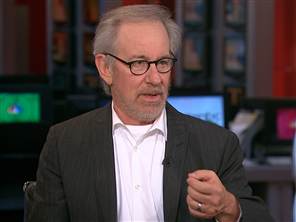
Harvard Economics Professor N Gregory Mankiw, in a new paper boldly titled “Defending The One Percent,” suggests that the growing gap between the top 1% in the U.S. income distribution and the bottom 99% may be justified. But his analysis flunks the Spielberg Test.
Mankiw was an economic adviser to Republican presidential candidate Mitt Romney, but he is no mere political hack. He’s a respected economist, and his paper is a carefully reasoned conservative challenge to critics of income inequality. But like many conservatives before him, Mankiw is unable to provide a persuasive explanation as to why the top 1% deserves its rapidly-growing share of the nation’s collective income.
Citing updated calculations by the economists Thomas Piketty and Emmanuel Saez (for a 2003 paper that strongly influenced the Occupy movement), Mankiw notes that the top 1% has doubled its income share since 1973. The top 0.01%, whose income (excluding capital gains) exceeds $5.9 million, increased its income share sixfold. To believe this a sensible development you’d have to believe that today’s 1% is twice as deserving as the 1% of 1973, and that today’s 0.01% is six times as deserving as the 0.01% of 1973.
Mankiw argues, provocatively, that it is. “Changes in technology,” he proposes, “have allowed a small number of highly educated and exceptionally talented individuals to command superstar incomes in ways that were not possible a generation ago.” Mankiw quotes with approval two other economists to the effect that digital technologies have made it much easier for “entrepreneurs, CEOs, entertainment stars, and financial executives” to reach a global market unavailable to such people four decades ago.
Even Mankiw has to concede that a good many of the above-mentioned financiers aren’t particularly deserving (“when a high-frequency trader figures out a way to respond to news a fraction of a second faster than his competitor, his vast personal reward may well exceed the social value of what he is producing”). But he seems to believe that the other superstar categories he cites are very deserving of their growing share of the pie, and he offers three real-life examples: Steve Jobs, J.K. Rowling, and Steven Spielberg. That’s pretty high-flying company: the most successful CEO of recent times, the most successful novelist of recent times, and the most successful film director of recent times. Jobs, Rowling, and Spielberg are hardly typical of the 1%, or even of the 0.01%. But if we can establish that Mankiw’s hypothesis doesn’t apply to even one of these three superduperstars, it’s doubtful it would apply to most mere superstars.
We can’t know whether Rowling’s success supports Mankiw’s hypothesis or not, because she didn’t start publishing Harry Potter books until the late 1990s. Jobs’s success does support Mankiw’s hypothesis, because between 1973, when Jobs went to work for Atari, and 2011, when he died, the economic value of his labor increased by a factor much greater than six. (Remember, though, that there’s no other person whose undisputed contribution to U.S. corporate profitability is remotely comparable to Jobs’. That ought to give Mankiw pause.)
And Spielberg? In 1973 he was a young journeyman director preparing to make his film debut with The Sugarland Express, a box-office flop, but in 1975 he released Jaws, which became the highest-grossing film in history to that point. Spielberg went on to direct a lot of other big hits as well. But even as the U.S. economy became larger and more global in the ensuing four decades, the box-office returns for Spielberg’s films did not grow higher.
Take a look at this ranking of Spielberg’s ten highest-grossing films based on worldwide ticket sales (courtesy of boxofficemojo.com):
1. Jurassic Park (1993): $924.5 million2. Indiana Jones and the Kingdom of the Crystal Skull (2008): $786.6 million3. ET (1982): $717 million4. The Lost World: Jurassic Park (1997): $618.6 million5. War of the Worlds (2005): $591.7 million6. Saving Private Ryan (1998): $481.8 million7. Indiana Jones and the Last Crusade (1989): $474.2 million8. Jaws (1975): $470.7 million9. The Adventures of Tintin (2011): $374 million10. Minority Report (2002): $358.4
If Spielberg’s market value had risen steadily after 1973, his highest-grossing films would be his most recent. But in fact there is no particular pattern. Spielberg released his biggest grosser 20 years ago. His second-biggest grosser is relatively recent (though part of a franchise he established way back in 1981). Number three, Spielberg released more than 30 years ago. And so on. Please note that these are nominal, not inflation-adjusted dollars, which means several of Spielberg’s older films actually ought to rank higher. Assuming that rankings for inflation-adjusted worldwide grosses approximate those for inflation-adjusted domestic grosses, Spielberg’s box-office performance has declined, since on the domestic list you have to go all the way down to number ten to find a Spielberg film released during the present century. Among the top five, only one (Jurassic Park) was released more recently than 1982. Please don’t misunderstand me. I am not trying to argue that Steven Spielberg is some kind of has-been. His films continue to generate extremely high grosses, and artistically Spielberg is, it is generally agreed, more accomplished than he was three or four decades ago. But Mankiw’s argument is an economic one, and, economically, Spielberg is not a more formidable wealth-creator today than he was before today’s income-inequality boom began in the late 1970s. If anything, he’s somewhat less formidable. Part of the explanation is that the globalization boom of the past three decades hasn’t affected movie ticket sales all that much; U.S.-produced movies had a very global audience even back when Jaws was released. It’s true that Betamax, VHS, DVD, and on-demand home-video formats enhanced sales over time, but Hollywood’s principal yardstick for financial success today remains ticket sales (because box office sales largely determine subsequent home-video sales). The digital market no doubt helped Spielberg acquire his current net worth of $3.2 billion (ranking him 125 on the Forbes 400), but that expanded digital reach has not translated into bigger box-office sales for Spielberg films over time. Unlike Jobs, Spielberg has not seen the return on his newer ventures surpass the return on older ones. (Spielberg, incidentally, has a very pessimistic view of the film industry’s future. In a recent appearance at the University of Southern California, he predicted a “big meltdown” precisely because it’s so focused on producing box-office megahits.) If a creative and financial genius like Steven Spielberg can’t justify Mankiw’s belief that the overclass is up to six times more valuable to the U.S. economy than it used to be, then it’s doubtful more ordinary members of the 1% or the 0.01% can justify it. Today’s rich are no more deserving of their wealth than yesterday’s. They’re just richer.
Timothy Noah Recommended


