








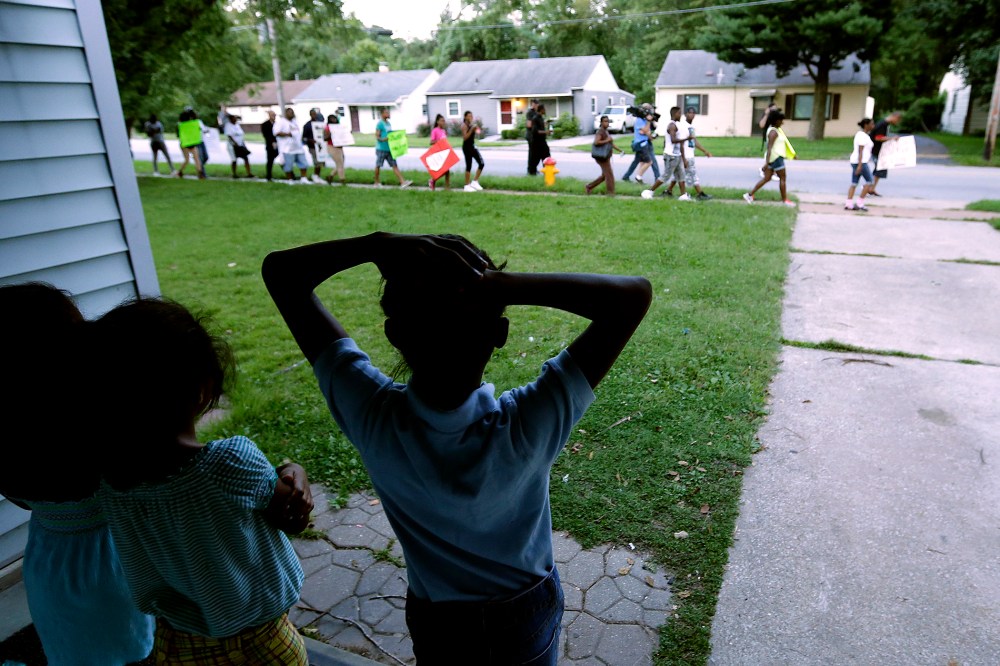
FERGUSON, Missouri — The images of armored vehicles and plumes of tear gas in the air seemed like a snapshot out of a war zone. But for the residents here in this suburb just outside St. Louis, such occupation has gone on for generations, downplayed and swept under the rug. This is just the first time anyone is paying attention.
The protests in Ferguson and the ensuing police crackdown after 18-year-old Michael Brown was shot and killed by a police officer in broad daylight gave a name and a face to tensions that have festered for decades. Police officers with rifles aimed at unarmed protesters reaffirmed cries that the police do not always act in the best interests of the residents they are sworn to protect. Lines of riot police raised suspicions that a citizen’s voice was to be subdued rather than heard, causing the pent up frustration in the city to boil over.
%22Nobody%20knows%20what%20we%E2%80%99re%20going%20through%20after%20our%20sons%20are%20killed.%22′
But even after the smoke cleared, a young man’s body was put to rest, and the camera crews left town, the anger in Ferguson has hardly settled — it’s back to where it all started.
As dark fell on Ferguson each night, the peacekeepers were there. Some were organized — legions of members from the New Black Panther Party, the Nation of Islam and Black Lawyers for Justice, were known to quiet the streets. Others simply assembled, almost spontaneously, to protect the neighborhood they call home.
Within minutes after handfuls of young people busted through the storefront of the supermarket that Brown was accused of robbing prior to his death, teams of peacekeepers came running from the side streets to stand guard between instigators and the store.
“Man, you’re better than that,” one yelled, pulling a young man to the side after he tried to break through the human barrier protecting the store.
While the extreme police presence in a city of just 20,000 rattled observers unwilling to believe that such a scene would take place in the U.S., what seemed to unsettle residents here more than anything was the perception that peaceful mourning was being hijacked by pockets of misguided young people who turned to violence over calm.
Solomon, a St. Louis resident, watched the looting scene from afar that first Friday, his eyes burning red with anger as youths ran by with bottles of stolen liquor tucked under their arms.
“You’re f****** it up for people, for Ferguson, for us as black people, for people period,” he said. “Now the shift to violence and chaos, no one cares about Mike no more, but there’s a young boy who’s dead.”
Those isolated outbursts, lasting moments in the span of calm throughout the entirety of the protests, drowned out conversations about protest and diverted attention away from a message of peaceful outrage.
Some are left questioning whether the camera crews would have come flocking, or the condemnations from national political figures would have been issued so quickly without the added drama in the media of riots in the street.
Men are trying to stop others from looting the liquor store. "Man you're better than that" pic.twitter.com/8ckpdlTOvP
— Amanda M. Sakuma (@iamsakuma) August 16, 2014“The president of the United States that was voted in by this black youth, the first black attorney general Eric Holder, he came out to speak only after the looting and the rioting,” said St. Louis resident Taurean Russell. “Some people’s voice was not heard until those riots and somebody’s property was damaged.”
“If you respond radically to a radical system, who’s really at fault there?”
Michael Brown’s death became that final straw on top of injustices building up and festering over time. Residents in the neighborhood where Brown was shot watched in horror as investigators left his body out in the middle of the street for more than four hours. The slow dribble of information being released in the days to come, and with his shooter still out on paid leave, only exacerbated the anguish.
The scene comes just weeks after police held Eric Garner in a chokehold, killing him as he pleaded that he could not breathe. Before that, it was a woman in Los Angeles who was seen beaten horrifically by police on the side of the street. It was all caught on camera.
“Black men have been dealing with this for years. It ain’t supposed to be like that,” a St. Louis homeowner named Dave said as he carried a leaf blower across his freshly manicured lawn.
Just last week, another young black man was shot and killed by police in from of the supermarket next to Dave’s house. He was distressed to see 25-year-old Kajieme Powell’s dead body lying on the sidewalk next to his home that Tuesday afternoon. He remembers seeing stains of red blood seeping through the young man’s white shirt.
But that imprint of death wasn’t the first he had seen in his neighborhood, nor was it going to be the last, he expected.
“It’s been like that for years and years,” Dave said. “I don’t know what it takes to change it.”
Almost every resident here has a story to tell of a run-in with local police that felt unjustified or targeted based on their race. In the mostly poor community where nearly three-fourths of the population is black, almost all government officials and officers in the police force are white. Money from fines and minor traffic stops add up to the second-largest revenue generator in the city, which residents lament is saddled on the backs of people already paying their taxes. Bobby Newberry will never forget the day he returned home to St. Louis in 1965, having been drafted into the military for 18 months abroad. %22If%20you%20respond%20radically%20to%20a%20radical%20system%2C%20who%E2%80%99s%20really%20at%20fault%20there%3F%22′ Newberry said he was standing on the corner of the street where he grew up, taking in the scene, when he claims police rolled by and arrested him for simply standing there. The cops handcuffed him and threw him into jail for the night, he said. “I actually cried,” he recalled as he prepped Greater Grace Church for a rally honoring Michael Brown later that day. Newberry, an usher at the church, said before the day he was jailed, his dream was to return home and become a cop. Those dreams dissolved as quickly as his warm homecoming, he said. It pained him to see how little had changed between the decades since police targeted him and when an officer opened fire on Brown. Outside the church sanctuary where Newberry was picking up discarded programs from that day’s service, Paula Coleman stood in line hours ahead of the scheduled rally for Brown. Coleman didn’t know the slain teen nor his family, but she was there to support his mother, Lesley McSpadden. Coleman had lost her own son in a gun fight nine years ago, and she knew of the special kind of pain McSpadden was going through. “Only my close friends knew I had to sleep in a recliner at night. I had to paint my son’s room two or three times because I was too scared to go in,” she said, gripping at her chest. “Nobody knows what we’re going through after our sons are killed.” The residents in the neighborhood here where Brown was killed, many of them mothers, take care each day to maintain the makeshift memorial honoring Brown in the middle of Canfield Drive. In the hours after her son’s body was lifted from the street, McSpadden sobbed as she lay down rose petals to cover the stains of her first-born’s blood spilt onto the streets. “I just wish I could have been there to help him,” she said later in a news conference. Since then, mourners have paid homage to Brown by laying down flowers, one by one, in the middle of the street. The roses number by the hundreds at times, left to whither away, marking the place where he died. Roses line the street where #MikeBrown was shot and killed #Ferguson pic.twitter.com/Pb8RT43DoD Additional reporting by Trymaine Lee
Amanda Sakuma Recommended


