








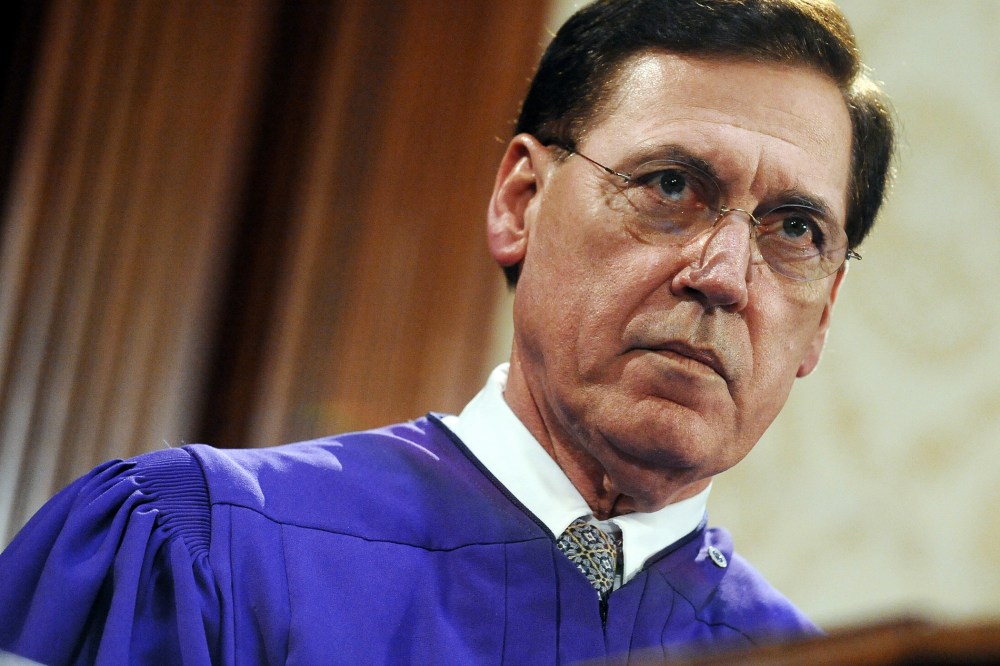
The College of Charleston is tearing at the seams as outraged students and alumni protest the selection of its next president — a defender of the Confederacy with a history of championing the Rebel Flag.
The board of trustees’ selection of Republican Lt. Gov. Glenn McConnell, a Civil War re-enactor who for years led the fight to keep the Confederate flag hanging over South Carolina’s capital building, comes just two years after the college embarked on an ambitious campaign to attract more minority students.
Critics say McConnell’s appointment will tarnish the college’s reputation and hinder efforts to diversify the student body, which with just 6% black students has one of the lowest student diversity rates in the state.
Both the student government and faculty Senate have issued unanimous votes of no-confidence in the school’s board of trustees. The board has not budged, insisting it stands by McConnell’s selection.
“We believe that Glenn McConnell is the best person to lead the College of Charleston, and we expect to quickly conclude the contract negotiations and formally introduce Lt. Gov. McConnell to the campus and the community,” Greg Padgett, chair of the Board of Trustees, said in a statement.
Critics of the appointment believe that politics, not credentials, played the biggest role in the selection.
McConnell, who has never worked in higher education, beat out a handful of finalists with extensive experience working in colleges and universities, including University of West Florida Provost Martha Saunders and Dennis Encarnation, a consultant and fellow at Harvard University.
“He’s been a divisive force in South Carolina for a long time,” said the Rev. Joseph Darby, a vice president with the Charleston NAACP, which has joined calls for McConnell’s removal. He called McConnell’s appointment a “sham” and said the selection is a smack in the face to the college and anyone associated with it.
Hundreds have attended protests and rallies on the college’s campus with thousands more signing a petition calling for McConnell’s removal. Student groups have joined forces with local civil rights groups to hold press conferences and to lobby sympathetic members of the state legislature, which is responsible for appointing board members at public colleges.
McConnell, 67, is a graduate of the College of Charleston and spent more than 30 years in the South Carolina legislature, serving as a senator and the president of the Senate before becoming lieutenant governor. He’s been both one of the most powerful politicians in the state and a lightning rod for Southern heritage, racial identity and racial politics.
In 2010 McConnell created a firestorm after a photo of him dressed as a Confederate General and posing with a pair of African-American actors portraying slaves during a “Southern experience” event went viral. A decade earlier he went to war with the NAACP as efforts to have the Confederate flag removed from atop the capitol building reached a fever pitch.
In 2002, McConnell rigorously defended Maurice Bessinger, a barbecue restaurant chain owner who came under fire after hoisting the stars and bars over his restaurants, which also sold racially-charged literature including a pamphlet entitled, “The Biblical Justification for Slavery.”
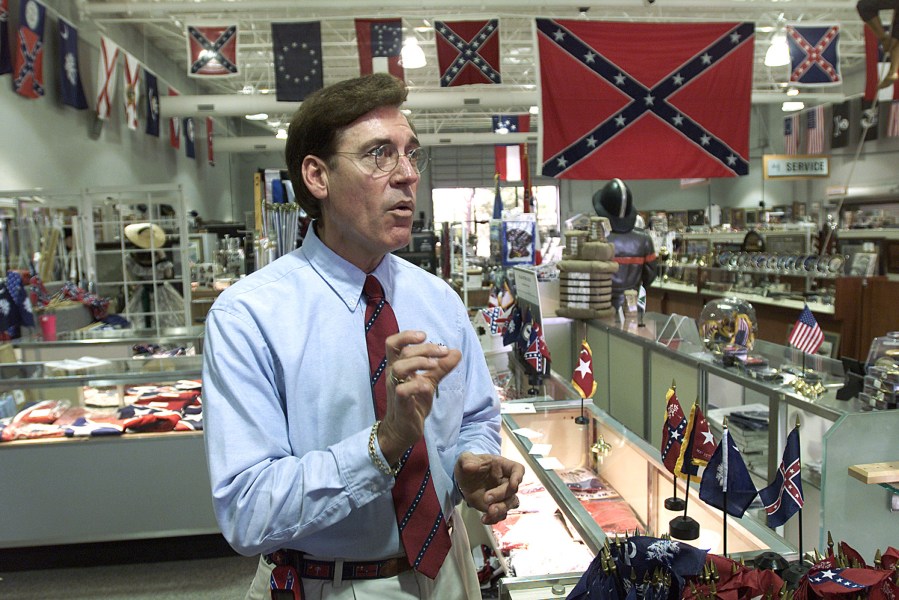
McConnell is also a member of the Sons of Confederate Veterans and until 2009 operated a family-owned Confederate memorabilia shop that sold Southern-themed items.
When the debate over the Confederate flag was flaring up in 1996, McConnell likened any threat to the flags sanctity as “cultural genocide” and called the flag “the emblem of our ancestors,” according to K. Michael Prince’s book, Rally ’round the Flag, Boys!: South Carolina and the Confederate Flag.
“The most problematic thing about this whole situation is the fact that the state Legislature shoved this confederate sympathizer down our throats. With so much controversy that comes along with his image, it pulls down the brand of the College of Charleston and taints it in the same light,” said Brandon Upson, who graduated from the college last year and has emerged as a leader of the campus protests.
Upson said many students, both black and white, are offended and hurt by the board’s choice. “It sparks so many emotions when you think about it, it just hurts your feelings as a person,” said Upson, 28, a black South Carolina native who served in Army during the Iraq war. The controversy surrounding McConnell’s appointment has resurrected the not-so-deeply buried bones of South Carolina’s troubling history of racial subjugation and terror. “South Carolina never really ended the Civil War. We’ve had a ceasefire since the 1860s, but the war is still going on,” Darby said. “In terms of the legal segregation, we’ve come light-years from where we were because there’s no more Jim Crow segregation. But in terms of social segregation, we’ve not come as far. In terms of political diversity, we haven’t moved one bit.” While the school had been making recent strides to open its doors to a wider demographic of students, some see McConnell’s selection as a serious setback. Darby said the school, in its best efforts,” are winging it against a culture that has not always been inviting to black students.” But among the clamor of critics, there are also a number of supporters, many of whom are African-American elected officials. State Sen. Darrell Jackson said that while he and McConnell were on opposing sides of the Confederate flag issue, McConnell had been a genial colleague in the 20 years they worked together. Jackson called McConnell a willing partner in the eventual compromise that moved the flag from atop the capital building to another location down on capital grounds by a memorial to Confederate soldiers. “Absolutely,” Jackson said. “I stand by the college’s decision 100%.” Hank Page, the lead spokesman for the lieutenant governor’s office, said McConnell was traveling and unable to comment. Dot Scott, president of the Charleston NAACP, said the organization will continue to fight to remind anyone who will listen of McConnell’s “disrespect” of people of color. She pointed no further than the photo of him in Confederate regalia. “We want to be a reminder, that this man is now the president of your college. That man in that picture is your president,” Scott said.
Trymaine Lee
Trymaine Lee is an NBC News correspondent. Recommended


