








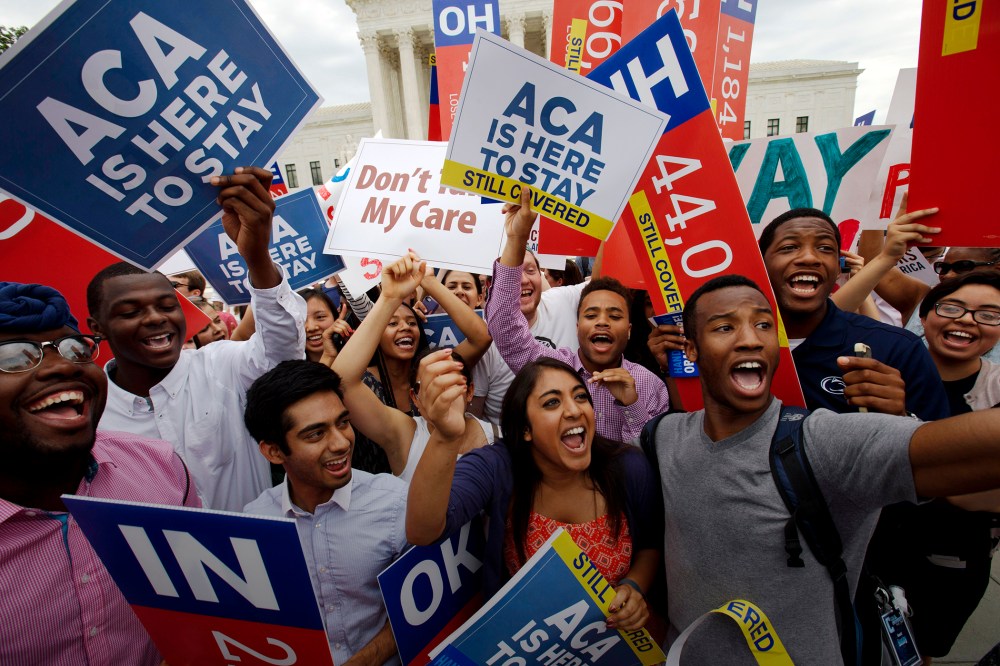
It’s now been six years since President Obama signed the Affordable Care Act (ACA). The sweeping health reform law has been praised by Democrats and demonized by Republicans. It has survived a botched rollout, two challenges in the Supreme Court, and dozens of votes to repeal it in Congress.
Health care reform remains a fierce topic of debate on the campaign trail, and the Supreme Court is hearing yet another challenge to the law Wednesday. Whether or not the law is a success depends on whom you ask. Yet something nearly everyone agrees on is how much our nation’s political landscape has shifted since the law, commonly referred to as Obamacare, was passed.
While the true effect of the law remains a thorny issue, here is a glimpse at how some things have changed since 2010:
1. The uninsured rate
The primary goal of the ACA was to help people previously unable to afford health coverage get insured. How did it fair in this regard?
Before the law was signed: The percentage of Americans without coverage in 2010 was 16.3 percent, according to U.S. Census data.
After: Late last year this rate dropped to 9 percent. In total, the law is estimated to have helped nearly 20 million people get health insurance.
2. Premium costs
Costs for plans under the ACA vary greatly by state. This fact should be considered when looking at average premium costs for the country at large. For instance, a recent study by the Commonwealth Fund found that the average premium price in Tennessee increased 44 percent in 2016, but the average premium for Florida residents dropped by 11 percent.
Before the law was signed: A 2014 study from the Commonwealth Fund found that from 2008 to 2010, premium prices grew by 10 percent or more per year.
After: Overall, the average increase in premium price under the ACA increased by 6 percent in 2016, according to the study. This actually marks a slower premium cost growth than in years prior to the law’s passage.
3. Partisan composition in Congress
Voters consider many factors when deciding who to elect, yet the ACA was one of the most-ferociously partisan laws ever passed. Not a single Republican voted for its final version. Many Democratic members of Congress who were swept out of office in the 2010 midterms blamed their electoral misfortune on the law. While it’s hard to say just how big a factor the law has been at the polls, the partisan makeup of Congress has done a 180 since the law was passed. Take a look at the numbers below:
Partisan makeup of 111th Congress: House: 257 Democrats, 178 Republicans; Senate: 58 Democrats, 40 Republicans, 2 Independents
Partisan Makeup of Congress today: House: 188 Democrats, 246 Republicans; Senate: 44 Democrats, 54 Republicans, 2 Independents
4. States with expanded Medicaid
A key provision of the ACA that helps more people afford coverage is the expansion of Medicaid. This coverage now allows households with an income below 138 percent of the federal poverty level to qualify on this measure alone. However, the June 2012 Supreme Court decision made expanding Medicaid optional for states. 32 states, including Washington D.C., have expanded Medicaid under the ACA. Yet 19 states led by Republican governors have declined to do so, citing fear of ballooning costs to their states as a top concern. 5. The law’s popularity Americans’ mixed feelings on the law seem to have held fairly steady over the past six years. The Kaiser Family Foundation has conducted polling on the law each month since the law was passed. In April 2010, the poll found that 46 percent of respondents viewed the law favorably, and 40 percent viewed it unfavorably. This past February, the same poll found that 41 percent of Americans viewed the law favorably, but 46 percent now view it unfavorably. Clearly, the public is still very divided over the law, and this division appears to break down largely across party lines. 6. Job Growth Most Republican presidential candidates have predicted that Obamacare will plunge the country into a recession. Perhaps it’s too early to say they’re wrong, but take a look at the unemployment rates just before the law was passed and today. Again, many factors affect the economy and job growth, but it appears fair to say that the Affordable Care Act hasn’t torpedoed the American economy. March 2010: 9.9 percent February 2016: 4.9 percent Now test your knowledge of the law with our quiz.
John Axelrod Recommended


