








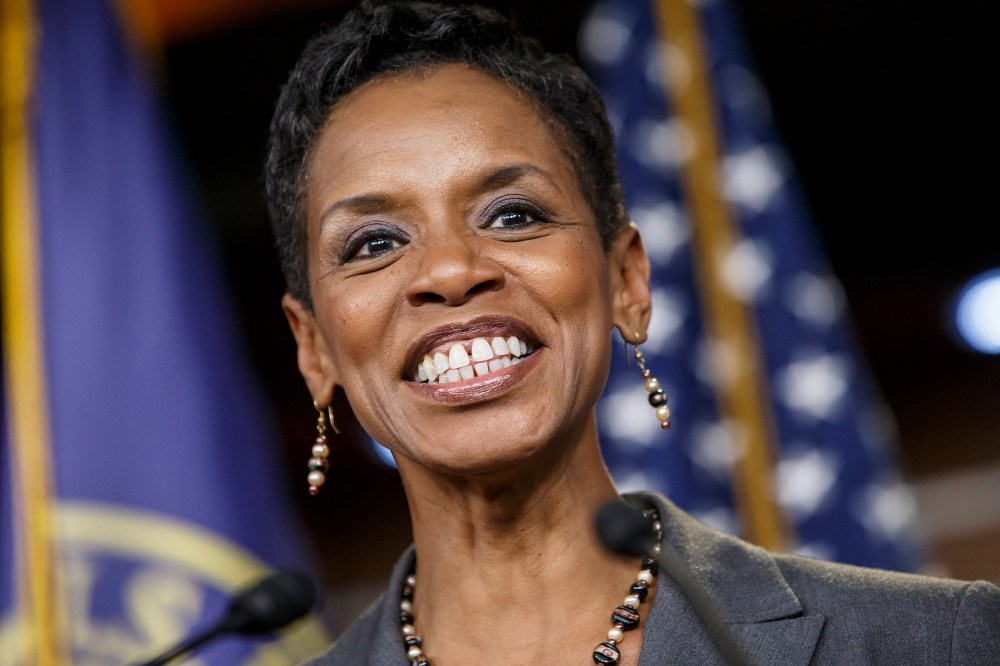
BALTIMORE – Rep. Donna Edwards couldn’t hide the fact that she is a black woman running for office even if she wanted to. Standing before a group of mostly black women at a senior center enjoying lunch recently, it’s clear she doesn’t.
Edwards, 57, a former anti-domestic violence activist elected to the House from a majority black Prince George’s County district in 2008, rattled off the stark numbers.
“There are only 20 women in the Senate. There are no black women,” she said. “What I would add to the U.S. Senate is a different kind of life experience and that would inform how I feel about public policy.”
Line up the portraits of all the senators ever elected, nearly two thousand of them, and you would see a sea of white male faces. Towards the end of the procession, you would see 46 women, but only one black woman, Democrat Carol Moseley Braun of Illinois, and she finished her only term almost two decades ago.
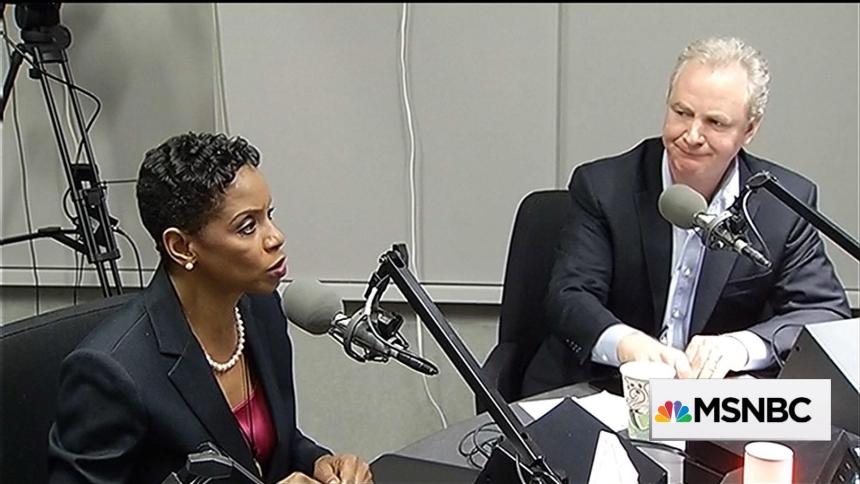
That could change this year, with both Edwards and California Attorney General Kamala running strong campaigns. But it is Edwards, hoping to replace retiring Sen. Barbara Mikulski, who faces the more immediate challenge: On April 26, she must win a tight primary battle against fellow Rep. Chris Van Hollen, a more politically-established progressive and a white man who has been endorsed by the Washington Post and the Baltimore Sun.
According to a RealClearPolitics average of four recent polls, Van Hollen is leading by 6.7 points. Breaking down the polls by demographics shows stark lines of support along race and gender. The Washington Post poll this month, for example, found that Edwards enjoys a 51-point lead with black women, while Van Hollen had a 32-point advantage with white voters overall.
Which voters turn out next Tuesday could make all the difference. In 2008, when Maryland Democrats were choosing between Hillary Clinton and Barack Obama, black voters made up 37 percent of voters, and 22 percent of primary voters were black women. (Both Van Hollen and Edwards are Hillary Clinton supporters this time, but the former secretary of state hasn’t made an endorsement in the Senate race.)
At the senior center, an apron-clad food service worker beamed and clapped mid-sentence as Edwards noted she is the first black woman to represent Maryland in Congress. Edwards talked about her grandmother, born on January 1, 1900, who could not vote “without interference” until she was 65, the year the Voting Rights Act passed.
The elders nodded as Edwards talked about her son, now 27, and rushing back to pick him up from daycare under threat of late fees she couldn’t afford. “I raised him mostly on my own,” Edwards says. “It’s not what I planned. It’s what happened. A lot of what I think government should do and not do is framed on how I grew up and raised my son.”
Marguerite Woods, 64, had taken her place in the row of blue vinyl chairs, waiting her turn to talk to Edwards about policies affecting the blind. When a reporter offhandedly remarked that it was amazing that only one black woman had served in the Senate in nearly 240 years, Woods raised her eyebrows.
“Amazing?” she repeated skeptically. “In the United States?”
****
Rep. Bonnie Watson Coleman of New Jersey, who recently co-founded the first-ever Congressional Caucus on Black Women and Girls, put it bluntly.
“Congress is still an old boys’ network,” Coleman told MSNBC. “Even the apparatuses that exist in the various counties and districts are mainly led by men. I think women have a harder time raising money, and I think African-American women have a double whammy.”
Black women make up 7.4 percent of the population, but only 3.4 percent of Congress, according to a report by the Center for American Women and Politics and Higher Heights, which recently formed a PAC to support black women running for office.
“Historically, only 35 black women from 15 states have ever served in the U.S. Congress, only 10 black women from 9 states have ever served in statewide elected executive offices, and three states have still never elected a black woman to their state legislature,” the report noted. Many of the women who do serve hail, like Edwards, from majority-minority districts and find themselves pigeonholed out of running statewide.
Moseley Braun was elected in 1992, the so called “Year of the Woman,” on the heels of Anita Hill’s devastating testimony before an all-white, all-male panel during Supreme Court Justice Clarence Thomas’s confirmation hearings. But of the women senators elected that year, Moseley Braun was the only one to lose her reelection bid. (Moseley Braun’s tenure was clouded by accusations about the misappropriation of funds, though she was never charged with a crime.)
Moseley Braun did not respond to interview requests. But in a panel discussion last year, she remarked, “Somebody once asked me which is worse,” meaning her race or gender as a politician. “My response to that is, if someone has their foot on your neck, it doesn’t really matter why it’s there.”
Progress does not necessarily move in a straight line, nor does it move quickly. Debbie Walsh, CFAWP’s director, pointed out that the first woman was elected to Congress in 1916. “It has taken 100 years for the number of women in Congress to go from 1 to 104,” Walsh said.
When CFAWP surveyed state-level representatives, a key pipeline to Congress, it found that women were much likelier than men to say it was harder for them to raise money. Women of color had an even stronger belief that fundraising was a huge challenge, 74 percent versus 60 percent of white women.
That’s where EMILY’s List, the organization solely devoted to electing Democratic pro-choice women, comes in, although mostly on a federal and state-wide level. (Almost all of the black women in Congress are Democrats; Rep. Mia Love of Utah is a prominent exception.)
EMILY’s List is supporting Edwards to the tune of millions of dollars through its PAC and its donor network — a decision that has led to open complaints from the Van Hollen camp and his supporters, since he is widely regarded as a progressive leader.
The National Organization for Women, which unlike EMILY’s List endorses men, also picked Edwards over Van Hollen, though it had backed both in their congressional runs.
“I don’t understand the idea that it’s somehow illegitimate for a black woman to run for Senate simply because there are progressive white men out there who want it and who are also good,” said the group’s national president, Terry O’Neill, who lives in Van Hollen’s district. “That’s not Donna’s problem.”
Some NOW members protested, with the Montgomery County chapter co-presidents, Van Hollen supporters who had asked the group to stay neutral, publicly registering their disappointment.
RELATED: An office of her own: Female lawmakers defy hurdles in quest to govern
Still, any impression that EMILY’s List has helped turn Edwards into a fundraising Goliath would be inaccurate. By the end of last year, Van Hollen had out-raised Edwards 10 to 1, though her fundraising totals edged up this year. Under election rules, candidates get more favorable ad rates than outside groups supporting them, so Van Hollen’s campaign funds go further in ad spending than Edwards’ support from EMILY’s List’s PAC, Women Vote. That group has spent a total of $2.9 million on Edwards, including a $500,000 ad spend for the final stretch announced Thursday that would bring Edwards to parity with Van Hollen in key markets. It’s clear that EMILY’s List’s donor network is excited about Edwards, too: Of all the candidates for which EMILY’s List has bundled donations from its network, only Hillary Clinton has brought in more support.
The Van Hollen campaign and EMILY’s List have openly feuded, culminating in the group filing a Federal Election Commission complaint accusing Van Hollen’s campaign of breaking campaign finance rules. Van Hollen’s campaign, in turn, has accused the Edwards campaign of distorting his record in its commercials.
Stephanie Schriock, EMILY’s List president, pointed out that the group had helped the beloved Mikulski win a Senate seat against the odds 30 years ago. This year, she said, women in the Senate present a “historic opportunity.”
The group is also supporting a record number of women of color running for the Senate, including Edwards, Harris, Illinois’s Tammy Duckworth, and Nevada’s Catherine Cortez Masto. Currently, Hawaii’s Mazie Hirono is the only woman of color in the Senate.
Without the support of EMILY’s List, said Edwards, “I think it would have been very difficult. Maybe not impossible, but very difficult … We just don’t have the same access to resources and networks that our male counterparts do.”
**** Ambitious candidates who aren’t white men have long been counseled to tread carefully around, even avoid, the subject of race and gender. Hillary Clinton’s advisors notoriously warned her in 2008 not to make too much of running to be the first female president. Later, commentators said such reticence had hurt Clinton, and this time she is waving the history-making flag. During his 2008 campaign, Barack Obama’s rhetoric about transcending divisions suggested a colorblind future, as advisors worried that, in the words of then-surrogate Cornel West, “he’d be pegged as a candidate who caters only to the needs of black folks.” Edwards prefers tackling identity head on. “I think it’s appropriate to talk about our elective bodies, our boardrooms, our workplaces, being places where every one of us, no matter who we are or where we grew up, can find a place,” she told MSNBC. She added, “If we could have gotten this right over the course of 240 years we wouldn’t be having this discussion. Clearly this strategy of just letting it go and letting elections take their course has not been one that’s resulted in women gaining seats in the House or the Senate.” Joseline Peña-Melnyk, a member of the Maryland House of Delegates who is running to succeed Edwards in the House and identifies as Afro-Latina, cheekily told an audience that they could remember her on the ballot by the fact that she’s the only woman on it. In an interview with MSNBC, Peña-Melnyk said gender mattered even among candidates who might hold the same position on, say, Planned Parenthood funding. “A man has never woken up and said, ‘You know, I’m worried I didn’t get my period,’” she said. Such an approach risks backfiring with some voters. “It would be nice if [Van Hollen] was a black lady,” Tony Jacobs, a Maryland voter whose race was not identified, told the Washington Post. “But he is a better politician, and that’s really what matters. . . . When race and gender is part of the conversation, than you’re having the wrong conversation, because you’re not talking about passing laws.” His words also happened to jibe with the criticisms Van Hollen has leveled against Edwards on the stump and in advertisements. He and his surrogates have accused her of being ineffective as a legislator and not working well with others. Van Hollen has also sought to defuse the race and gender question. Last week, his campaign distributed a letter from 100 African-American women leaders in the state supporting him over Edwards. “It is not about race, gender, creed or color, it is about a person. And that person is Chris Van Hollen,” read the letter. RELATED: Six women politicians shifting the local political landscape Another Van Hollen endorsement provided Edwards with a perfect opportunity to pounce: Maryland Senate President Thomas V. Mike Miller Jr. described Van Hollen as “a leader who has been born to the job.” Edwards responded with a fundraising appeal: “Born to the job? The fact is, our country’s systems and institutions have largely been led by people who have always looked like that senior elected official, not like me,” she wrote. “See, when I was born, no one ever thought I could be a United States Senator; and why would they?” At the EMILY’s List gala on April 12, Rep. Gwen Moore of Wisconsin, one of the few members of the Congressional Black Caucus who has endorsed Edwards, evoked those words. “Even when you’re not ‘born’ to be a senator, you’ve got EMILY’s List to get you there,” she said. She added, in words that could also apply to the presidential primary, “Don’t let anyone tell you a nice progressive guy can do it as well as a woman. No. Doesn’t work that way.” **** The first black president may be soon followed by the first woman president, but as conflicted reactions to both suggest, Americans are still unresolved about how much the politics of representation matter. Edwards isn’t. “It was important for me, growing up, to see Bella Abzug and Shirley Chisholm and Barbara Jordan,” Edwards told MSNBC. “I aspired to that.” She added, ”I’m proud that my son – my son – got to cast his very first votes for his mom and for Barack Obama. That’s transformative.” That Edwards would be replacing Mikulski, known as the Dean of the Senate women, matters to NOW’s president. “In a perfect world, where the U.S. congress does look like the United States population, it would not be so important that Barbara Mikulski’s successor should be a woman,” said O’Neill. “But we are not in that perfect world.” Mikulski has remained neutral in the race. Walsh said that when it comes to black women, personnel is policy. “All of the research we’ve done on women in office is that if what you’re supporting is a progressive agenda, the most progressive and the most feminist of the legislators are African-American women,” Walsh said. At a meeting of Prince George’s County Democrats one evening, Ingrid Turner, a veteran of the Navy JAG corps and a candidate for circuit court judge there, reflected on the race in an excited whisper. “I like Congressman Van Hollen. Some people will say you know, Congressman Van Hollen, he’s nice, it’s easier for him to get along with people,” she said. “You know, Donna had to fight for everything. She had to fight to get where she is right now.” Turner’s voice grew more urgent, pointing out that black women make up the most reliable Democratic voters. “So why can’t we have somebody around the table who understands the same thing we had to go through?” Turner said. “You know what, if we want anything, we have to fight twice as hard!” To be a senator, Turner said, Edwards has to venture out alone. “She doesn’t have another African American female, looks like her, tells her, this is what you have to do. She’s at the top! It’s lonely.” She repeated it: “It’s lonely.”
Irin Carmon Recommended


