








SELMA, Alabama — One day after President Barack Obama gave a momentous speech at the base of the Edmund Pettus Bridge, where he urged Americans to fight for racial equality, thousands of people filled the streets of Selma on Sunday to commemorate the 50th anniversary of the 1965 voting rights campaign.
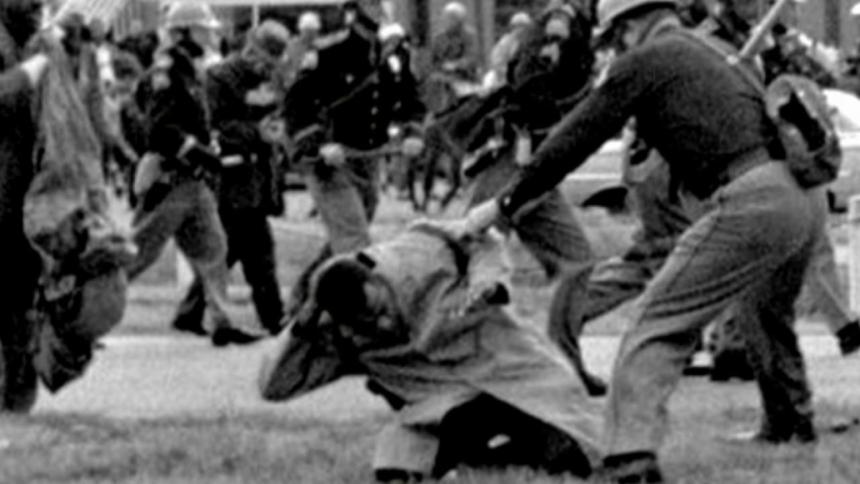
Crowds came together in front of the historic Brown Chapel African Methodist Episcopal Church in the morning, where dignitaries including Attorney General Eric Holder attended Sunday service. A symbolic march over the famous bridge followed, where on March 7, 1965 state troopers attacked voting rights demonstrators.
The march will continue Monday morning from Selma to Montgomery, Alabama, following the footsteps of Martin Luther King Jr. on his journey to make voting possible for African-Americans in the South.
Among the attendees at the church Sunday were incoming Attorney General Loretta Lynch, head of Homeland Security Jeh Johnson, Rev. Al Sharpton, and Julian Castro head of Housing and Urban Development.
Johnson told MSNBC standing outside of the church said that he has a deep familial connection to Selma and Brown Chapel in particular. One of his ancestors was a co-founder of the century-old church and their name is etched into its corner stone.
“My ancestors are from Selma. My mother’s family were all from Selma, and in fact, a person who I believe to be my great great grandfather’s name is on the cornerstone of this church right here,” Johnson told Melissa Harris-Perry.
“It’s a family connection, it’s history, and it reflects a determination to continue to a more perfect union,” Johnson said.
Related: Obama’s emotional race speech on MLK’s bridge
Andrew Young, a confidant of Dr. Martin Luther King Jr., who was one of the young leaders of the 1965 Selma marches for voting rights, said the mission started in this city 50 years ago continues today despite social progress won since.
He described his return to Selma as something of a homecoming.
“It’s always great to be back in Selma. We’re not through, we’re still working on Selma, we’re still working all across this area,” he said. “Because we started to redeem the soul of America of the triple evils of racism, war and poverty. We’ve done pretty good on racism, as you can see, but we’ve still got a long way to go on poverty.”
Rep. John Lewis told Melissa Harris-Perry that he was not afraid while marching on the front lines in 1965. “I was not afraid. I was inspired by Rosa Parks and Martin Luther King Jr. and lost all sense of fear. I was prepared to die for what I believed in,” he said on MSNBC on Saturday. “We wanted to be able to have some control over our own destiny.”
Outside of the church, thousands lined the streets, gazing up at a large screen set up to broadcast the service inside.
Just before service started hundreds jostled, schemed and tried to cram their way into the iron gates around the church grounds. They pleaded with Reginald Moore, head of church security and logistics, for a coveted badge to grant the a seat in the sanctuary.
“If you don’t have a badge I can’t help you!” Moore boomed. “Nobody’s going anywhere until y’all move back!” As a child, Moore said he watched his mother and family friends assaulted by troopers, tear gassed and whipped and beaten by posse men on horseback. He recalls it being something you’d see in an old Western, something terrible. Among those attempting to get in was the family of Michael Brown Jr., whose killing by a police officer in Ferguson, Missouri set off nationwide protests against police brutality. “This is the family of Mike Brown,” one of the officers guarding the entrance told Moore. Related: The home that became a safe haven for MLK Michael Brown Sr., stoic as usual and holding a little girl in his arms, led his wife and a half-dozen or so protesters from Ferguson into the church. About 15 minutes later, before service began, the group emerged from the chapel with their hands up, chanting. Also among the crowd was Gwen Carr, the mother of Eric Garner, who was killed in an apparent police chokehold in New York last July. People drove in from across the country, a sort of pilgrimage to one of the most sacred sites of the Civil Rights movement. Roderick Lester Harris drove all the way from Washington, D.C. to be in Selma this weekend. He stood this morning holding two original newspapers from March 1965, detailing the long, sometimes violent journey from Selma to Montgomery. “I wasn’t going to miss this for anything,” he said, holding the tattered ephemera in his hands. “We owe so much.”
Trymaine Lee
Trymaine Lee is an NBC News correspondent. Recommended


