








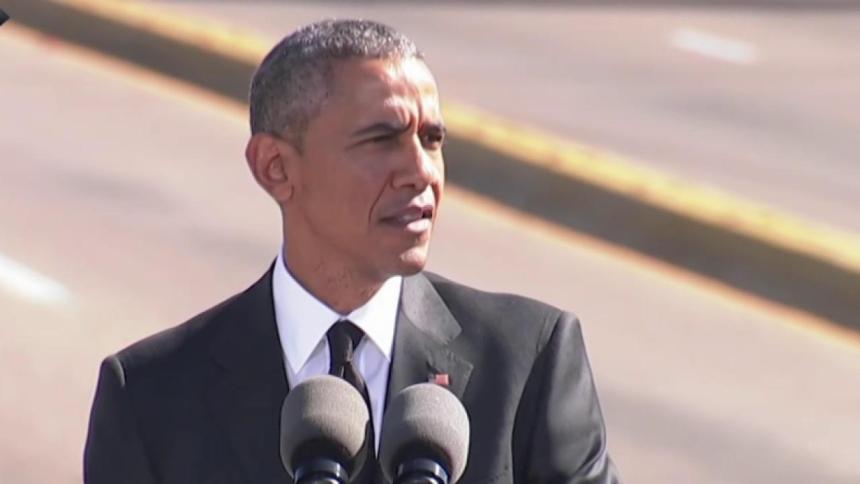
SELMA, Alabama—Standing at the base of the Edmund Pettus Bridge here on Saturday, President Barack Obama pushed Americans to continue to fight for racial equality and challenged Congress to strengthen the Voting Rights Act.
Obama urged Americans to channel the “fierce urgency of now” felt by those who marched on the infamous bridge 50 years ago in the brutal fight for voting rights. He disputed the belief that America is still a country deeply divided on race, as seen in the wake of shocking police shootings of unarmed black men, which triggered waves of protests throughout the nation over the past year.
“I rejected the notion that nothing’s changed,” Obama said. “What happened in Ferguson may not be unique, but it’s no longer endemic, or sanctioned by law and custom; and before the civil rights movement, it most surely was.”
The president’s remarks on race were notable — despite being America’s first black president, Obama tends not to discuss race in such blunt terms. He referred to the Justice Department’s recent report showing that police in Ferguson routinely expressed racial hostility and used excessive force. Early in his speech, some members of the crowd chanted “Ferguson’s here, we want change” to mixed reactions of those around them in the crowd. Some felt the protest was disrespectful to the occasion, which marked the 50th anniversary of the violent confrontation that became known as “Bloody Sunday.”
“With such effort, we can make sure our criminal justice system serves all and not just some,” Obama said. “Together, we can raise the level of mutual trust that policing is built on — the idea that police officers are members of the communities they risk their lives to protect, and citizens in Ferguson and New York and Cleveland just want the same thing young people here marched for — the protection of the law.”
Obama also noted that, despite five decades’ worth of change, voting rights are once again in peril. “Right now, in 2015, 50 years after Selma, there are laws across this country designed to make it harder for people to vote,” he said, adding, “Meanwhile, the Voting Rights Act, the culmination of so much blood and sweat and tears, the product of so much sacrifice in the face of wanton violence, stands weakened, its future subject to partisan rancor.”
RELATED: Revisiting Selma, Alabama, 50 years after ‘Bloody Sunday’
The president noted that the Voting Rights Act once enjoyed bipartisan support and urged the 100 members of Congress in attendance to return to Washington “and gather 400 more and together pledge to make it their mission to restore the law this year.”
The Supreme Court struck down a key provision of the Voting Rights Act in June 2013.
Obama opened his remarks by pointing to one of his heroes, who was present then and now: Rep. John Lewis. On that fateful day, “his knapsack stocked with an apple, a toothbrush, a book on government — all you need for a night behind bars — John Lewis led them out of the church on a mission to change America,” Obama said.
Half a century ago, Lewis was accompanied on the march by famed civil rights leaders Martin Luther King Jr. and Andrew Young. At Saturday’s commemoration, he arrived along with a congressional delegation of more than 100. Former President George W. Bush also attended the event.
“Each of us must go back to our homes after this celebration and build on the legacy of this march in 1965,” Lewis said Saturday before introducing Obama. “The Selma movement is saying today that we can all do something. Don’t yield up anything … don’t get lost in a sea of despair …. We are one people, one family, the human family. We all live in one house, the American house, our house.”
Lewis added that he never thought he would be back on the Edmund Pettus Bridge introducing the first African-American president of the United States.
RELATED: Rep. John Lewis: ‘Still work left to be done’
Newsman Bill Plante, who is white, covered the marches 50 years ago and was among those in attendance on Saturday. Obama noted that, at the time, the journalist “quipped that the growing number of white people lowered the quality of the singing. To those who marched, though, those old gospel songs must have never sounded so sweet.”
Obama on Saturday also awarded the Congressional Gold Medal, the highest honor issued by Congress, to activists who marched in Bloody Sunday, Turnaround Tuesday and the final march from Selma to Montgomery for voting rights. In Selma, he celebrated the activists who faced jeers, condemnation, potential arrest, and outright violence in the fight for equal voting rights in the then-deeply segregated South. “So many people bled and died for us to have the right to vote and fought right here in Selma,” said Billy Ingrham, 41, whose family is from Selma and nearby Marion, where the shooting death of Jimmy Lee Jackson at the hands of a white police officer was the impetus for the original march. “I grew up hearing all the stories. So for Barack Obama to be coming to Selma, man. That’s something else.” Obama paid sweeping tribute to the courage of those activists. “The Americans who crossed this bridge were not physically imposing. But they gave courage to millions,” he said. “They held no elected office. But they led a nation. They marched as Americans who had endured hundreds of years of brutal violence, and countless daily indignities — but they didn’t seek special treatment, just the equal treatment promised to them almost a century before.” The president also noted that the actions that day on the Pettus Bridge not only led President Lyndon Johnson to send federal protection for the activists and for him to echo their words “we shall overcome,” it also eventually secured the passage of the Voting Rights Act of 1965. Their perseverance that day also inspired those around the world to rise up and demand justice. “Young people behind the Iron Curtain would see Selma and eventually tear down a wall,” Obama said. “Young people in Soweto would hear Bobby Kennedy talk about ripples of hope and eventually banish the scourge of apartheid …. From the streets of Tunis to the Maidan in Ukraine, this generation of young people can draw strength from this place, where the powerless could change the world’s greatest superpower, and push their leaders to expand the boundaries of freedom.” He invoked the ongoing immigration debate by mentioning the journey many in this country took “across oceans and the Rio Grande.” The president also paid tribute to those engaged in the modern day fight for LGBT rights. “We are the gay Americans whose blood ran on the streets of San Francisco and New York, just as blood ran down this bridge,” he said, also referring to the strength and courage of Americans spanning from the slaves who built the White House to the firefighters who rushed into the Twin Towers on Sept. 11, 2001. He continued, “50 years from Bloody Sunday, our march is not yet finished. But we are getting closer. Two hundred and thirty-nine years after this nation’s founding, our union is not yet perfect. But we are getting closer. Our job’s easier because somebody already got us through that first mile. Somebody already got us over that bridge.”
Trymaine Lee
Trymaine Lee is an NBC News correspondent.
Joy Y. Wang Recommended


