








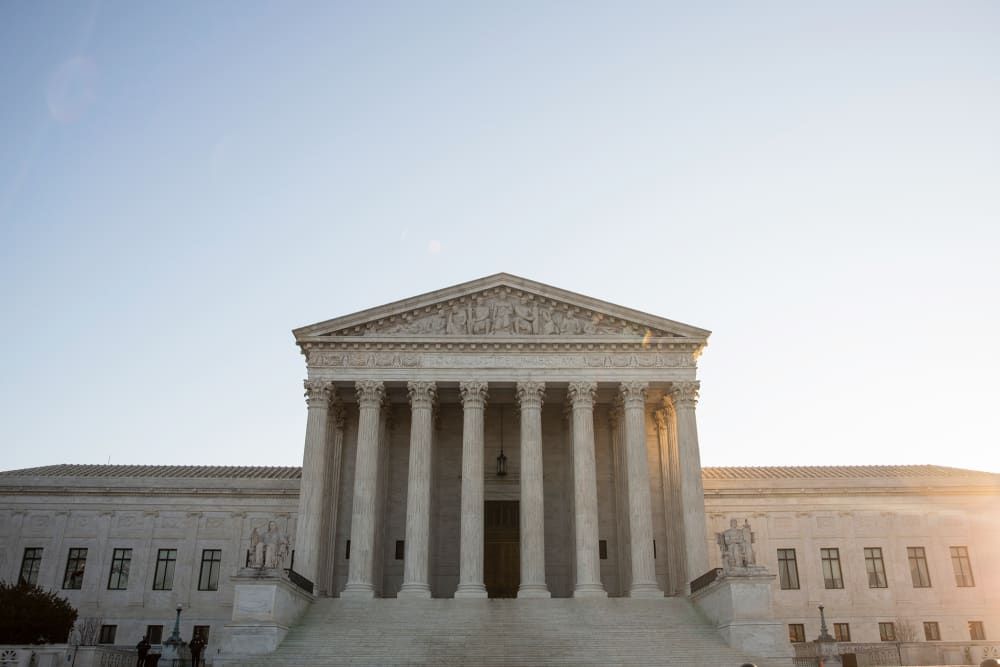
In a major blow to some 300,000 registered voters in Wisconsin who lack state-issued photo ID, the U.S. Supreme Court on Monday declined to hear a challenge to the state’s controversial voter photo ID law — a move that clears the voting restrictions to take effect in the Badger State. But as far as nationwide voting rights are concerned, Monday’s action by the justices may be a blessing in disguise.
As Election Law Blog’s Rick Hasen writes, taking the Wisconsin case — Frank v. Walker — to the nation’s highest court “divided the civil rights community.” The Department of Justice did not file a supportive brief urging the Supreme Court to take the case. And Daniel Tokaji, a law professor at Ohio State University, recently told msnbc’s Zack Roth that it was a mistake for the Wisconsin plaintiffs to ask the Supreme Court for review, rather than wait for a different case out of Texas to make its way through the appeals process.
That’s because Wisconsin officials, who lost at the trial court level but prevailed in the 7th Circuit Court of Appeals, stood a very good chance at swaying a majority of the Supreme Court justices to uphold the voter ID law and set a strong precedent in favor of similar measures.
This court already struck down a key provision of the Voting Rights Act (VRA) in 2013, and could’ve issued a ruling in the Wisconsin case that made the landmark civil rights law all but useless. A much stronger voter ID challenge, however, is currently making its way to the high court from Texas, and many legal experts like Tokaji believe it has a better shot at drawing a Supreme Court ruling that strengthens voting rights nationally, rather than weakens them.
RELATED: GOP readies new wave of voting restrictions
“In the Texas voter ID case, now pending before the 5th Circuit, we have a holding that Texas’s passage of the voter ID law was the product of intentional racial discrimination,” wrote Hasen Monday. “That’s a finding which should be very hard to reverse on appeal. It provides an easier constitutional path for the Supreme Court to strike down Texas’s voter ID law.”
“The upside of that would be a Supreme Court decision striking down a voter ID law on constitutional grounds,” Hasen continued. “The downside is that other cases, like Wisconsin, do not involve intentional discrimination and so a Texas holding might not help very much outside of Texas.”

In addition to the fact that Texas’ voter ID law was found to be a product of “intentional discrimination” — something prohibited under Section 2 of the VRA — the district judge who struck it down issued a much more thorough and convincing opinion than the judge who struck down Wisconsin’s voter ID law. Texas officials also put up a far weaker defense of their law than did Wisconsin officials. And lastly, in Texas, people have to travel greater distances than in Wisconsin to get the ID required in order to vote.
For all of those reasons, the Supreme Court is more likely to side with plaintiffs in the Texas case, legal experts say, leaving voting rights advocates with reason to be relieved that the justices rejected the Wisconsin case. Still, Monday’s action could have negative consequences for thousands of voters in the Badger State — particular low-income, minority, and younger voters — who are disproportionately impacted by voter ID laws. RELATED: Push to restore voting rights for felons gathers momentum “The Supreme Court’s decision is a huge step backward for our democracy,” said Penda D. Hair, co-director of the Advancement Project, a civil right organization, in a statement. “The 300,000 registered Wisconsin voters who lack the limited forms of photo ID needed to vote in Wisconsin — disproportionately African Americans and Latinos ― deserve to have their voices heard in our political process. The values enshrined in our Constitution, and protected in the Voting Rights Act, are undermined when burdensome laws like photo ID requirements make the ballot box inaccessible to any eligible voters. Our elections should always be free, fair and accessible to all citizens. Under Wisconsin’s restrictive photo ID law, they simply are not.” The American Civil Liberties Union has filed an emergency motion asking the 7th Circuit Court of Appeals to keep Wisconsin’s voter ID law from taking effect until after the April 7 election. Absentee ballots have already been sent out to voters, and early in-person voting began Monday morning. “Although the Supreme Court has declined to take this case, it previously made clear that states may not impose new requirements for voting in the weeks before Election Day,” said Dale Ho, director of the ACLU’s Voting Rights Project, in a statement. “Imposing a new restriction in the midst of an election will disenfranchise voters who have already cast their ballots. It is a recipe for disaster.”
Emma Margolin
Emma Margolin is a reporter at MSNBC.com. Recommended


