








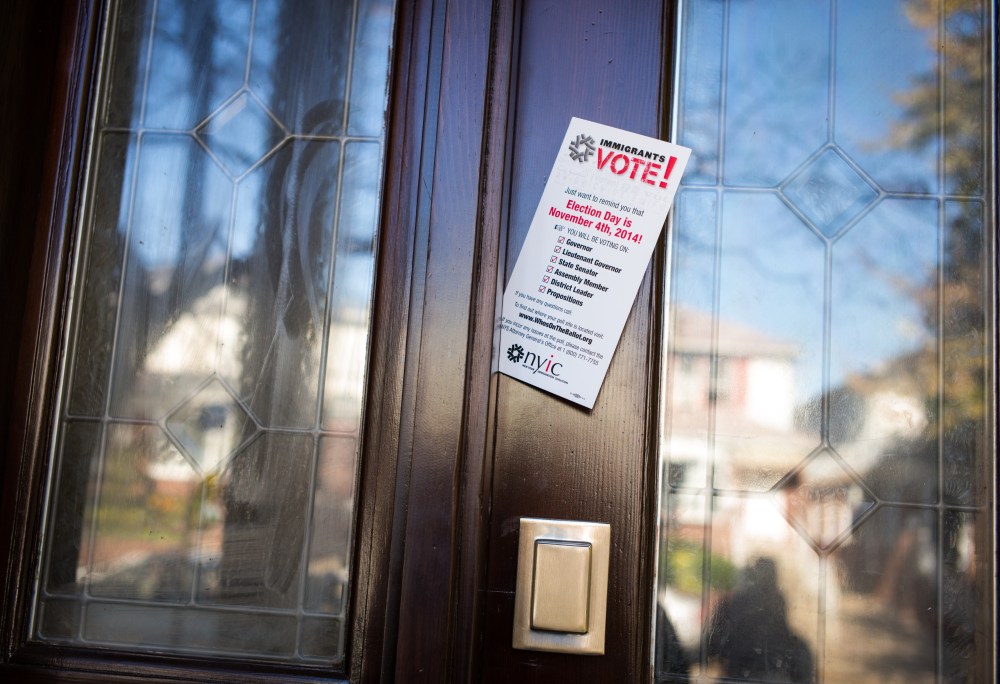
Lately, the Republican war on voting has re-emerged with a vengeance.
From Georgia to Nevada, the GOP is taking advantage of gains made in last fall’s midterms to move forward with restrictive laws—defying some predictions that the party might back off its campaign to make voting harder. Meanwhile, a group of Republican election officials has found a creative new way to stoke fears over illegal voting.
A roundup this month by the Brennan Center found that at least 40 restrictive voting bills have been introduced in state legislatures just since the start of the year. But more revealing, recent weeks have seen advances for some of the most far-reaching of those bills.
In Georgia, a bill that would slash the state’s early voting period from 21 to 12 days crossed its first legislative hurdle last week. It comes after 44% of Georgia voters took advantage of early voting last fall, setting off a panic among some Republicans about an expanding electorate. (One state senator complained on Facebook that an early voting site had been opened in an area “dominated by African-American shoppers.” He later clarified that he preferred “more educated voters.”)
The GOP already cut early voting in the state from 45 to 21 days just four years ago. Thanks to the Supreme Court’s 2013 ruling weakening the Voting Rights Act, Georgia won’t need to get federal approval before implementing the law, should it pass.
In Missouri, Republicans are so desperate to impose a voter ID requirement they’re trying to change the state’s constitution. The state House on Wednesday gave initial approval to two measures: One would put a constitutional amendment on the ballot asking voters to allow voter ID, and the other would implement the ID requirement, should the amendment pass. The two-pronged strategy is needed because of a 2006 state Supreme Court ruling that voter ID is barred under the state constitution.
This is just the latest of several recent efforts by the state’s Republicans to pass an ID law. But with the party expanding their majorities in both houses last fall, its prospects appear decent. Aides to Gov. Jay Nixon, a Democrat, didn’t immediately respond to a question about the governor’s stance on the twin bills.
RELATED: Will the Supreme Court rule on the right to vote?
It’s a similar story in Nevada. Republicans gained full control of state government this year for the first time in decades, and this week introduced a voter ID bill modeled on Indiana’s strict law. It’s said to be one of three ID bills that recently were being drafted—a sign of lawmakers’ eagerness on the issue. Secretary of State Barbara Cegavske is helping to get the bill through, and Gov. Brian Sandoval has said he supports voter ID.
Nebraska is a rare good news story for voting rights advocates — for now. That state too saw Republicans make gains last fall, and then introduce a strict ID bill. But a bipartisan coalition voted Wednesday to shelve the measure, meaning it’s dead until at least next year. But that may not be a broader omen for other states: The opposition campaign was helped by the unusual fact that Nebraska’s state’s legislature isn’t organized by party, so there’s less voting along party lines.
Voter ID laws could also be introduced in New Mexico, West Virginia, and Iowa—all states where the GOP gained strength last fall.
Of course, all this comes after the 2011-12 and 2013-14 sessions, which saw Texas, North Carolina, Ohio, Wisconsin, Florida, Mississippi, Alabama, Virginia, South Carolina, Pennsylvania, Arkansas, and other states all pass voter ID laws or early voting cuts, some blocked by the courts.
Meanwhile, alongside this spate of state-level initiatives, a group of Republican election officials and political operatives has launched a new campaign to gin up fear about illegal voting—the better to build support for more restrictive voting laws. %22It%20is%20a%20certainty%20that%20the%20administration%E2%80%99s%20executive%20actions%20will%20result%20in%20a%20large%20number%20of%20additional%20aliens%20registering%20to%20vote%20throughout%20the%20country.%22′ Last month, Ohio Secretary of State Jon Husted sent a letter to President Obama warning that his recent executive action on immigration, which is set to protect over 4 million undocumented immigrants from the threat of deportation, could make it easier for non-citizens to vote, since it will allow many to obtain driver’s licenses. Kansas Secretary of State Kris Kobach and the Heritage Foundation’s Hans von Spakovsky, a leading advocate of restrictive voting rules, joined Husted in testifying before Congress on the subject last week. “It is a certainty that the administration’s executive actions will result in a large number of additional aliens registering to vote throughout the country,” said Kobach, calling the problem of non-citizens registering to vote “a massive one, nationwide.” The conservative grassroots is mobilizing on the issue, too. On Tuesday night, von Spakovsky joined a conference call with activists organized by True the Vote, a tea party-linked “voter integrity” group, to sound the alarm about the non-citizen voting threat. RELATED: GOPers raise fears on non-citizen voting In reality, the number of non-citizens found to have voted in recent elections is minuscule, and experts say the president’s immigration order would do almost nothing to boost the number. And of course, in another sign of the national party’s mood, House Republicans confirmed last month they have no plans to move bipartisan legislation aimed at strengthening the wounded Voting Rights Act. What’s the takeaway? Last year, there were predictions that the GOP might be backing off its commitment to making voting harder, for fear of firing up minorities and hurting the party’s brand with moderate voters. It’s now clear that those predictions were premature, to say the least.
Zachary Roth Recommended


