








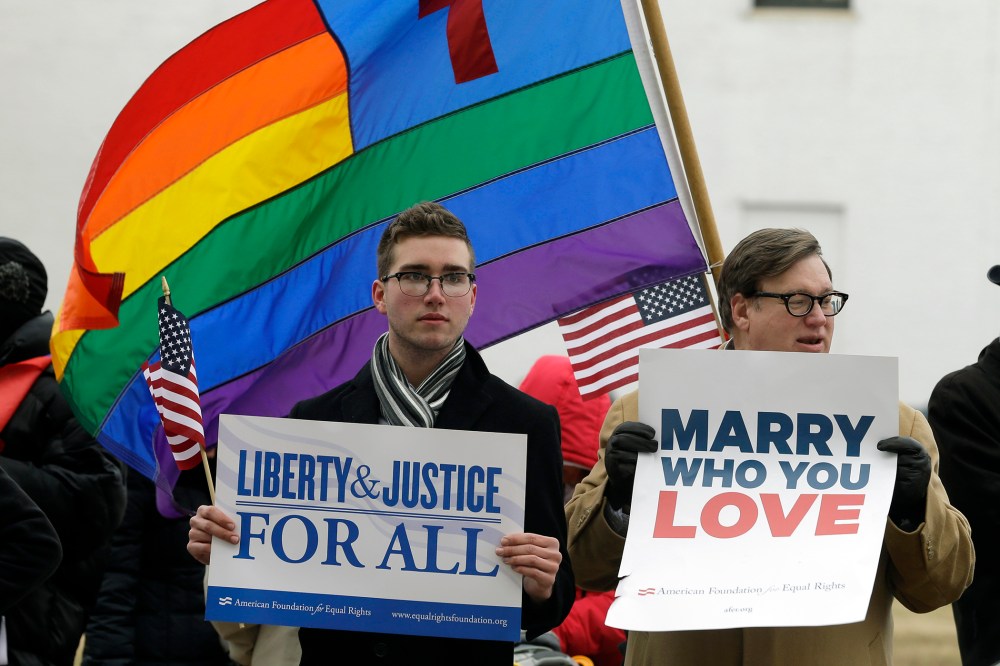
In a disappointing move for gay and lesbian couples hoping to marry this week in Virginia, the U.S. Supreme Court has delayed the effects of a ruling that found the state’s same-sex marriage ban unconstitutional.
Preparations were well underway for clerks to begin issuing marriage licenses to gay and lesbian couples at 8 a.m. on Thursday, when a ruling in favor of marriage equality from the 4th Circuit Court of Appeals was due to take hold. According to the Associated Press, Virginia officials had drafted a revised marriage license form for clerks to use as soon as they opened their doors, and some courthouses had readied overflow rooms in anticipation of the large crowds.
But the arrangements were all for naught, as the Supreme Court moved to block same-sex marriages from going forward in Virginia — only hours before they were slated to start.
Breaking: Supreme Court grants stay of Virginia marriage ruling. #SCOTUS #LGBT pic.twitter.com/1COVpaNDtL
— Chris Geidner (@chrisgeidner) August 20, 2014The stay, granted on Wednesday, marks the third time the nation’s highest court has weighed in on a marriage equality case since its landmark decision last year to upend the Defense of Marriage Act (DOMA), a law that prevented the federal government from recognizing same-sex nuptials. In January, Justice Sonia Sotomayor granted a stay that blocked gay and lesbian couples from marrying in Utah, following a lower court’s ruling that cleared the way for more than 1,000 same-sex nuptials to take place in that state. And earlier this summer, the high court again granted a stay allowing Utah officials to avoid recognizing those marriages, which are now in legal limbo. Such stays are generally issued without explanation.
Though the Supreme Court has sided with the states in blocking same-sex nuptials during the appeals process, the pattern does not indicate how the justices would rule if they consider a marriage equality case. The lawsuit in Virginia is one of several that could potentially win a broad Supreme Court ruling that would legalize same-sex marriage throughout the nation. When the justices reconvene in October, they will have petitions waiting for review on at least three marriage equality suits — one in Oklahoma, one in Utah, and one in Virginia.
But that number could easily go up after oral arguments are heard next week at the 7th Circuit Court of Appeals and early next month in the 9th Circuit Court of Appeals. Judges of 6th Circuit recently heard arguments in marriage equality cases out of Kentucky, Michigan, Ohio, and Tennessee, and could issue a ruling at any time.
Supreme Court justices are not required to hear any of the cases before them, but both sides of the debate believe that they will. No ban on same-sex nuptials has survived in federal court since last year’s DOMA ruling, which affirmed both states’ rights and the human dignity of gay and lesbian Americans — two concepts seemingly at odds when it comes to voter-approved laws excluding same-sex couples from the institution of marriage.
In February, a federal judge struck down a Virginia constitutional amendment that defines marriage as a union between one man and one woman. Five months later, the 4th Circuit Court of Appeals upheld that decision. Because the appeals court did not issue a stay on its ruling, gay and lesbian couples were scheduled to begin marrying in the state by this Thursday.
But attorneys representing the Prince William County clerk, who’s defending Virginia’s ban, requested a stay from the U.S. Supreme Court last week. Attorney General Mark Herring, a Democrat who successfully argued against his state’s ban in court, also asked for the stay, citing “the need for an orderly process” in a statement. “I’ve worked to move the case along quickly and asked the Supreme Court to take this extraordinary step because I don’t want this discriminatory ban to stay in place one day longer than necessary,” said Herring. “However, a stay is warranted in light of the negative impact on Virginia children, families, and businesses if the Supreme Court eventually rules against marriage equality and forces an unwinding of Virginians’ marriages, adoptions, inheritances, or workplace benefits.” Other lawyers representing the plaintiffs — including Theodore Olson and David Boies, the American Civil Liberties Union, ACLU of Virginia, and Lambda Legal — asked the Supreme Court to deny the stay and let same-sex couples marry as soon as possible. “The Fourth Circuit finally ruled to let us get married and we are anxious to finally plan our wedding,” said Joanne Harris, who with Jessica Duff is one of the named plaintiff couples, in a statement earlier this week. “Jessi and I are prepared to continue to fight, but we shouldn’t have to wait any longer.” Following the Supreme Court’s decision, Democratic Gov. Terry McAuliffe sounded a hopeful note in a statement, calling the move “a temporary delay to the inevitable conclusion that Virginians who love each other should have the opportunity to marry regardless of their sexual orientation.”
Emma Margolin
Emma Margolin is a reporter at MSNBC.com. Recommended


