








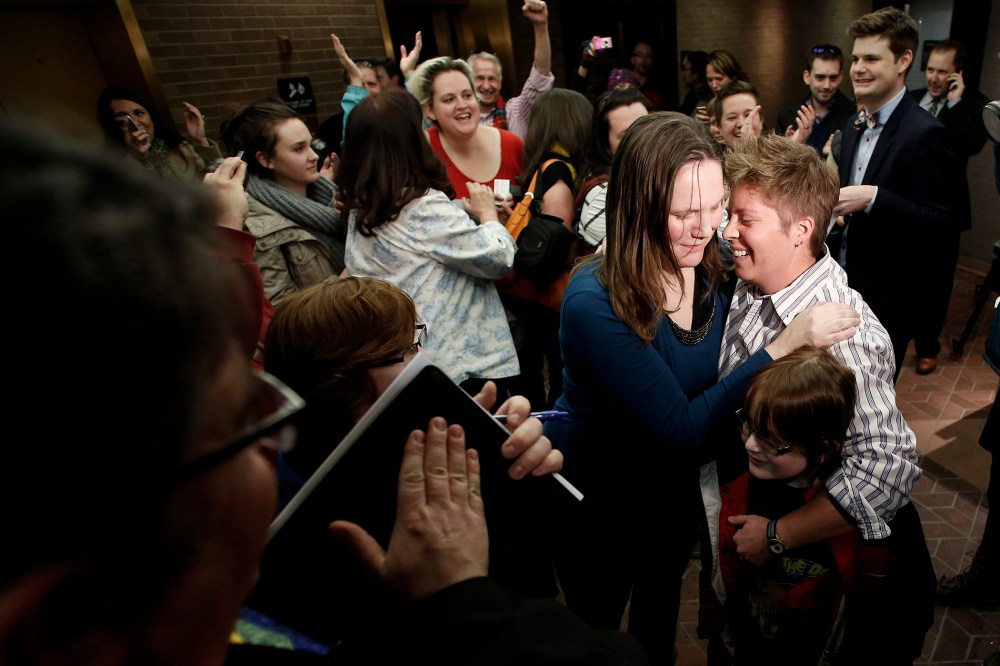
Though diametrically opposed on the merits of marriage equality, both challengers and defenders of laws standing in the way can usually come together on one point: their shared conviction that the matter will soon be decided by the nation’s highest court.
And yet, despite a growing chain of judicial triumphs for gay and lesbian couples — each ruling now an almost routine, predictable event — there are still no sure things, and those betting on when or which case could go before the justices, as well as the outcome, may regret putting money down.
True, no ban on same-sex nuptials has survived at the federal district level since the Supreme Court invalidated a key portion of the Defense of Marriage Act (DOMA) last year. That trend now looks to be continuing at the appellate level with the 10th Circuit Court of Appeals’ conclusion that bans in both Utah, and Oklahoma are unconstitutional. On Monday, the 4th Circuit Court agreed, upholding a lower court’s ruling that struck down Virginia’s same-sex marriage ban.
Already, Utah officials have announced plans to appeal their loss to the Supreme Court, meaning the justices will have at least one request to review a marriage equality case when they come back in October for next term. That number could easily go up with arguments scheduled in the 6th Circuit for Aug. 6; the 7th Circuit for Aug. 26; and the 9th Circuit for Sept. 8.
But there’s no guarantee any of those requests, known as petitions for writ of certiorari, would get the four votes necessary to grant review from this Supreme Court, whose makeup is pretty evenly mixed with liberal and conservative members. Justice Kennedy, who wrote a powerful opinion in the DOMA case affirming both states’ rights and the basic dignity of same-sex unions, falls smack-dab in the middle.
“If I were one of the conservative justices — Thomas, Alito, Scalia, or Roberts — I would vote to deny cert to prevent these cases from being affirmed at the Supreme Court level, and hope that a Republican president would come in and replace one of the more liberal justices,” said John Pagan, a University of Richmond law professor, to msnbc.
James Esseks, director of the ACLU Lesbian Gay Bisexual and Transgender Project who argued the Virginia case before the 4th Circuit, disagreed, saying that flatly denying cert is an unlikely scenario. However, he speculated, delaying Supreme Court review until after next year would not fall outside the realm of possibility.
“The way they might get there is to say, we’re not going to rule on these petitions; we’re just going to hold them pending other petitions and take our time,” Esseks said. “The court could decide next June to grant cert in one of them, then the case would be up for review the following year. I could see people on the more liberal side of the court thinking it’s a good thing to wait for more circuit court authority to develop.”
Though marriage equality’s winning streak since DOMA has been nothing short of phenomenal — with 28 legal victories to date and over 75 challenges to same-sex marriage bans across the country — some anticipate the movement will hit a speed bump. Carl Tobias, another University of Richmond law professor, believes a marriage equality loss could come either out of the 6th Circuit — which will hear arguments next week for Ohio, Michigan, Kentucky and Tennessee — or out of the 5th Circuit, which has yet to schedule arguments in an appeal to the February ruling that struck down Texas’ ban.
“For the 6th Circuit, the panel composition includes two George W. Bush appointees, whose reputations are pretty conservative. They’re more likely to rule against same-sex marriage,” Tobias said. “And the 5th Circuit has a reputation of being the most conservative in the country.”
Disappointing as a marriage equality loss may be for supporters, it wouldn’t be without a silver lining. If there’s disagreement among the appeals courts, that could spur the justices to grant cert for one of the cases where a same-sex marriage ban was upheld. For those hoping that a broad Supreme Court ruling would come sooner rather than later, a circuit split may be their best hope.
“The principal role of the Supreme Court is to resolve conflicts in constitutional law,” said Pagan. “At the moment, where there is no conflict, there’s no pressure on the court to take a case at this time.” If Tobias’ prediction proves correct, and either the 6th or the 5th Circuit courts determine that same-sex marriage bans are constitutional, that appeal would likely stand the best chance of going before the Supreme Court. Others think a loss for marriage equality won’t be necessary. “I don’t that anyone would welcome a court denying same-sex couples their constitutional rights,” said Elizabeth Wydra, chief counsel at the Constitutional Accountability Center. “If we continue with an unbroken chain of victories, then marriage equality will be legal across the country, regardless of whether the Supreme Court steps in or not.” Even if the Supreme Court is looking for a split — which, it doesn’t have to; the justice can grant review simply because they think an issue is matter of public importance — Esseks believes that threshold may have already been reached. In 2006, the 8th Circuit Court upheld Nebraska’s sweeping ban on same-sex nuptials, civil unions, domestic partnerships, “or other similar same-sex relationships.” “If I were going to write a cert petition,” said Esseks, “I would say first of all, this is a question of public importance, and it would be helpful to have a clear rule. And point two, there is a split between the 10th Circuit and the 4th Circuit on one hand, and the 8th Circuit on the other.” Another question is how the justices would rule on a marriage equality case, should they decide to accept one in the near future. All eyes will undoubtedly turn to Justice Kennedy as the deciding factor. But as the New York Times’ Adam Liptak pointed out this week, a conclusion from Judge Jerome Holmes of the 10th Circuit, which recently found Oklahoma’s ban unconstitutional, could complicate matters. In his 27-page concurrence, Judge Holmes rejected the idea that animus toward gay people played any role in Oklahoma’s same-sex marriage ban. And, as Liptak noted, “animus has figured prominently in the Supreme Court’s gay rights decisions,” particularly in those from Justice Kennedy. Despite these unknowns, many legal experts are confident the Supreme Court will soon consider a marriage equality case and ultimately conclude that gay and lesbian couples do have a constitutional right to wed. When and which case that will be is a guessing game, but one both sides of the debate can’t help but play.
Emma Margolin
Emma Margolin is a reporter at MSNBC.com. Recommended


