








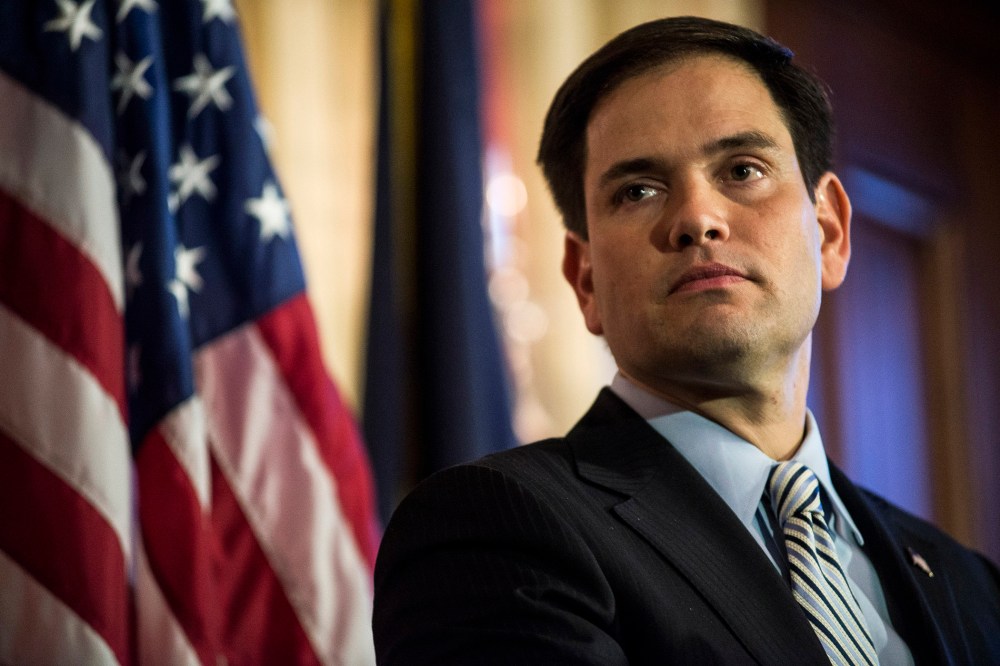
2013 wasn’t the greatest year for Sen. Marco Rubio. After starting out as the tentative GOP frontrunner for president, the Florida Republican devoted himself to passing immigration reform only to awkwardly back away from the issue after conservatives rebelled. While he was busy regaining his footing, the Senate’s tea party stars Ted Cruz and Rand Paul outflanked him with the grassroots. A then-ascendant New Jersey Gov. Chris Christie rallied the donor class.
But now, for the first time in a long while, Rubio is getting another look from his skeptics on the right.
On Monday, the son of Cuban immigrants delivered an impassioned polemic against communism from the Senate floor, lighting into his Democratic colleague Tom Harkin for praising the Castro government’s national health care system after a recent visit.
“I heard him…talk about these great doctors that they have in Cuba,” Rubio said in his speech. “I have no doubt they’re very talented. I’ve met a bunch of them. You know where I met them? In the United States because they defected, because in Cuba, doctors would rather drive a taxi cab or work in a hotel than be a doctor.”
Rubio went on to accuse Cuba of having “exported repression in real-time,” displaying pictures of protestors in Venezuela killed in a brutal crackdown on opposition to socialist president Nicolás Maduro.
The riveting 14-minute performance captured the imagination of conservative commentators, who gushed over YouTube clips of Rubio. Rush Limbaugh, who has been a major critic of Rubio’s immigration position, called it the best speech on communism “since the days of Reagan.”
Rubio’s remarks were the culmination of weeks of efforts to highlight Venezuelan repression — efforts that earned Rubio a denunciation from Maduro himself as “el loco de los locos.”
“The rest of the country may not have been paying attention, but in South Florida the events in Venezuela are local and are front page news,” Ana Navarro, a Republican strategist in Florida, told msnbc.
Venezuela isn’t likely to be a prime topic in the 2016 Republican primaries or in the general election outside of Florida. But the broader issue of foreign policy could be an important dividing line among Republicans if Rand Paul, who favors scaling back America’s role abroad, runs for the party’s nomination. The speech was a reminder that Rubio, who serves on the Foreign Relations Committee, has tended to side with the hawks more often than not.
“He’s a contrast with Rand Paul in that he’s not isolationist, he’s calling for a muscled foreign policy,” Republican strategist John Feehery said.
Rubio and Paul have also broken over whether to press the Obama administration for more Iran sanctions, and Rubio has sparred with Paul over the Kentucky lawmaker’s attempts to slash foreign aid. If Paul gets close to the nomination, Rubio might draw some interest from more traditional Republicans nervous about an open retreat from the Bush era.
Immigration still stands as a major obstacle. While reform is broadly popular, a significant segment of the GOP base is viscerally opposed, which helps explain why the House is so reluctant to follow Rubio’s lead. It’s also not clear how much benefit he’ll get from the pro-reform side for his troubles either given that Rubio has been criticized by activists for avoiding the issue since the Senate bill passed.
“The guy has got some incredible talent, it’s kind of phenomenal,” one Republican strategist told msnbc “I just don’t know if he’s going to be able to move past whatever challenges that he may have created.”
Feehery suggested that Rubio’s best hope at this point would be for the House and Senate to pass a final deal this year rather than force Rubio into the middle of a contentious immigration debate in 2015 and 2016. Ted Cruz, a potential presidential candidate, has derided Rubio’s attempts to legalize undocumented immigrants as “amnesty” and has shown little hesitation when it comes to directing grassroots rage against rival Republicans.
“If it’s still a festering issue out there during the debates, it’s going to hurt the Republican party, first of all, and it’s going to hurt Rubio,” he said.
Domestically, Rubio has tried to make a name for himself in other areas lately. After moving on from immigration, he moved to brand himself a leading Obamacare opponent. It hasn’t always worked out well.
After weeks of demanding Congress defund Obamacare last year, Rubio was caught in a difficult position when Congress – led by Cruz and Paul – actually followed his advice and triggered an unpopular shutdown.
A more recent attempt to defund an Affordable Care Act provision designed to protect insurance providers from unexpected losses during implementation, which Rubio dubbed an “Obamacare bailout,” hit a roadblock when the Congressional Budget Office determined it would likely cost taxpayers billions of dollars if eliminated.
But away from the ultra-politicized Obamacare wars, Rubio has also been building up his credentials on less divisive policy measures.
He delivered a speech at a community college in Florida outlining steps to control rising tuition costs and make student loans less burdensome. Among them is a bill he’s sponsored with Democratic Sens. Ron Wyden and Mark Warner that would require universities to make public information about past graduates’ incomes and debt. He’s also looking at tying student debt payments to income and laying the legal groundwork for private investors to buy equity in students’ future income as an alternative to traditional loans. In another speech, on poverty, Rubio proposed rejiggering the Earned Income Tax Credit, one of the government’s most critical tools for helping the working poor, to subsidize childless adults as well as families. Education and poverty were topics largely left out of the 2008 and 2012 presidential elections, but both are coming into vogue among national Republican leaders trying to erase the party’s cold rich guy image left in Mitt Romney’s wake. Rubio could face some obstacles in running a national campaign around those issues, however. For one, higher education policy isn’t particularly partisan, meaning Democrats can plausibly claim credit for many of the same broad ideas. Both President Obama’s State of the Union and Rubio’s televised response last year mentioned retooling the accreditation process for colleges to keep costs down and both have talked about expanding online and trade schools as an alternative to traditional four-year colleges. “It’s not an obviously ideologically based Republican vs. Democrat kind of thing,” Richard Vedder, a professor of education at Ohio University who Rubio has consulted, told msnbc. “It’s more of a good governance thing.” Rubio has tried to differentiate himself symbolically from Obama on higher education. After the president apologized to an art history professor for suggesting students consider more lucrative fields, Rubio called Obama’s contrition “pathetic” on Twitter, adding “we do need more degrees that lead to jobs.” Obama offered another death hug on Rubio’s top poverty proposal in his latest State of the Union speech, calling on Democrats and Republicans to follow the Florida Senator’s advice and apply the Earned Income Tax Credit to single workers. There are differences, though: Obama wants to expand the credit by cutting tax expenditures elsewhere, Rubio’s plan would likely require taking the money from elsewhere in the EITC. In a general election, it might be beneficial for Rubio to be able to talk about his work across the aisle with Democrats. But, as Rubio has discovered on immigration, bipartisan policy proposals have a tendency to get real partisan real fast once they move to the front of the conversation, sometimes turning them into an unexpected liability. Take Common Core, a revised set of education standards championed by Jeb Bush, the former Florida governor and a Rubio mentor also eyeing a possible 2016 presidential bid. Common Core has enjoyed widespread support among Democratic and Republican reformers alike. But as it’s moved closer towards implementation and garnered more attention, a combination of legitimate concerns about federal overreach and wild-eyed indoctrination conspiracy theories pushed by Glenn Beck and others are making it toxic in tea party circles. Rubio has said he won’t support the policy. It’s not hard to imagine something like Rubio’s seemingly uncontroversial plan to make college statistics public — which would require schools to provide anonymous data on individual students to the federal government — spun into paranoia about big government tracking Americans. Whatever route he chooses, the field’s never been more wide open for Rubio to try and reclaim his old place in the right’s imagination. Christie, potentially his top rival for establishment Republican support, has collapsed in the polls because of Bridgegate. Jeb Bush could potentially take his place and split Rubio’s Florida base of supporters — a CBS/NYT poll found 41% of Republican respondents want him as an option in 2016, the most of any candidate — but it’s not clear Bush will run. For all of Rubio’s stumbles, GOP voters might decide they can do worse than a strong speaker with a compelling biography.
Benjy Sarlin Recommended


