








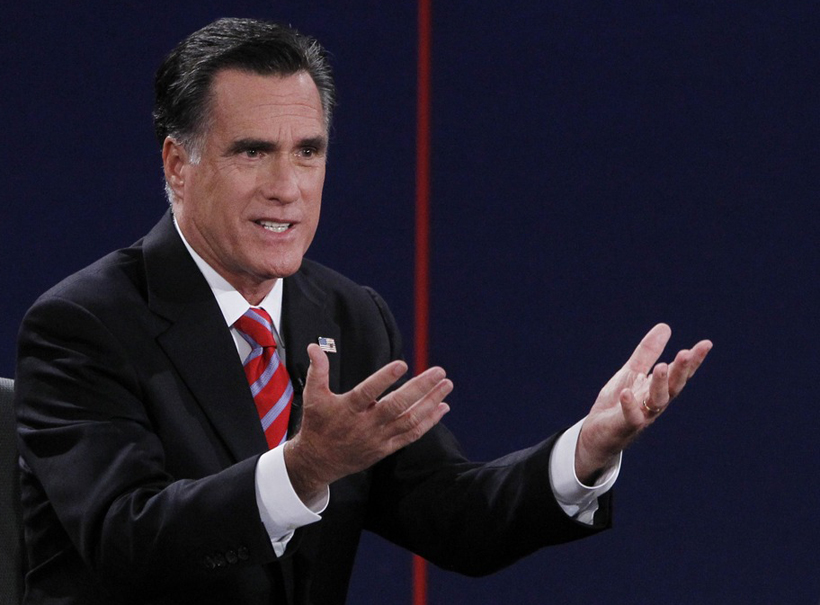
Mitt Romney complained in Monday night’s debate that we have “in Egypt a Muslim Brotherhood president,” declaring that “what we’re seeing is a pretty dramatic reversal in the kind of hopes we had for that region.”
The implication was that President Obama shouldn’t have ushered out Hosni Mubarak—who Romney last year declined to call a dictator, describing him instead as a “march-type figure”—in 2011, which led to the Muslim Brotherhood coming to power. But then Romney went on to declare that he wouldn’t have stood by Mubarak, since America had to stand “for freedom in that part of the world.”
These mixed signals were nothing new. Since his campaign began, Romney’s views on the Arab Spring have swung from one extreme to the other, as he has searched for a way to attack President Obama. On the one hand, Romney claims, Obama is recklessly ushering out U.S. allies, or at least figures who offer stability; on the other, the president isn’t doing enough to support western-friendly groups and support the transition to democracy.
Can he square that circle? “I don’t think he can,” said Matthew Duss, a Middle East expert at the Center for American Progress. “They want to have it both ways when it suits them.”
Eliot Cohen, a top adviser to Romney, almost parodied this confusion this week, telling the New York Times that he doubted the existence of an Arab Spring. “It is not clear to me what is germinating,” Cohen said. And yet, he insisted, Obama should be doing more to nurture it. “If you don’t even try to shape events,” Cohen added, “then for sure you are going to get a bad outcome.”
In other words, the U.S. should be wary of supporting the Arab Spring, except when it should be encouraging it.
Some of Romney’s foreign-policy advisors, as well as Romney himself, suggest a Romney administration would support the nascent democratic forces in the Middle East. Dan Senor, said to be Romney’s closest international-affairs counselor who played a key role in touting the Iraq invasion on behalf of the Bush administration, has said that Romney would usher Assad out of power by funding rebels.
“It’s been over a year since the president said Bashar Assad must go,” Senor said in September. “Bashar Assad is still in power. America looks impotent in the region.”
Romney has echoed that outlook many times. “The Arab Spring presented an opportunity to help move millions of people from oppression to freedom,” he wrote in a September op-ed. And yet, other key Romney advisers have attacked Obama for being too willing to let longtime Middle Eastern strongmen fall to opposition forces. John Bolton, who served as the Bush administration’s U.N. ambassador, said at the time of the Egyptian uprising that Obama shouldn’t be abandoning the government, which was “secular” and “an authoritarian regime in power that has been our ally.” After all, we don’t know what the alternative would be, Bolton said, and the Muslim Brotherhood would be terrible for American interests. And yet, on Syria, Romney has also slammed Obama for not doing more to support the opposition groups—many of whom are Islamists, just like the Brotherhood. In fact, Syrian groups affiliated with Al-Qaeda are gaining power as the regime crumbles. Which approach would Romney take as a president? Would he support democracy, or stifle it when it harms what he sees as the American interest? On this matter, as on so many issues facing the country, nobody knows what Mitt Romney really thinks. Or whether he has thought out the problem at all.
MS NOW staff Recommended


