









BOULDER, Colorado – It was a wild and woolly debate in Boulder on Wednesday as former Florida Gov. Jeb Bush sputtered, Sen. Marco Rubio soared, and candidates and GOP leaders turned their ire on the event’s host, CNBC. Here were three of the big takeaways from the night.
Rubio 1, Bush 0

If Bush ends up losing, this may stand out as the night that sealed his fate.
For weeks, Rubio has steadily gained ground in the polls as Bush has steadily slipped, setting up a confrontation between two campaigns that are heavily reliant on the same pool of voters and donors. Bush, whose campaign announced major spending cuts last week after a difficult fundraising quarter, entered the debate with sky-high pressure to blunt Rubio’s momentum. Instead, he handed Rubio the finest moment of the debate — and arguably any of the debates so far.
After the moderators pressed Rubio on his record of missed votes during the campaign, Rubio responded with a fast-paced barrage of statistics about past senators missing voters while running for the White House.
Bush tried to pile on with his own attack: “I’m a constituent of the senator, and I helped him, and I expected that he would do constituent service, which means that he shows up to work,” he said.
But Rubio wasn’t done, landing a meticulously rehearsed answer that painted Bush’s attack as a desperate move from a flagging candidate.
“Do you know how many votes John McCain missed when he was carrying out that furious comeback that you’re now modeling after?” Rubio said. Bush struggled to respond and Rubio kept going: “I don’t remember you ever complaining about John McCain’s vote record. The only reason why you’re doing it now is because we’re running for the same position, and someone has convinced you that attacking me is going to help you.”
Rubio had an advantage in that he could see the attack coming from a mile away. Bush’s campaign had been raising Rubio’s absentee record in the press for days ahead of the debate and it was no surprise he had a comeback prepared.
In the spin room afterward, Rubio’s aides were glowing and spokesman Alex Conant told reporters he’d received calls from Bush donors after the debate. Bush’s aides were peppered with questions about Rubio’s response.
“Marco Rubio is an outstanding performer,” Bush campaign manager Danny Diaz told reporters. “The reality is he doesn’t have a record of accomplishment.”
The candidates love dumping on the press
After Rubio filleting Bush, the most violent confrontation wasn’t between the candidates and each other at all, but between the candidates and the moderators of the event.
From early on, contenders complained that moderators were treating them unfairly by asking pointed questions designed to elicit conflict.
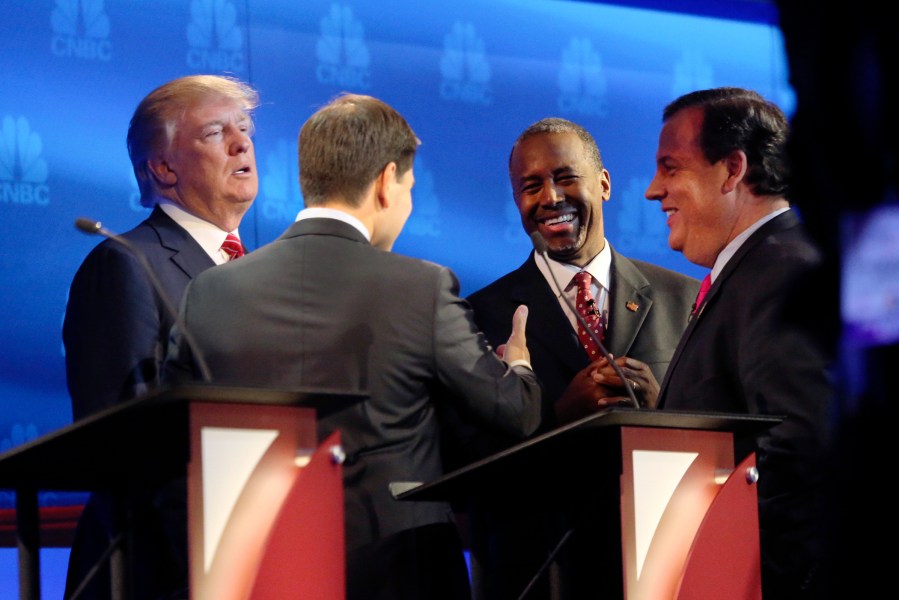
CNBC’s John Harwood asked Donald Trump if he was running “a comic book version” of a presidential campaign based on his lofty promises to deport millions of immigrants, cut taxes massively without adding to the deficit, and bend foreign leaders to his will through sheer power of personality. The billionaire real estate mogul said it was “not a very nicely asked question” but noted that CNBC’s own Larry Kudlow had praised his tax plan. Later, Trump told moderator Becky Quick that a quote she attributed to him criticizing Mark Zuckerberg on immigration was inaccurate. As she brought up later in the debate, the quote came from Trump’s website.
Texas Sen. Ted Cruz earned a heap of applause after he decried the moderators’ handling of the debate.
“The questions that have been asked so far in this debate illustrate why the American people don’t trust the media,” he said. “This is not a cage match and you look at the questions — Donald Trump are you a comic book villain, Ben Carson can you do math, John Kasich will you insult two people over here, Marco Rubio why don’t you resign, Jeb Bush why have your numbers fallen — why not talk about the substantive issues people care about?”
Other conflicts occurred offstage. Diaz, Bush’s campaign manager, confirmed to reporters that he had confronted CNBC producers mid-debate to complain about his candidate’s lack of speaking time. Republican National Committee chairman Reince Priebus said in a statement that “the performance by the CNBC moderators was extremely disappointing.” Expect a lot more of this in the future. Just as Newt Gingrich revived his campaign by battling with CNN’s John King over questions about his infidelity in 2012, plenty of candidates see the press and debate moderators as an easy punching bag to rile up the base. Carson sweats in the spotlight This was the first debate where Carson was a true front-runner, with all the added attention that entails. If the debate’s any indication, he’s still shaky in the role and he seemed to raise more questions about his positions and biography than he answered. Asked about his call for a flat tax based on Biblical tithing, Carson struggled to articulate his plan after telling moderators the original figure he floated — 10% — was only an “analogy” and that estimates that he would blow a huge hole in the deficit were inaccurate despite his calls for drastic cuts from current tax rates. He said he would eliminate “all the deductions” and “all the loopholes” to make up some costs, which sets him up this week for follow ups of whether he would preserve popular items like the mortgage deduction or charitable deductions and — if not — how he could claim his plan would be anywhere near deficit-neutral. Steve Deace, a conservative radio host in the spin room for Cruz (who had a very strong debate), saw opportunity in Carson’s hesitating answer. %E2%80%9CI%20think%20you%20saw%20tonight%2C%20and%20Ben%E2%80%99s%20a%20great%20guy%2C%20issue-wise%20he%E2%80%99s%20out%20of%20his%20depth.%E2%80%9D’ “I think you saw tonight, and Ben’s a great guy, issue-wise he’s out of his depth,” Deace said. Carson also gave an odd response when asked about his reported involvement with a company called Mannatech that made fantastical claims that its nutritional products could cure cancer, autism and other diseases. The former neurosurgeon said he “didn’t have an involvement with them” and it was “total propaganda” to suggest so. Bizarrely, he then went on to say he gave paid speeches for them and that he supported their business. “Do I take the product? Yes. I think it’s a good product,” Carson said. Clear as mud. Who knows if it will matter to Carson’s current supporters when the next polls come out. But if his goal was to prove he can appeal beyond a hardcore conservative base and convince other voting blocs to take him seriously, his answers did not help.
Benjy Sarlin Recommended


