








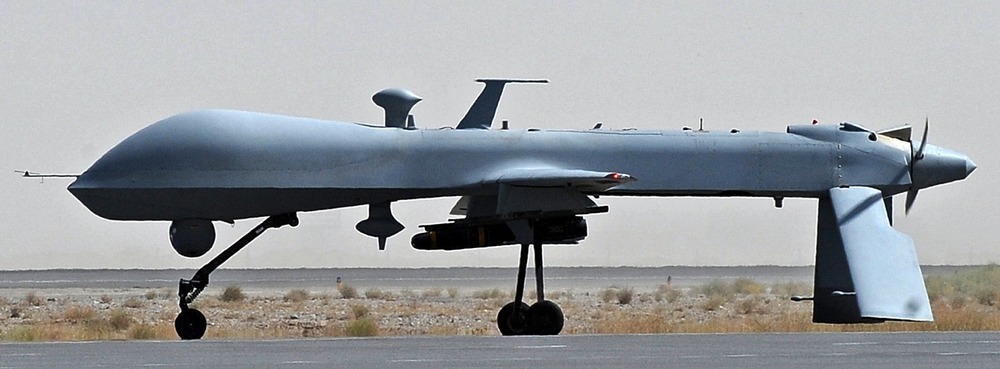
There’s no way of knowing when the drones will strike. Sometimes they just pass overhead, observing. But then, seemingly out of nowhere, they’ll attack; bombing markets, funerals, tribal gatherings. Two drone attacks may occur in the same place within minutes of one another, meaning that anyone who tries to help survivors of the first attack puts themselves at risk. The easier thing to do is run and hide—and stay hidden.
This is how a new report describes life in much of northwestern Pakistan, one of the main fronts in America’s covert drone war. For this report—called “Living Under Drones”—researchers and human rights lawyers from Stanford Law School’s International Human Rights and Conflict Resolution Clinic and New York University School of Law’s Global Justice Clinic collected the testimony of more than 130 Pakistanis, many of whom were personally affected by drone strikes.
Americans have very little information about how the drone war affects day to day life in Pakistan, said Sarah Knuckey, a professor in the NYU School of Law’s Global Justice Clinic and one of the lead researchers and editors of the report. “It’s certainly not referred to by our government,” she told Lean Forward, “and very little in the mainstream media.” She said “Living Under Drones” was drafted in order to fill that knowledge gap.
Although the U.S. government’s drone campaign is still shrouded in secrecy, the region of Pakistan known as the Federally Administered Tribal Areas (FATA) is considered a bombing hot spot. According to the Bureau of Investigative Journalism, the Obama administration has launched 293 drone attacks in Pakistan alone, as compared to 52 strikes under the Bush administration. The bureau estimates that between 2,565 and 3,329 people have been killed, among whom 474 to 884 were civilians. However, distinguishing militants from civilians in the drone war is notoriously difficult, both because militants have an incentive to exaggerate the civilian death count and because, according to The New York Times’ sources, the administration “in effect counts all military-age males in a strike zone as combatants … unless there is explicit intelligence posthumously proving them innocent.”
For “Living Under Drones,” Knuckey and her co-authors interviewed 69 “experiential victims” (people whose lives had been directly affected by drone strikes) in the region of FATA called North Waziristan. The people of that region, Knuckey said, “have a constant fear that they’ll be hit, even though they know they’re civilians.”
“There’s a pervasive fear for people every second of the day,” she said. “It has a significant mental health impact for people living there.”
“We are always thinking that it is either going to attack our homes or whatever we do,” said cab driver Haroon Quddoos, according to the report. “It’s going to strike us; it’s going to attack us … No matter what we are doing, that fear is always inculcated in us.”
As a result, many residents of North Waziristan are reluctant to go out in public at all. According to Shahbaz Kabir, “education was always a problem in Waziristan, but, after the drone attacks, it got even worse. A lot of the children—most of the children—had to stop going to school.”
“Even in mosques, if we’re praying, we’re worried that maybe one person who is standing with us praying is wanted,” said Sadar Dawar, president of the Tribal Union of Journalists, according to the report. “So, wherever we are, we have this fear of drones.” Even the “community-based conflict resolution process” known as the jirga—which the report calls “fundamental to Pashtun civil organization”—has been shirked by tribal leaders who see gathering in large groups as too big of a risk.
However, though “Living Under Drones” argues for plenty of skepticism regarding the drone war’s efficacy in keeping American secure, Knuckey said there is at least some merit to the government’s claims. “I think there’s no doubt that drones have killed some level of high level militants,” she said. But without more transparency and accountability from the U.S. government, there’s no way to have an informed, democratic debate about drone policy. “Part of the reason why we focus on the transparency and accountability piece of it [in our report] instead of the policy program itself is because we don’t know about the policy itself,” said Knuckey. Hence the report’s policy recommendations’ focus on encouraging policy disclosure and investigations into drone deaths. Even with serious reform, however, the pockmarked region of North Waziristan may endure long-term scarring. Knuckey said the effect drones have had on education in particular could leave a lasting impact. “The education is certainly a big piece,” she said. “We’re already talking about a region where literacy levels are very low and violence from the Taliban impacts those institutions. Drones exacerbate those preexisting problems; in terms of the long term development of the region, it’s a disaster.” Many North Waziristan residents are also reportedly more suspicious of their neighbors. According to the report, “Many Waziris have come to believe that paid informants help the CIA identify potential targets, including by placing small tracking devices … in vehicles or houses.” The report finds no evidence to corroborate this belief, but it remains widespread among Waziris. It’s not just negative relationships among Waziris that have been exacerbated. The drone strikes have also given many people in that region an overwhelmingly negative impression of the United States. Many of the people Knuckey and her colleagues interviewed, she said, had been barely aware of the United States’ existence before the drone bombings started. Now, she said, they say, “what I know is the U.S. government kills people with flying robots where I live.”
Ned Resnikoff is an urban policy analyst, researcher, writer, and editor. His byline has appeared in a variety of publications, including the New York Times, San Francisco Chronicle, Dissent, and The Nation. He writes the newsletter Public Comment, which can be found at publiccomment.blog. Recommended


