








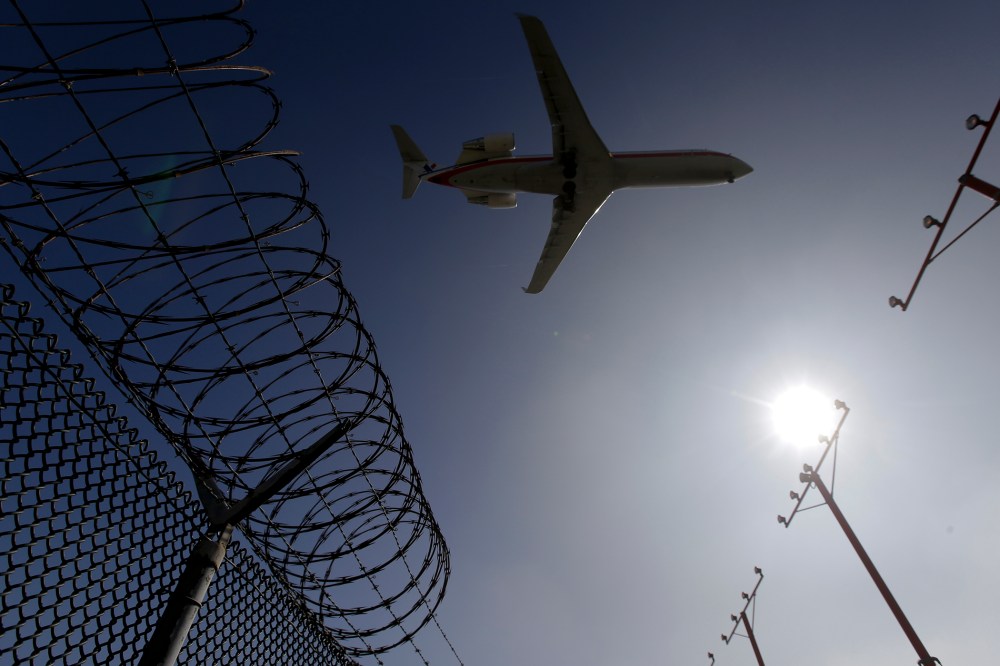
Several hundred times over the last decade, intruders have hopped fences, slipped past guardhouses, crashed their cars through gates or otherwise breached perimeter security at the nation’s busiest airports – sometimes even managing to climb aboard jets.
One man tossed his bike over a fence and pedaled across a runway at Chicago O’Hare, stopping to knock on a terminal door. Another rammed a sports-utility vehicle through a security gate at Philadelphia International and sped down a runway as a plane was about to touch down, forcing officials to hold takeoffs and landings.
At Los Angeles International, a mentally ill man hopped the perimeter fence eight times in less than a year – twice reaching stairs that led to jets. In Fort Lauderdale, Florida, a man who was on the run after stabbing a plumber scrambled over a barbed-wire fence and dashed into an empty plane.
In all, an Associated Press investigation found 268 perimeter security breaches since 2004 at airports that together handle three-quarters of U.S. commercial passenger traffic. And that’s an undercount, because two airports among the 31 that AP surveyed didn’t have data for all years, while Boston’s Logan refused to release any information, citing security concerns.
RELATED: Officer shoots machete-wielding man at New Orleans airport
“Disturbing,” Los Angeles Mayor Eric Garcetti said in response to the AP report during an “Ask the Mayor” segment on KNX-AM radio, noting that he wasn’t surprised at his airport’s 24 breaches because it is one of the largest in the nation.
“All it takes is one person who can get through and do something,” he said.
Until now, few of these incidents have been publicly reported. Most involved intruders who wanted to take a shortcut, were lost, disoriented, drunk or mentally unstable but seemingly harmless. A few trespassers had knives, and one man who drove past a raised security gate at O’Hare in January had a loaded handgun on the vehicle console. He told police he was bypassing train tracks.
None of the incidents involved a terrorist plot, according to airport officials.
%22This%20might%20be%20the%20next%20vulnerable%20area%20for%20terrorists%20as%20it%20becomes%20harder%20to%20get%20the%20bomb%20on%20the%20plane%20through%20the%20checkpoint.%22′
The lapses nevertheless highlight gaps in airport security in a post-9/11 world where passengers inside airports face rigorous screening to prevent attackers from slipping through, and even unsuccessful plots – such as the would-be shoe bomber – have prompted new procedures.
“This might be the next vulnerable area for terrorists as it becomes harder to get the bomb on the plane through the checkpoint,” said airport security expert Jeff Price.
Since the Sept. 11 attacks, hundreds of millions of dollars have been spent to upgrade fencing, cameras and other detection technology along airport perimeters. Many have dozens of miles of fencing, but not all of that is frequently patrolled or always in view of security cameras.
Airport officials insist their perimeters are secure. They declined to discuss specifics, other than to say they have layers that include fences, cameras and patrols. Employees are required to ask for proof of security clearance if a badge is not obvious. Other measures may include ground radar and infrared sensors.
If a person hops a fence but is immediately caught, “the system did work,” said Christopher Bidwell, vice president for security at Airports Council International-North America, representing airport operators.
At the world’s most fortified airports, the outermost security layer has been enough. Tokyo’s Narita and Israel’s Ben Gurion airports report no perimeter intrusions. At Ben Gurion, officials said they spend more than $200 million annually on perimeter security.
In the U.S., airport authorities said it is neither financially nor physically feasible to keep all intruders out.
“There is nothing that can’t be penetrated,” said LAX Police Chief Patrick Gannon, noting that even the White House has struggled with perimeter security; last year an intruder with a knife climbed a fence and made it inside the executive mansion before being arrested.
The AP’s analysis was prompted by a high-profile breach last spring that resulted in one 15-year-old’s improbable journey to Hawaii. Yahya Abdi climbed a fence at San Jose International Airport, hoisted himself into a jet’s wheel well and survived an almost six-hour flight. Abdi, who lived with his father and stepmother, said he was trying to get back to his mother, a refugee in Ethiopia.
Afterward, San Jose airport spokeswoman Rosemary Barnes said breaches are more common than people realize.
Through public records requests, news archive searches and interviews, the AP created the most comprehensive public accounting of perimeter security breaches from January 2004 through January 2015 at San Jose and the nation’s 30 busiest airports. The analysis excluded incidents inside the airport, such as when a passenger went unscreened through a security checkpoint or walked out the wrong exit door.
Among the findings:
– At least 44 times, intruders made it to runways, taxiways or to the gate area where planes park to refuel or load passengers. In seven cases, including Abdi’s, they got onto jets.
– Seven airports in four states accounted for more than half the breaches, although not all provided data for all years examined. San Francisco International reported the most, with 37. The others were the international airports in Philadelphia, Los Angeles, Las Vegas, San Jose, Miami and Tampa, Florida.
– Four years had more than 30 breaches each: 2007, 2012, 2013 and 2014. The most was 38, in 2014 and 2012; the fewest 12 in 2009.
– Few airports revealed how long it took to apprehend suspects, saying this detail could show security vulnerabilities. Available information showed most arrests happened within 10 minutes. Several people went undetected for hours or never were caught – including a Charlotte, North Carolina, stowaway who was found dead in 2010 after he fell from a wheel well when the landing gear opened on approach to Boston.
%22Too%20often%20%E2%80%A6%20we%20don%E2%80%99t%20really%20have%20an%20idea%20of%20how%20long%20the%20individual%20has%20been%20roaming%20around%20the%20airport.%22′
“Too often … we don’t really have an idea of how long the individual has been roaming around the airport,” said U.S. Rep. Eric Swalwell, a San Francisco Bay Area Democrat who began focusing on airport perimeter security after the Abdi incident.
While the Transportation Security Administration is responsible for screening passengers and baggage, individual airports are responsible for securing perimeters, typically with a mix of private security guards and airport police. The TSA reviews airport plans, conducts spot checks and can levy penalties. The agency said that from 2010 through 2014, it issued $277,155 in fines for 136 perimeter breaches.
Airports are supposed to inform the TSA of such lapses, but the federal Government Accountability Office in 2009 found not all incidents were reported. In 2011, a TSA report shared with a congressional subcommittee counted 1,388 perimeter security breaches since 2001 at the 450 airports that TSA regulates.
Details from that report are not publicly available, and nearly a year after the TSA granted expedited status to AP’s Freedom of Information Act request for incident data, it has released nothing. The agency declined to comment on AP’s findings, and pointed to previous statements that perimeter security is the responsibility of each airport.
In a news conference called Thursday in response to AP’s findings, the spokesman for San Francisco International suggested that his airport had the most breaches because it disclosed everything, whether the breach was intentional or accidental. Spokesman Doug Yakel said the airport has beefed up security and that while its airfield is safe, “The goal is always zero” breaches. U.S. Sen. Barbara Boxer, D-Calif., said she’s been asking the TSA and airport officials since the San Jose case to “work together and resolve this alarming situation” and added: “Enough is enough, let’s get it done.” Former TSA director John Pistole said that fences, patrols and alarms are effective. “Overall, people should feel confident that terrorists and bad guys aren’t able to exploit it, recognizing it’s not a perfect system,” said Pistole, who retired in December. RELATED: Homeland Security releases plans in advance of possible shutdown Among the breaches, an elderly woman who apparently thought she was at Sears drove through a security gate at the Philadelphia airport. Also in Philadelphia, two party-goers drove through a gate to ask an officer for directions. At Washington Dulles and Tampa International, two men were caught skateboarding on tarmacs. In Chicago, Marlow Sahron Land Jr. tossed his bike over a fence in 2010, rode it across taxiways and at least one runway, then knocked on a terminal door; a gate agent let him inside. Witnesses told arresting officers that he looked “wacked out.” Land pleaded guilty to misdemeanor attempting to resist arrest, spent six months under court supervision and paid a $190 fine. Other intruders posed greater dangers or brought operations to a halt when they came too close to planes about to take off or land. At Philadelphia International, Kenneth Mazik rammed his SUV through a gate in March 2012 and sped onto the runway as a plane carrying 43 people was about to land. Air traffic controllers told 75 aircraft to circle and held 80 on the ground for about half an hour. He faced a rare federal prosecution and served 16 months, paying a $92,000 fine. Part of his defense was that he was high on the attention deficit drug Adderall. At the nation’s busiest airport, Hartsfield-Jackson in Atlanta, three different intruders reached runways – in 2007, 2012 and 2014. One was an aggravated assault suspect who came within 50 feet of a plane that had landed as he was pursued by police. In Phoenix in 2006, a pilot told air traffic controllers he “nearly collided with a pedestrian” as he was taking off. Fence jumper Jesus Duarte Verdugo told authorities he wanted to take a shortcut to a bus stop “because I was being lazy,” adding he had done so three days earlier without getting caught. Among the intruders, Christopher McGrath stands out. Eight times between April 2012 and March 2013, police caught McGrath after he got over the fence at LAX on a mission to board a flight. In an affidavit, FBI special agent David Gates said McGrath demonstrated how he used his travel bag to protect himself from the barbed wire. He never was armed but twice reached the stairs leading to jets, once with a bunch of bananas he hoped a pilot would accept in return for a ride to Australia. It wasn’t clear from police reports whether the planes were empty or full. Another time he hid for hours, later telling the FBI he had spent the night behind a trash bin before an airport employee discovered him. McGrath’s repeated break-ins helped airport police address vulnerabilities: They trimmed a tree branch he had used to get over the fence. When McGrath kept returning following short stints in local jail, LAX police turned to federal prosecutors. Last year, a federal judge found him not guilty by reason of insanity on a charge of entering an airport area in violation of security requirements. He remains at a medical lockup in Missouri. In an email, McGrath told the AP that he had gone to Southern California to live as a transient because of the good weather, but after his belongings were stolen he wanted a fresh start. He said he targeted planes bound for Brisbane, Sydney, Melbourne and New Zealand. Click here to continue reading the full Associated Press report Contributing to this report were Associated Press researchers Judith Ausuebel, Jennifer Farrar, Susan James, Monika Mathur, Barbara Sambriski and Rhonda Shafner; writers Ian Deitch in Jerusalem, Yuri Kageyama in Tokyo and Steve Karnowski in Minneapolis; and Interactive Editor Dan Kempton in Phoenix.
Associated Press Recommended


