








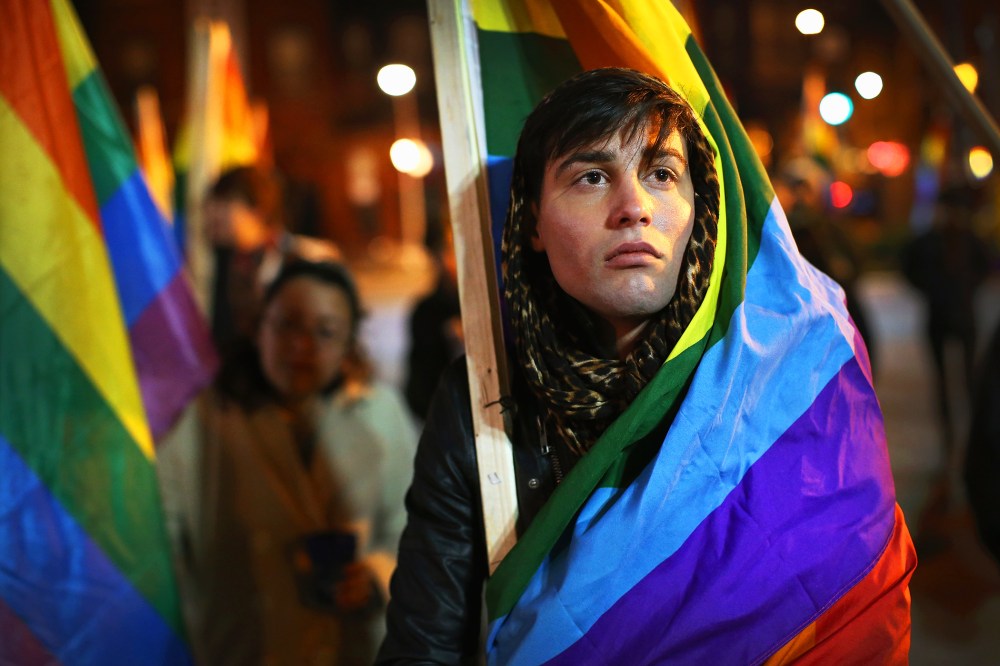
With court victories everywhere from Virginia to Utah, LGBT rights activists seem to be winning the fight over same-sex marriage. Yet even as same-sex couples celebrate hard-won victories, conservative activists in states all over the country are pushing back — sponsoring legislation that would allow businesses to discriminate against same sex couples.
“This is a deliberate strategy as gay people are getting greater rights, to take away those rights and be able to discriminate,” says Eunice Rho of the American Civil Liberties Union. “You can have marriage, but you have no right to the privileges that come with that.”
Last week the Kansas Senate put the brakes on legislation previously passed by the state House that would have allowed businesses to refuse services or employment benefits if it would involve “the celebration of,” or that would “solemnize,” or treat “as valid” any “any marriage, domestic partnership,” or “civil union” that “would be contrary to the sincerely held religious beliefs of the individual or religious entity regarding sex or gender.”
The bill would also allow individual government employees with such religious objections to refuse to provide government services–the Republican president of the state Senate, in expressing opposition to the bill, suggested that could include cops and firefighters. The government would still be required to find someone else to provide those services, but a private employer would only have to do so “if it can be done without undue hardship to the employer.”
The use of the phrase “sex or gender,” Rho warns, means that the letter of the law suggests even straight people whose marriages don’t conform to an individual’s religious beliefs could find themselves being discriminated against.

News of the Kansas bill has provoked a national outcry, but what’s happening there is not unique. Similar proposals, not all as broad as the one in Kansas, have been put forth or are being considered in other states, including Oregon, Tennessee, Ohio, Arizona, Idaho, Nevada, Utah and South Dakota. The language of Oregon’s proposed ballot initiative, for example, is limited to wedding celebrations, while the Tennessee bill is almost identical to the one in Kansas.
“We think it’s overly broad, and encourages a variety of businesses and service providers to discriminate against married same-sex couples,” Chris Sanders of the Tennessee Equality Project said of the bill proposed in that state. “That’s why we call it the ‘Turn the Gays Away’ bill.” That bill was effectively killed Tuesday afternoon, days after losing a crucial Republican sponsor.
With public opinion swiftly moving in favor of allowing same-sex couples to get married, conservative activists have refocused their efforts on enshrining or bolstering exceptions to anti-discrimination law when it comes to religious belief and sexual orientation. They see the issue as one of religious freedom, protecting believers’ right not to participate in same-sex marriage ceremonies or celebrations, and not to be forced by the state into doing so. Crucially, they believe that as far as services are concerned, proposals like the Kansas legislation are narrowly tailored to allow individuals not to participate in events related to same-sex unions if they have religious objections.
“It would apply not to all public accommodations, but only those involved in celebration of a marriage or domestic partnership/civil union, and it would carve out an exception for those who have sincerely held religious objections,” said UCLA law professor Eugene Volokh of the Kansas legislation. “It would be limited to situations where there’s a solemnization of the marriage, the actual ceremony, or the celebration, presumably the reception to honor the marriage as such.”
LGBT rights activists however, say the Kansas bill as written, and many of its counterparts in other states would go much further, allowing discrimination against gays and lesbians in all spheres of public life. The distinction is important, because it’s the difference between the law stating that a photographer or caterer can refuse to take pictures of or provide food for a same-sex wedding (which LGBT rights supporters also find objectionable) and say, a restaurant refusing to serve a same-sex couple. An exemption for churches and other religious institutions is one thing–businesses that want to participate in the public marketplace shouldn’t be allowed to discriminate.
LGBT rights supporters point to a phrase in the Kansas legislation that states individuals can refuse to provide services “related to, or related to the celebration of,” same-sex marriages in the proposal. If the drafters simply meant to allow discrimination in services related to weddings or wedding celebrations, they say, the first “related to,” which appears to refer to the unions themselves and not the ceremony or celebration, wouldn’t be necessary.
“I think you can read these laws broadly to allow discrimination in places of public accommodation,” said Caroline Mala Corbin, a law professor at the University of Miami. In the case of the Kansas legislation, an employer could also deny an employee with a same-sex spouse benefits meant for married couples based on the employer’s religious beliefs, unless federal law says otherwise. In states like Kansas, which don’t have statewide laws barring discrimination on the basis of sexual orientation by private employers, LGBT rights activists fear these proposals will allow gays and lesbians to be treated as second-class citizens. Proposals similar to the one in Kansas have been advanced by national and state-based conservative organizations. As Al Jazeera reported, in Arizona, Idaho and Tennessee, the legislation is being backed by affiliates of the DC based group Focus on the Family, the religious right organization founded by James Dobson. Another, the American Religious Freedom Program, helped craft the bill in Kansas. The American Religious Freedom Program is part of the Ethics and Public Policy Center, a DC based think tank run by Edward Whelan, a former Reagan administration official who writes on legal affairs for the conservative magazine National Review. Conservative activists insist they are not trying to recreate a system of old timey discrimination along the lines of sexual orientation. “The core purpose is to protect clergy, faith communities, individuals from being compelled by law or government to participate in a wedding ceremony,” Brian Walsh, executive director of the American Religious Freedom Program, said of the religious freedom bills. “I just don’t know anybody influential in the religious freedom arena who thinks that you should giving people some type of pocket veto not to provide services to people based on their sexual orientation in general public accommodations.” While conservative activists frame the debate as one of potential state coercion of religious believers, the truth is that government is involved either way–either in enforcing anti-discrimination laws or in laws that would protect religious believers who don’t want to provide services or employment benefits to same-sex couples. This is about more than just gay and lesbian rights. As with the lawsuit against the Obama administration’s mandate that insurance companies cover birth control, it’s just the latest chapter in a crucial debate over which freedoms we want to protect. “These religious objections have existed for decades if not longer, there were religious objections to civil rights laws in the 60s, there were religious objections to equal pay for women,” says Rho. “This is not a new tactic.”
Adam Serwer Recommended


