








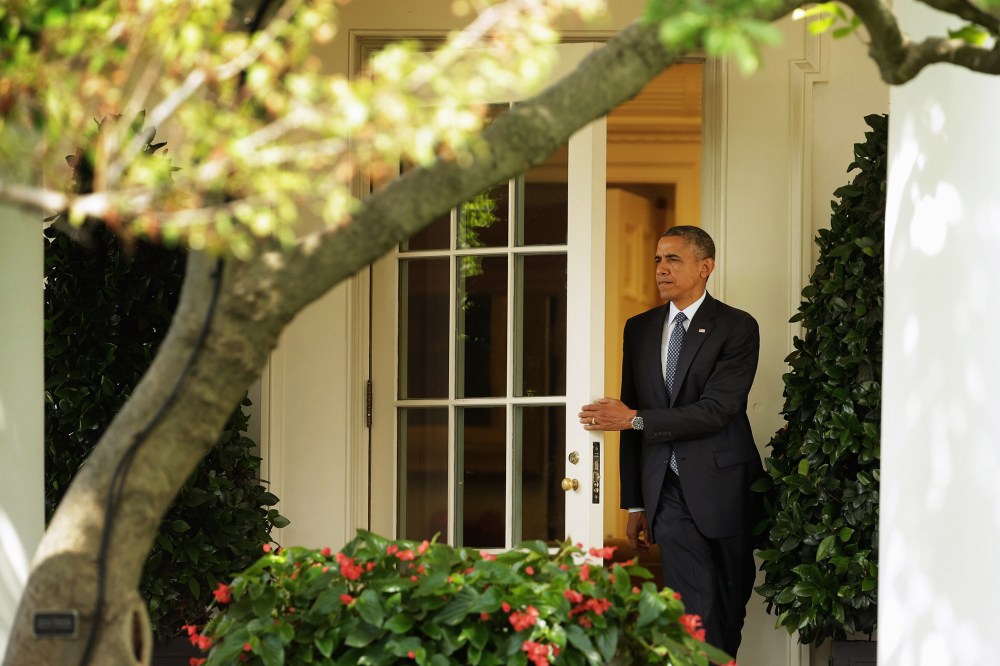
A loss for the president, a win for the presidency.
That’s the best way to describe the Supreme Court’s landmark decision Thursday on the “recess appointment” power — the president’s power to fill government posts when the Senate isn’t in session.
Technically speaking, the Obama administration lost 9-0, with not even one liberal coming to the administration’s aid. And that’s how it was pitched in the media. “A Humiliating Supreme Court Loss for Obama,” blared one typical headline.
The reality is more complicated. The court’s decision in NLRB v. Noel Canning wasn’t a one-sided loss for the administration; it was in large part a win for presidential power.
Nor was it really unanimous. In fact, it split 5-4 along partisan lines, with Justice Kennedy lining up with the court’s liberals and Justice Scalia writing a concurring opinion — not a dissent, for reasons explained below — fiery enough to singe off your eyebrows.
Indeed, Scalia dug deep into his grab-bag of insulting adjectives for this one. The court’s lead opinion by Justice Breyer, he wrote, was a “sad,” “astonishing” “tragedy” that employed “awkward” and “absurd” reasoning. As a coup de grace, Scalia offered this typically understated assessment: “no sane constitutional theory” could proceed along the lines Breyer adopted.
This is not a man who thinks his position won the day.
And he’s right. The court’s decision leaves the recess-appointment power largely intact, and deals defeat to two of the three arguments the administration’s challengers advanced.
To see why, it’s important to understand exactly what the parties were fighting about. The Constitution says the Senate must vote to confirm high-ranking government officers, such as cabinet secretaries. But it also gives the president a loophole: He has the “Power to fill up all Vacancies that may happen during the Recess of the Senate,” without waiting for Senate confirmation.
Presidents have used that power to appoint thousands of officials, including such notables as Supreme Court Justice Earl Warren and Federal Reserve Chairman Alan Greenspan. In the Noel Canning case, however, the plaintiffs proposed an interpretation that would have eliminated the power, for all practical purposes.
Their argument depended on two words: “the” and “happen.” The plaintiffs said “the Recess” doesn’t mean any old break the Senate takes, but instead one particular recess — the one at the end of each session of Congress. And, they argued, vacancies “happen during the Recess” only if an office becomes vacant during that recess. If it was already vacant, they said, the vacancy didn’t “happen” during the recess; it happened before.
Put those arguments together, and recess appointments are near-impossible. The president can make appointments only during the winter recess, and only to fill slots that just came open during those few days. And that is exactly what an influential appeals court held last year. It agreed with the plaintiffs about both “the” and “happen,” leaving the recess-appointment power in its death throes. The Supreme Court, however, has now rejected the plaintiffs’ arguments on both points in a 5-4 vote split along partisan lines. The five-justice majority — Kennedy plus the four liberals — agreed with the Obama administration that “the Recess” means any break in the Senate’s proceedings lasting more than a few days. And it agreed with the administration that vacancies “happen during the recess” even if they actually began before the Senate adjourned. The court’s four core conservatives — Roberts, Scalia, Thomas, Alito — disagreed on both counts. And the majority’s willingness to stretch the word “happen” left Scalia fairly apoplectic. “The majority’s reading,” he wrote, “not only strains the Clause’s language but distorts its constitutional role.” Nonetheless, the court’s left carried the day, and the result is a robust presidential power: The president can make recess appointments any time the Senate takes more than a short break, and can use the power to fill pre-existing vacancies. That, as Scalia recognized, is a “vast” exception to the requirement of Senate confirmation. Despite all that, the decision was technically unanimous — and the outcome a blow to Obama — because all nine Justices agreed on a third point: the Senate gets to decide when it’s in recess and when it’s not. The administration had argued that short pro forma Senate sessions held when most Senators are out of town don’t count as sessions at all, but as a recess. Even the liberals disagreed. “The Senate is in session when it says it is, provided that, under its own rules, it retains the capacity to transact Senate business,” Breyer wrote. That conclusion does cut back on presidential power to some degree. And it leaves open the possibility that a hostile Senate could try to eliminate the recess-appointment power by claiming never to be in recess. But on balance, this decision was a victory for the presidency, not the stinging defeat that has been portrayed. It resurrects a power that had been effectively nullified by a lower court. And it creates, in Scalia’s words, “a weapon” that can “be wielded by future Presidents against future Senates.” Dominic Perella is a partner in the law firm of Hogan Lovells, where he specializes in Supreme Court and appellate litigation.
Dominic Perella Recommended


