








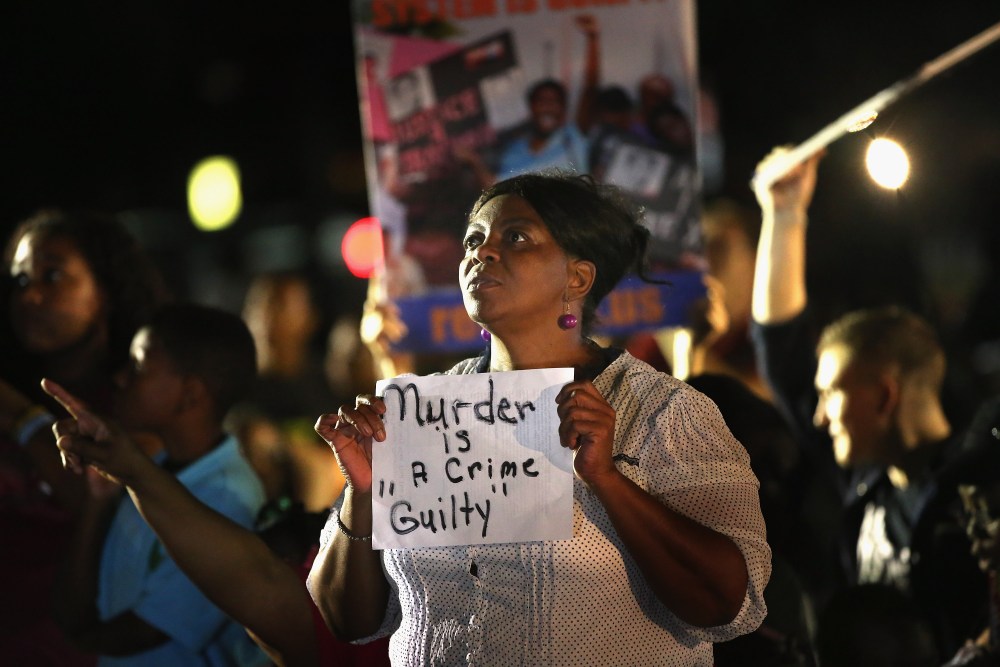
George Zimmerman followed the unarmed Trayvon Martin, ignored an emergency dispatcher’s warning not to follow him and shot the teen dead. Yet, Zimmerman walked free.
Many legal analysts, convinced that the prosecution did not have enough evidence to prove its case, had predicted the acquittal even before the trial began. Reasonable doubt, they said repeatedly. The state must persuade the jury beyond a reasonable doubt.
But reasonable doubt is an elastic standard, and it seems to work in favor of whites much more often than it does blacks. It is hard to imagine that a black “neighborhood watch volunteer” who pursued and killed a white kid under the same circumstances would have walked away a free man.
The prosecution was limited by shoddy police work in the crucial hours after Martin died, by a stand-your-ground law that invites violence and, critically, by the fact that Martin could not give his version of events. Zimmerman took care of that. But black men and women have been convicted with much less to work with.
Race and ‘Stand Your Ground’
There are many cases on record in which black defendants brought evidence showing they were elsewhere when the crime was committed, that they were physically unable to commit the strenuous assault they were accused of or that another person had confessed to the crime. Any doubt that evidence sowed, though, wasn’t reasonable enough to bring an acquittal.
Nowhere is that more true than with stand-your-ground laws, which are the gun lobby’s way of provoking legal mayhem. You can run a person to ground, provoke a confrontation, kill him and get away with murder. Especially if the person you kill is black.
Last year, the Tampa Bay Times did an exhaustive investigation of cases involving Florida’s controversial stand-your-ground law, which was passed in 2005. The newspaper examined nearly 200 cases.
The findings? “People who killed a black person walked free 73% of the time, while those who killed a white person went free 59% of the time,” the newspaper reported.
That conclusion mirrors others about the inequities still endemic in the criminal justice system. Decades ago, a landmark study of the death penalty in Georgia found that black defendants were 1.7 times more likely to receive the death penalty than white defendants and that murderers of white victims were 4.3 times more likely to be sentenced to death than those who killed blacks.
A biased criminal justice system
Those statistics simply confirm what many black Americans already know to be true: the criminal justice system is among the country’s last bastions of rank discrimination, a patchwork of institutions that rely on stereotypes as much as evidence, implicit assumptions as much as proof. Black men and women are more easily judged criminals, and black victims more easily viewed as disposable. Kareem Jordan, a criminologist at the University of Central Florida, told the Tampa Bay Times: “I don’t think judges or prosecutors or whoever works in the field of criminal justice is consciously saying black life is worth less than that of other ethnicities. But at the end of the day, it could be something that’s subconscious going on if you look at how the media depicts black life.” One of the more egregious cases in Florida involved 31-year-old Marissa Alexander, a black woman with a master’s degree and no criminal record. Separated from her husband, she had taken out a restraining order against him. When she went to the house she had shared with him to pick up personal belongings, he confronted her and threatened her. She fired a weapon — she called it a “warning shot” — but did not strike him. Even Gray admits he understood her fear: “If my kids wouldn’t have been there, I probably would have put my hand on her. Probably hit her.” Nevertheless, a Florida jury took 12 minutes to convict her of aggravated assault, for which she was sentenced to 20 years in prison. Though Zimmerman racially profiled and followed a young black man who was minding his own business, six white women believed that Zimmerman acted in self-defense — or, at least, that the prosecution didn’t prove its case beyond a reasonable doubt. That wouldn’t be as quite as painful if black defendants were given the same benefit of those doubts.
Cynthia Tucker Recommended


