








Tensions over President Barack Obama’s next course of executive action on immigration have reached a boiling point for many on the right, who fear – incorrectly – that the president will soon offer blanket amnesty for millions of undocumented immigrants.
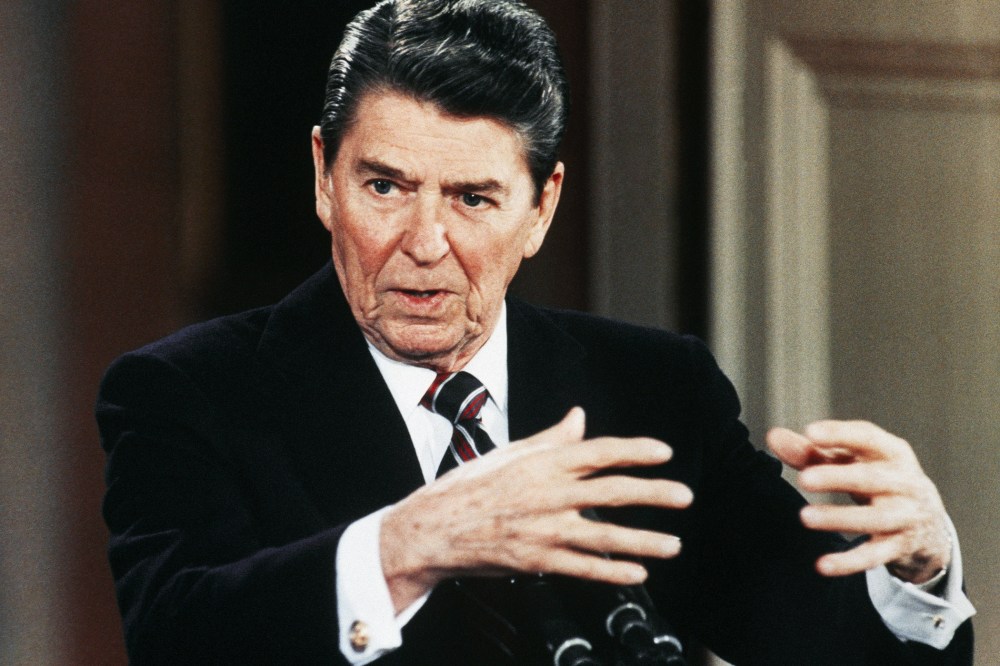
Some conservatives forget, however, that despite the anti-amnesty fervor on the right, the grandfather of amnesty happens to be one of the Republican Party’s most beloved heroes: President Ronald Reagan.
Much as many Republicans might like to forget it, the last major comprehensive immigration reform bill to make it through Congress was signed into law by then-President Reagan in 1986. The Immigration Reform and Control Act, Americans were told, was an immigration crackdown that simultaneously “preserves and enhances the nation’s heritage of legal immigration.”
The law lifted more than 2.7 million immigrants out of the shadows and into the U.S. workforce. For the first time, millions of undocumented immigrants could apply for a job, open a bank account, start building credit and even buy their own homes. Undocumented immigrants who had lived in the U.S. continuously before 1982 and were able to pay a $185 fee became eligible for a green card in an expedited process that in many cases took just months to complete.
The economic impact from granting amnesty to millions of people who were already living in the U.S. was “extremely positive, right off the bat,” said Raul Hinojosa-Ojeda, professor at the Cesar E. Chavez Department of Chicano Studies at UCLA. “It drove up wages because people were empowered to operate in the market with greater right.”
But not everything worked out as planned. Reagan’s initial intent was to tighten border security to stem the flow of immigrants coming in the future and to place sanctions on employers continuing to hire undocumented immigrants. Instead, the undocumented immigrant population in the U.S. exploded from 5 million in 1986 to more than 11 million today.
A rise in identity fraud became a major issue as fake documents and applications became a cornerstone of the undocumented labor market. The sanctions against employers did little to block illicit hiring. And poor foresight failed to anticipate future growth in migration across the border.
The 1986 amnesty law also led to lasting demographic shifts and voting changes that so far have tilted in Democrats’ favor. When the law was passed, only 3% of Americans who voted in presidential elections were Latino. In 2012, Latinos made up roughly 10% of the overall electorate and represented a much higher percentage in swing states like Colorado and Florida. Nationally, Obama carried the Latino vote by a whopping 71-29 percent over GOP rival Mitt Romney.
“Ronald Reagan’s signature on the 1986 amnesty act brought about Barack Obama’s election,” Iowa Republican Rep. Steve King said on the House floor last May. “If that’s the case, then how do people on my side of the aisle think that they can fix that problem if it was created by amnesty?”
King isn’t alone in suggesting Obama’s immigration policies have a purely political motive.
Obama already granted a special reprieve in 2012 to immigrants brought into the U.S. as children, oftentimes known as DREAMers, allowing them to find jobs and temporarily remain in the country without the threat of deportation. That executive action, timed in the midst of his re-election campaign, has sparked theories among conservatives that the president is again looking to increase the ranks of potential Democratic voters.
“The president supports the surges in illegal alien children and other illegal aliens coming to our country, again, because he sees this as the equivalent of a Democratic Party voter registration drive,” Alabama Republican Rep. Mo Brooks said this week.
Sarah Palin this week suggested that Obama should be impeached if he even hinted at amnesty through executive action. Sen. Jeff Sessions, an Alabama Republican, warned unilateral amnesty would be a “permanent stain” on the president’s second term.
But if anything, President Obama has done more to kick undocumented immigrants out of the U.S. than welcome them in. Those actions have angered immigration advocates and earned the president a reputation as the “deporter-in-chief,” with more than 2 million deportations under his watch. The U.S. passed the milestone just five years into Obama’s tenure, far outpacing the number of deportations during President George W. Bush’s two full terms. The White House is even pushing to roll back a 2008 human trafficking law in order to expedite deportation proceedings for the thousands of unaccompanied minors apprehended at the border. Meanwhile, House Majority Leader Eric Cantor’s stunning primary defeat in Virginia serves as a constant reminder of the occupational hazards of being linked — however tenuously — to the prospect of amnesty for immigrants. Cantor’s opponent – a virtually unknown economics professor – managed to launch a successful campaign warning that the top Republican’s sympathetic stance toward DREAMers could slide into amnesty for all. If today’s Republicans view Reagan’s 1986 law as marring the legacy of the right’s greatest hero, any attempt at passing a new immigration reform bill under a Democratic president is made that much harder. “Ronald Reagan passed immigration reform and you love Ronald Reagan,” President Obama chided Republicans during a rally in Texas last month. “Let’s go ahead and do it.” Obama is expected to make sweeping changes to his administration’s deportation policies in the face of growing resentment over legislative inaction on immigration reform. But the president is not asking for universal amnesty for all undocumented immigrants, and it is unlikely that he would be able to make any dent in providing a path to citizenship without congressional approval. If anything, the policy changes would grant work permits and enhance protections from deportations. The influx of unaccompanied minors at the southwestern border certainly doesn’t help the situation. Opposition among conservatives forced House Republicans to abandon a vote for emergency funding on Thursday, further exposing internal strife on immigration-related issues. While Congress grapples over the humanitarian crisis, a number of conservatives are tacitly accusing the president of intentionally setting the surge in motion. “[Obama] has been unable to work with Congress to get an immigration reform bill done and he’s feeling that he needs to do something,” said Mercedes Schlapp, a Republican strategist and former Spanish-language media spokeswoman for President George W. Bush. “When you’re looking at this abuse of power in the presidency,” Schlapp added, “I think that’s where this concern is stemming from.”
Amanda Sakuma Recommended


