








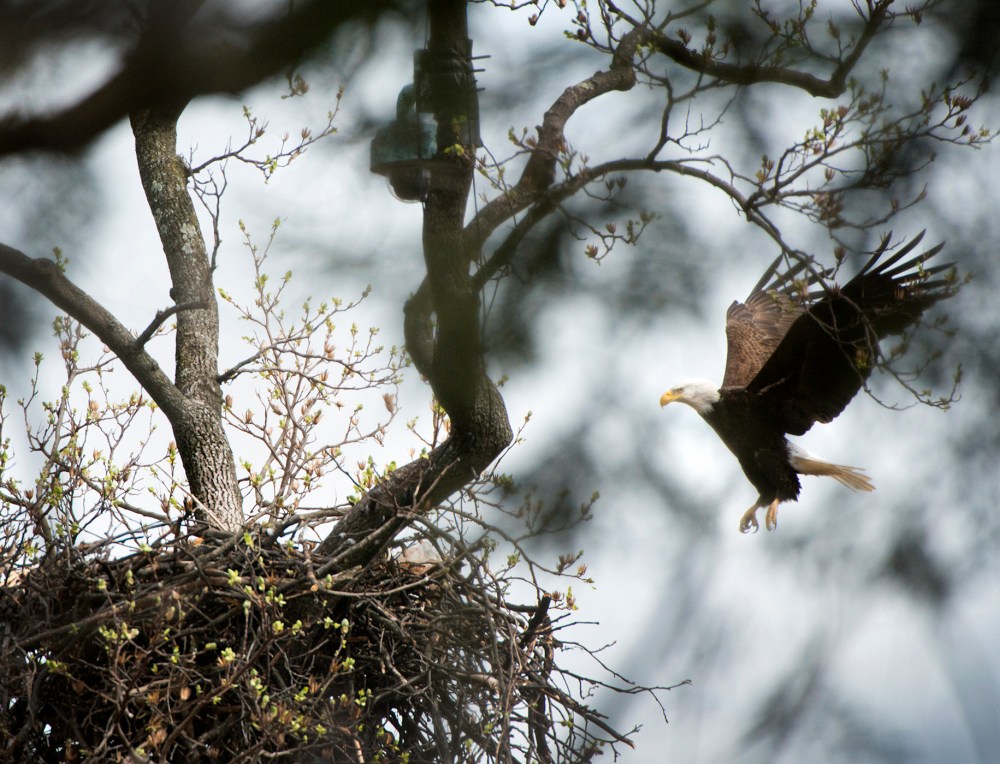
A single bald eagle found dead in southern Delaware last Saturday didn’t raise red flags for state wildlife officials.
But then a few hours later and a mile away, a startling scene unfolded: Eight bald eagles — distressed and disoriented — were discovered on the ground, barely moving on a fallow farm field.
“Seeing one in a field wouldn’t be irregular, but then so many of them — and they weren’t sitting up,” said Sgt. John McDerby of Delaware’s Fish and Wildlife Natural Resources Police. “It was a devastating sight.”
Three of the eagles died, two were rescued and the rest flew away, officials said. The following day, another dead bird was found during a sweep.
The cluster of deaths comes just a month after 13 bald eagles died about 35 miles away on the Eastern Shore of Maryland — the largest single die-off of bald eagles in the state in three decades.
This mystery surrounding the bird species that has soared back from the brink of extinction has investigators and wildlife advocates asking: Is someone poisoning or intentionally harming these national symbols?
At this point, investigators can’t say, but they aren’t ruling out a criminal act.
In Maryland, necropsies indicated the birds did not die from natural causes, meaning diseases such as avian influenza can be ruled out. But they did not pinpoint a cause of death.
Poison is a popular theory since landowners use it to kill rats, foxes and other nuisances that tear up crops. Eagles, in turn, can eat the poisoned carrion.
But Bob Edgell, who owns the Maryland farm where the eagles were found, told NBC News on Friday that he doesn’t use poison on his property and isn’t sure if anyone else in the area does.
“Our investigation is now focused on human causes,” Catherine Hibbard, a spokeswoman for the U.S. Fish & Wildlife Agency, said in an earlier statement.
Investigators hope to learn what killed 13 bald eagles in Federalsburg. Call 410-260-8888 with tips. pic.twitter.com/8U0vN36tLt
— MD NRP (@MDNRPolice) February 22, 2016
The two birds rescued by the nonprofit Tri-State Bird Rescue of Newark, Delaware, are still under the group’s care. Staff declined to provide information about their recovery because the investigation is ongoing, but said that if the creatures fully recuperate, they’ll be released into the wild.
Edgell said he’s not sure what took down the eagles on his land in Maryland. He found no evidence of tracks, after first thinking someone may have dumped the recognizable white-headed birds of prey on purpose.
He also saw no indications they had been shot or had other signs of trauma.
“I was dumbfounded, shocked and everything else,” Edgell said. “I had never seen that many at one time, especially on my property.”
Anyone convicted of causing the death of the federally protected bald eagle could be fined as much as $100,000 and sentenced to up to a year in prison.
Wildlife groups have banded together with the government to offer a reward for information leading to anyone who contributed to the birds’ deaths. The Virginia-based American Bird Conservancy added another $5,000 to the pot last week, boosting the total to $30,000. Mike Parr, vice president and chief conservation officer for the group, said he’s “completely baffled” as to what happened. “I can’t see any possible explanation of any sort why anyone would deliberately do something like that. It’s outrageous,” Parr said. Even into the 1970s, bald eagles were shot fairly regularly, said Kevin McGowan, an ornithologist at the Cornell University Lab of Ornithology. “The decrease in shooting was part of the reason the eagles have recovered so spectacularly (but just one part),” McGowan said in an email. “Populations are probably at a 100-year high. Growth of the eastern population over the last 20 years alone has been impressive.” Nationwide, the birds went from fewer than 500 breeding pairs in the Lower 48 in 1963 to over 11,000 pairs in 2007, when they were taken off the endangered species list, federal figures show. Now, bald eagles — beloved as a national symbol of the United States — are celebrated. A pair of babies born at the National Arboretum in Washington, D.C., took the Internet by storm this month thanks to a live cam. But the sudden loss of so many under strange circumstances should serve as a warning that the magnificent birds still need protection, experts say. “This is a significantly bad and unusual event,” McGowan said. This article originally appeared on NBCNews.com.
Erik Ortiz Recommended


