








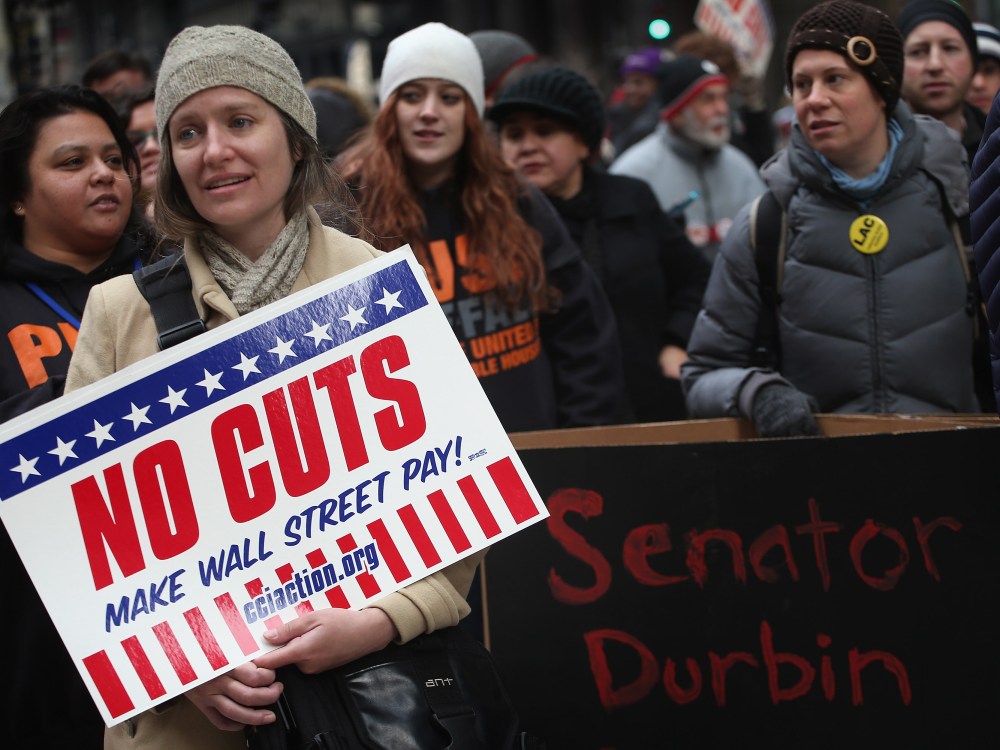
President Obama is said to be floating the idea of raising the eligibility age for Medicare—a potential concession to Republicans in negotiations over the fiscal cliff. And progressives are pushing back hard.
msnbc contributor Ezra Klein reported on his Washington Post blog Friday afternoon that the White House may agree to raise the age at which seniors qualify for Medicare from 65 to 67, as a cost-saving measure in a potential budget deal. Republicans are dead-set on cuts to Medicare, and key White House negotiators, Klein reported, reason that the shift would leave few people without healthcare, since the Affordable Care Act (ACA) now ensures almost everyone can get insurance.
But if the White House was floating a trial balloon, it didn’t take long for some key Obama backers to shoot it down.
On msnbc’s Up with Chris Hayes Sunday, Neera Tanden, president of the Center for American Progress, which has been a reliable administration supporter, called it “a very bad idea.”
“It’s actually going to increase the cost for everybody,” Tanden explained. “It will raise national health expenditures and will cut off hundreds of thousands of seniors.”
New York Times columnist Paul Krugman was even blunter. “If Obama really does make this deal, there will be hell to pay,” he wrote on his blog.
And even Dick Durbin, the number two Democrat in the Senate and a close Obama ally, said on NBC’s Meet the Press Sunday he’s wary of raising the idea. “When you talk about raising the Medicare eligibility age, there’s one key question: What happens to that early retiree? What about that gap in coverage between their workplace and Medicare? How will they be covered?”
That gap in coverage is the crux of the issue, experts say. First, as Krugman noted, the ACA itself is hardly on sure footing, despite Obama’s re-election. The state exchanges aren’t up and running yet, and some Republican-led states appear to have little interest in making them function effectively. Congressional GOPers are looking for ways to chip away at the law, while some conservatives explore new avenues for legal challenges.
But even if the ACA does survive largely intact, kicking 65- and 66-year-olds off Medicare is hardly painless. Many seniors would buy insurance through the new exchanges created by the ACA. But adding millions of older people to the exchanges could mean higher premiums for participating insurance plans, raising costs for everyone.
“We can’t really predict what the participation of perhaps millions of people at the top of the age-range—many with age-related health difficulties—will do to the everyday operation and average premiums charged within the new exchanges,” Harold Pollack, a health policy expert at the University of Chicago, told msnbc.com.
The poorest people under 67 might still qualify for Medicaid. But nine states have so far refused to participate in the ACA’s expansion of Medicaid coverage, and many more haven’t yet said whether they plan to do so. So in states that reject the expansion, younger seniors making just above poverty wages would get neither Medicaid nor Medicare. And of course, buying insurance on the open market is too expensive for most seniors—which is why Medicare was created in the first place. The other group getting stuck with the bill for the shift would be employers. That’s because many 65- and 66-year-olds would likely be afraid of retiring and losing the insurance they receive through their job. That would leave employers stuck with higher premiums for their employees’ health insurance, because their employees would now be an older and more expensive risk pool. Those costs may then be passed on to employees, in the form of lower salaries or higher contributions to their health-insurance premiums. It could even put a dent in hiring. And, however we choose to shift the costs, those costs would increase. Because private health insurance plans are less cost-efficient than Medicare, insuring 65- and 66-year-olds would cost twice as much to society if they’re not on Medicare, according to a Kaiser Family Foundation study. If the idea were in effect in 2014, the study found, it would generate $5.7 billion in net federal savings but $11.4 billion in higher health-care costs to individuals, employers, and states. According to Len Nichols, director of the Center for Health Policy Research and Ethics at George Mason University, the idea epitomizes the problems inherent in having policies made solely by wealthy elites who work in sedentary jobs. “Raising the age of eligibility, the legal retirement age, sounds like a good idea if what you do for a living is talk and write, mostly while sitting in comfortable chairs in climate-controlled buildings,” Nichols observed. “But if what you do for a living is pick up and move heavy things, or spend eight to ten hours a day on your feet without interruption bringing food and clearing tables, or waiting on retail customers, or doing one physical thing over and over on an assembly line, then being required to do that for two or five or 10 more years before you can join Medicare is fairly cruel.” President Obama ran in 2008 on a pledge to expand health care, and he succeeded in doing so. It would be ironic, to say the least, if his first major act upon winning re-election was to contract it.
Ben Adler
Ben Adler is a journalist covering climate change, politics, policy and cities. He has written for The New York Times, The Washington Post, Politico, Yahoo News, Grist, and The Nation, among others. Recommended


