








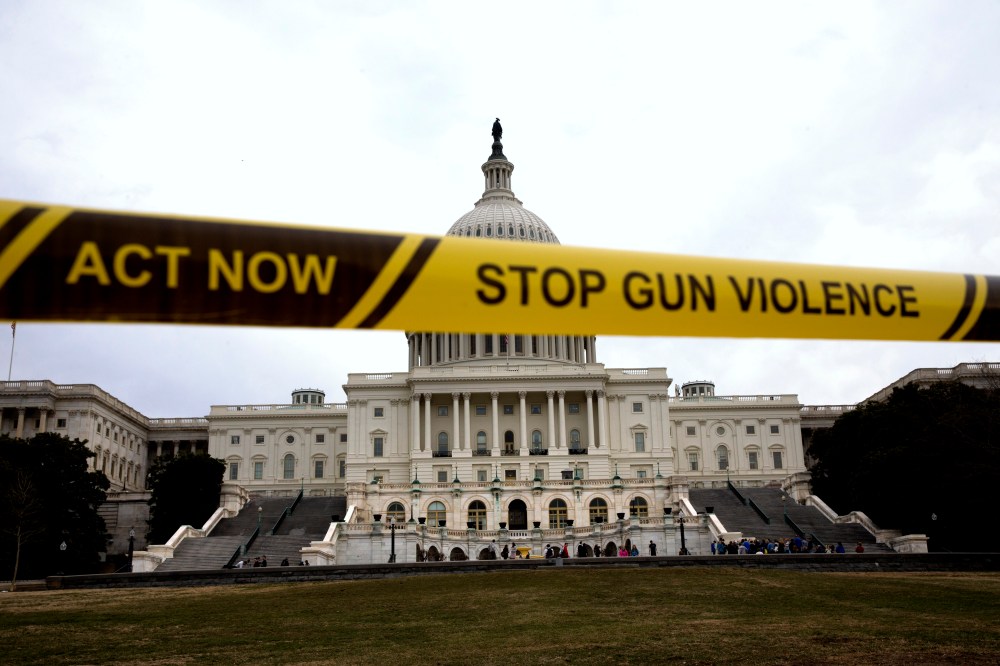
Washington, D.C. is pleading with a federal judge not to allow angry people to tote guns around the nation’s capital before the 2014 midterm elections.
That may sound like the opening of a story from The Onion, but it is not.
Seven years ago, the Supreme Court decided, in District of Columbia v. Heller, to strike down the city’s handgun ban, thereby establishing a Second Amendment right to possess a gun. The Supreme Court had previously followed the actual language of the Constitution, which established a right to bear arms only in the context of a “well-regulated militia.”
%22Of%20the%20four%20presidential%20assassinations%20in%20U.S.%20history%2C%20two%20%E2%80%93%20Lincoln%20and%20Garfield%20%E2%80%93%20took%20place%20in%20Washington%2C%20as%20did%20the%20most%20recent%20near-miss%2C%20John%20Hinckley%E2%80%99s%201981%20attack%20on%20Ronald%20Reagan.%20This%20isn%E2%80%99t%20rocket%20science.%22′
The lead plaintiff in the case, Dick Heller, was a security guard and gun-rights activist who was peeved that the District government wouldn’t let him take his handgun home. “I want to be able to defend myself and my wife from violent criminals,” Heller told The Guardian before the Supreme Court ruling, “and the Constitution says I have a right to do that by keeping a gun in my home.” The Supreme Court agreed in a 5-4 ruling.
The courts dealt another blow to D.C.’s gun ban this summer in the case of Palmer v. District of Columbia, which included the Second Amendment Foundation — a legal arm of the gun rights lobby — as a plaintiff. On July 24, U.S. District Court Judge Frederick J. Scullin ruled that the city’s “complete ban on the carrying of handguns in public is unconstitutional.”
The lead plaintiff in the case, Tom Palmer, is a senior fellow at the Cato Institute, a libertarian think tank in Washington, D.C. Palmer, who is gay, told The Washington Post that 32 years ago he used a pistol to scare off “19 or 20 men” who had threatened to kill him. The incident took place in California, where it was then legal to “open carry” a gun in public, but only if it wasn’t loaded. In 2011, California made it illegal to open carry a gun in public whether it was loaded or not.
We can all be grateful that Palmer, one-third of a century ago, fended off a vicious attack by people who were either unfamiliar with California’s gun statutes or uncertain Palmer obeyed them. But the gun owner of 1982 bears little resemblance to the gun owner of 2014 (much less the gun owner of 1787, when the Second Amendment was written). In 1982, nearly half of all U.S. households owned guns; today, fewer than one-third do. The percentage of gun-owning households has dwindled even in the south and the west, Michael Waldman reported in his recent book, “The Second Amendment: A Biography.” That’s probably because there’s a lot less hunting going on.
Yet the number of guns concentrated in the U.S. remains high. According to one estimate, the U.S. accounts for more than a third of all the guns in the world. “Fewer people,” Waldman writes, “own more guns.” The gun lobby’s shift over the past three decades toward extremism is no mystery. It reflects the reality that gun ownership, at the national level, has stopped being part of the American mainstream.
The suddenness of Judge Scullin’s ruling was so obviously disruptive to the D.C. police that he granted a 90-day stay, until Oct. 22. Now the District is frantically pleading for Scullin to grant a second stay pending appeal or, failing that, 90 days more. Scullin, incidentally, lives nearly 400 miles north of D.C., in Syracuse; he got assigned the case to relieve a backlog of cases. In its motion, the District of Columbia* points out that Washington, D.C. is “home to the White House, the U.S. Capitol, dozens of federal agencies, and hundreds of international diplomats and has, over the years, experienced attempted as well as successful assassinations of presidents and other officials of national importance using firearms.” Indeed, of the four presidential assassinations in U.S. history, two — Lincoln and Garfield — took place in Washington, as did the most recent near-miss, John Hinckley’s 1981 attack on Ronald Reagan. This isn’t rocket science. The District of Columbia’s motion makes no actual mention of the midterm elections, but inviting gun-toters into D.C. before Nov. 4 seems especially rash. In truth, though, it will never be a good time to allow guns legal passage through the streets of Washington. Too many people have very bad reasons for wanting to bring a gun into the nation’s capital. In pressing this case, Second Amendment extremists have reached a new low. Correction: Due to an editing error, a previous version of this story misidentified the issuer of the motion. It is the District of Columbia, not the D.C. District Court.
Timothy Noah Recommended


