








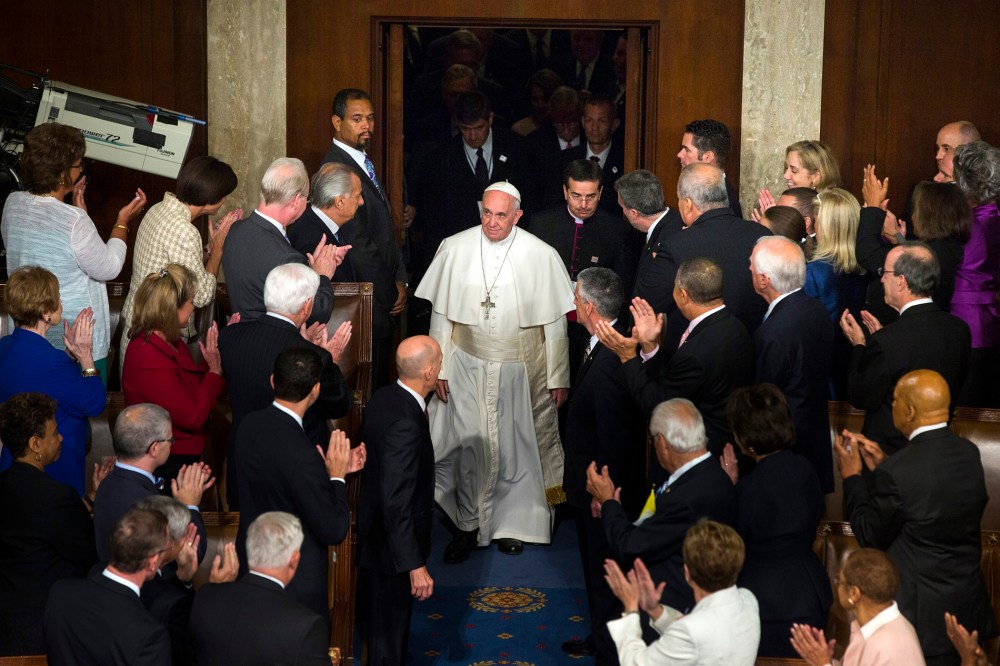
Welcomed with three standing ovations and steady tears from the Speaker of the House, Pope Francis confronted the climate change skeptics in Congress on Thursday with his own call for global action. But his remarks were more measured and deferential than they have been in recent months, disappointing environmentalists who hoped for a chamber-shaking, moral plea.
The pope’s remarks on climate change were also briefer than expected, comprising a single cordial and carefully-worded passage near the end of a 3,500 word speech. He invoked “Laudato Si,” his recent papal letter on the environment, but quoted some of the meekest sections from that unusually forceful document. And his speech did not even include the words “climate change.”
“I call for a courageous and responsible effort to ‘redirect our steps,’ and to avert the most serious effects of the environmental deterioration caused by human activity. I am convinced that we can make a difference — I’m sure,” Francis said.
The room interrupted him with applause.
“And I have no doubt that the United States – and this Congress – have an important role to play. Now is the time for courageous actions and strategies, aimed at implementing a culture of care and an integrated approach to combating poverty, restoring dignity to the excluded, and at the same time protecting nature.”
Another round of applause.
“’We have the freedom needed to limit and direct technology,” he continued, “to devise intelligent ways of developing and limiting our power, and to put technology at the service of another type of progress, one which is healthier, more human, more social, more integral,” he concluded.
There is a powerful subtext to this message: a call for the United States to address climate change, wed it with social justice, and reinvent capitalism along the way. But in both his encyclical and recent remarks in South America, this subtext was out front, and expressed with exceptional force.
RELATED: Even Pope Francis can’t convince Congress to act on climate change
In his earlier writing and speeches, he warned “every living person on this planet” about the reckless pursuit of infinite growth and boundless, buyable pleasures. He diagnosed it as “the deification of the market,” arguing that if we hope to flourish, we need “a bold cultural revolution” in the way we live and work.
“Doomsday predictions can no longer be met with irony or disdain,” Francis wrote in his encyclical. “We may well be leaving to coming generations debris, desolation and filth. The pace of consumption, waste and environment change has so stretched the planet’s capacity that our contemporary lifestyle, unsustainable that it is, can only precipitate disaster.”
He also chastised those who deny reality or play politics, indirectly shaming the same members of Congress he addressed so gently on Thursday. In his earlier comments, he specifically hammered business-people and elected officials for “masking the problems or concealing their symptoms,” often for personal gain. “This is the way human beings contrive to feed their self-destructive vices: trying not to see them, trying not to acknowledge them, delaying the important decisions and pretending nothing will happen,” he wrote. He even threw a punch at the oft-cited Republican idea that innovation, not regulation, is the best response to climate change. “We seem to think that we can substitute an irreplaceable and irretrievable beauty with some which we have created ourselves,” the pope countered. This thinking is “based on the lie that there is an infinite supply of the earth’s goods, and this leads to the planet being squeezed dry beyond every limit.” In his earlier remarks, Francis closed by calling for “one world with a common plan,” and he suggesting some elements to get us started on it ahead of crucial climate change talks in Paris this coming December. For the believers, he even added one final idea, “a prayer for our earth.” But if none of this passion was evident on Thursday, it’s possible that Francis may still regain his voice. He is scheduled to address the United Nations on Friday, where, once again, the world will be watching.
Tony Dokoupil Recommended


