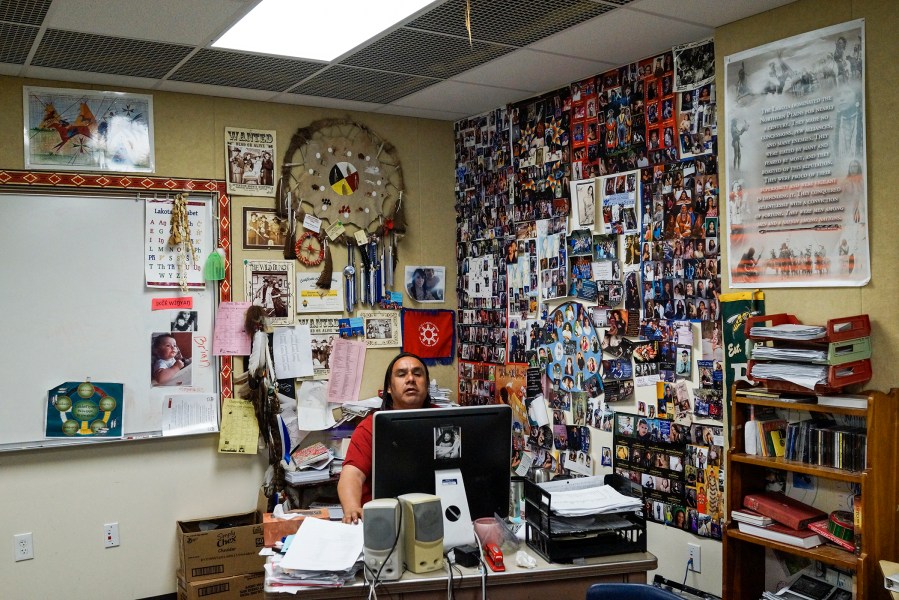
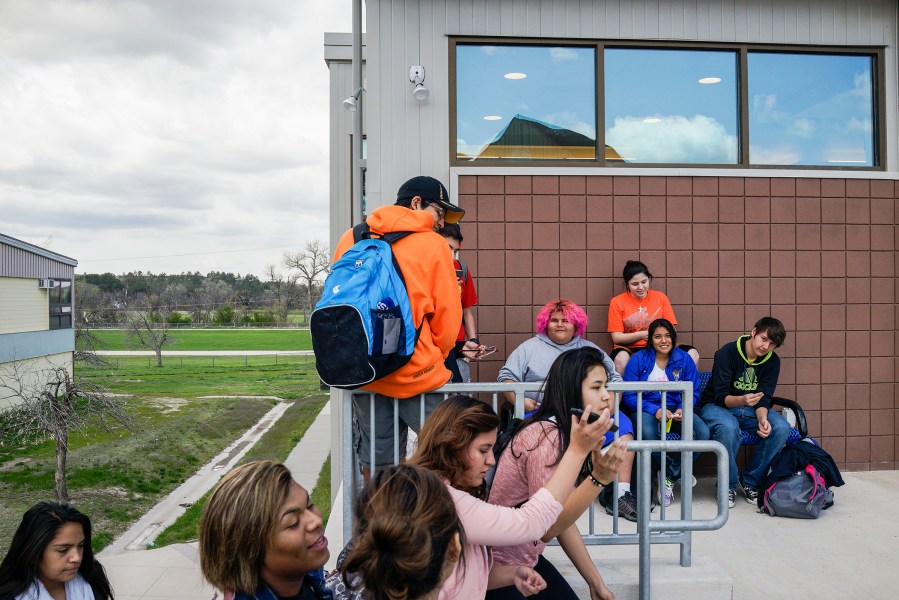
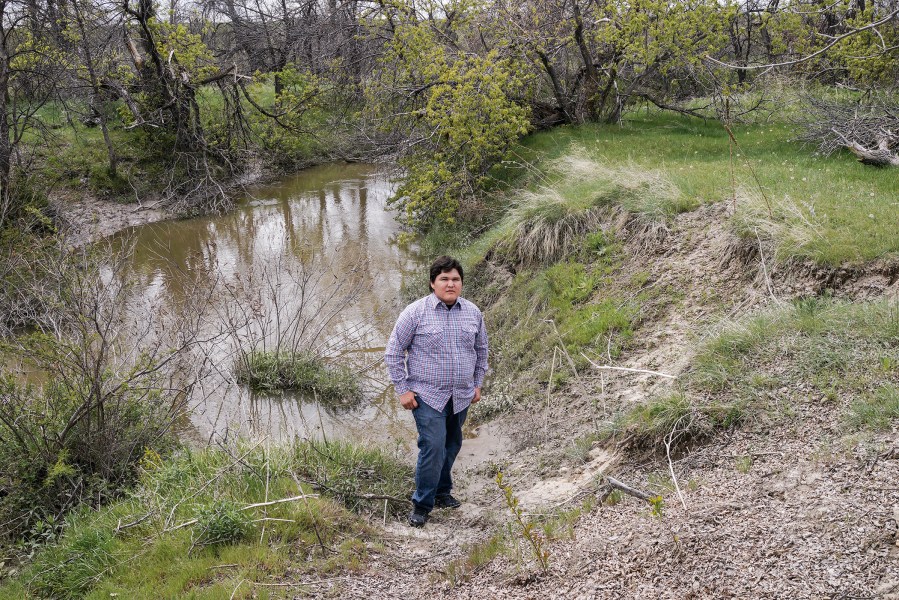
Manderson, South Dakota — The big open sky over the Pine Ridge Indian Reservation swelled angrily, breaking into a million tiny shards of ice. The main road through town grew whiter and lonelier. And all Principal Alice Phelps could muster as she looked out onto the Olympic-sized slush pool forming in her school’s parking lot was a sigh of resignation: another day, another obstacle to overcome.
It was two hours after the morning bell and less than half of Phelps’ students had made it to school. The freak April sleet storm had left many of them stranded down muddied dirt tracks, some as far as two miles off the main road. Most of her students’ families don’t have cars or cars in good condition. And the school’s small fleet of travel-worn school buses was down to three, none of which would’ve survived the trek across what is inhospitable terrain on a good day.
The next day would be a loss as well, as a half-day was scheduled to honor a tribal elder who had recently passed away. With no community center on the reservation, school buildings are often the only communal spaces for celebrations, meetings and mourning.
“There are no community centers. But there’s alcohol, there’s drugs, there’s gang-banging. There’s up to no good. There’s making kids,” said Phelps, principal of the Wounded Knee School, a K-8 on the reservation. “So that’s why we try to instill hope and try to instill possibilities. Maybe some of it’s circumstantial, but then again, you don’t have to drink. You don’t have to do drugs. You don’t have to neglect your family.”
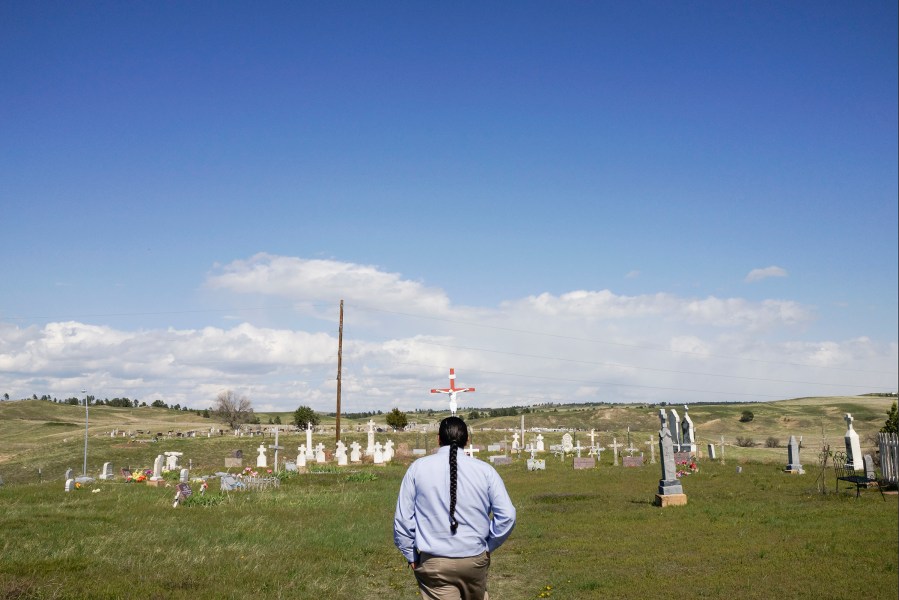
The Pine Ridge Indian Reservation has become emblematic of rural poverty, neglect and the plight of struggling American Indians. But across the reservation, there are glimmers of hope and resistance against the monumental challenges the Lakota people face.
In the case of Phelps and the Wounded Knee School, it means raising expectations and squeezing the most out of meager resources. For others it’s the simple yet provocative notion of going off to college and one day returning to the reservation to work. Or it’s a scrappy community-based group re-imagining the reservation’s infrastructure, with dreams of creating jobs and high-quality housing for residents. Others are planning an all-girls school or pushing for state charter school legislation that would give community folks the opportunity to run their own schools infused with tribal language and culture.
“Our challenges, as much as they are challenges, are absolutely opportunities,” said Nick Tilsen, 31, founder of Thunder Valley Community Development Corporation, a non-profit youth and housing group. “Throughout history so much has been taken away from our communities and our people. I think that the generation that’s alive now, the younger generation, 40 and younger, is a generation that is growing to be way more connected to culture, to identity. And recognize that as a value.”
‘I Didn’t Ask Permission from Nobody’
Nearly 40% of the population of Shannon County, which lies entirely within the Pine Ridge boundaries, is under the age of 18. That’s compared to just about 25% for the rest of the state. Well over half of the reservation’s population is under 30. While the large population of young people speaks to a staggering need for resources and jobs, it also offers the rare opportunity to tap into the unharnessed youthful energy and ambition.
At Thunder Valley, Tilsen and his group offer culture-based youth and job training programs, and have proposed a bold plan to build dozens of houses using the reservation’s untapped teen and young adult labor force. Tilsen is an outspoken community leader, wise beyond his years, whose work has made ripples locally but also caught the notice of the White House.
During a recent Tribal Nations Conference, President Barack Obama implored Congress to expand support for Native American small businesses and job creation. Obama said he’s been encouraged by the work of Tilsen and Thunder Valley.
“See, that makes me hopeful, talking to young people like that, because throughout Indian Country, you’ve got a generation ready to build on what generations before them have built,” Obama said. “They’re out there right now, stirring with hope, and restless for change, and ready to take ownership of their future.”
Thunder Valley was established in 2007 after Tilsen and a group of friends emerged from a traditional Lakota sweat lodge, in which he said the spirit of tribal ancestors spoke to them through a young Iyeska Wakan, or sacred interpreter.
It was a challenge:
“How long are you going to let other people decide the future for your children?”
“Are you not warriors?”
“They said, ‘stop talking, and start doing. Don’t come from a place of fear. Come from a place of hope,’” Tilsen recalled. “They said a long time ago, when we rode into battles, we didn’t know what the outcome of that battle was going to be, but we knew that riding into that battle was the only option.”
Thunder Valley is the ancient name for the valley near the heart of the reservation, until recently only used by elders and old ranchers. Tilsen’s organization adopted the name in homage to the hallowed ground for which they plan on birthing a new future for the tribe.
On a recent afternoon at the group’s headquarters in Kyle, Tilsen pointed up to a large master plan propped up on a wall. He called it “the vision.”
The rendering showed mixed income housing, a community “empowerment center,” a skateboard park and retail spaces etched with dark pencil. The proposed space sits on 34 acres of land the organization purchased and would include 31 single family housing units. Tilsen said the vision would cost between $8-$10 million, and the group currently has access to about $3 million for phase one of the project.
The development would be a hub for a reservation lacking even the most basic infrastructure, food markets or other businesses.
In a part of the country where the per-capita income is only about $6,000 a year, the kind of money raised by Thunder Valley is a testament to the group’s commitment to reshaping life on the reservation. But it also took the courage to buck a culture that embraces humility to a fault and the status quo of old-school politics and ring-kissing.
Tilsen said some people in the community questioned whether or not the group’s ambitions would syphon resources from the tribal government or pit them as competitors for similar grants and funding.
“Some people actually said to me, ‘Nick, who told you that you guys could do that over there? Who gave you the right? he said. “Not only do we have the right, we have the responsibility. This is our community here. I didn’t ask permission from nobody.”
‘You’re Either in or You’re Out’
When Alice Phelps took over as the principal of the Wounded Knee School in September, the place was physically and emotionally beaten down.
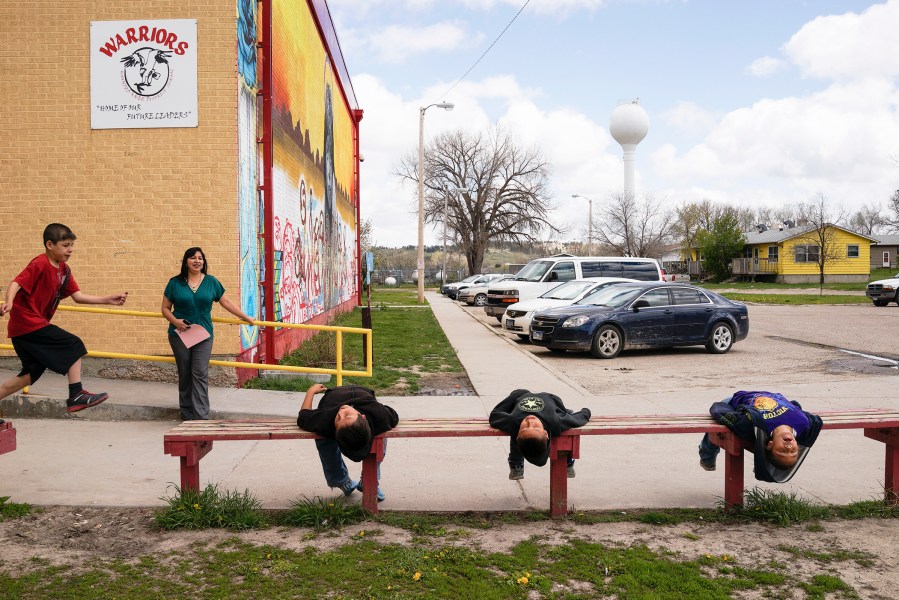
There was trash strewn across the campus and overflowing in the restrooms. Only about seven of 25 computers in the school’s lone computer lab actually worked. Each day about 45 students were cycling through the front office for disciplinary issues. With no counselor on staff, Phelps scraped-up funding to bring on someone part-time. With only one laundromat on the reservation, many of her students come to school embarrassed by their dirty clothes.
“You’d walk through and say, these kids don’t have to live like that,” Phelps said. “The time for excuses is over.”
Phelps and her team went to a school supply auction and for about $3,000 purchased some gently used desks, chairs and lunchroom equipment. The IT team reassembled dozens of non-working computers and created a second computer room.
Phelps also shook up the staff. A few weeks ago she called a meeting at which she informed every teacher that they wouldn’t have a job come the summer. They could reapply if they wanted, but the message was clear: it’s a new day.
“If you’re not here with your heart, then you’re just wasting your time here. You’re either in or you’re out, you’re not half way,” she told the school’s 10-person teaching staff during the meeting. “This is the way we’re going to approach education, and this is the way we’re going to approach our children. And if you’re not in with it then you know what? You’ll weed yourself out and you won’t be here.”
Phelps lobbied the school board to allow a pay bump to entice new teachers. And there are plans to refurbish the five teacher housing units located on the school’s campus. Since the beginning of the year she has applied for millions of dollars in federal turnaround funds and other grants aimed at chronically failing or impoverished schools.
But the most radical change the school has undergone was bringing in Phelps in the first place. She is technically an employee of the American Indian Institute for Innovation, a local education consulting group run that has been helping schools and students improve for more than 20 years. But this is the first time a school board has allowed an outside group to essentially take the reins of a school administration. A team of employees from the group joined Phelps in the school’s front office.
“This school was doing the best it could with the resources it had and the plan it was going off of, but we’re looking at things in a dramatically different way,” said Stacy Phelps, the CEO of the American Indian Institute for Innovation and Principal Phelps’s brother-in-law.
There was also a shocking lack of data on academic performance, teacher evaluations and little in the way of the brass tacks of accounting and overall mission. By using data driven assessments Phelps and her team realized that they were losing about 90 minutes a day in classroom instruction due to lax classroom management. Teachers now are sternly warned when they veer off schedule. The school is also in the planning stages of building a parent work space on the campus equipped with washers and dryers.
“A lot of them feel like their future is hopeless,” Phelps said. “A lot of people say well that’s up to outside, that’s up to the families to handle that aspect. But when you walk in the doors to our school, it’s going to be our responsibility. Our responsibility to do whatever it takes for this child.” ‘They Need My Help’ About 30 miles from the Wounded Knee School is the private Red Cloud Indian School, home to some of the reservations best and brightest students. Students must test-in to Red Cloud and its student body consists mostly of kids from families whose parents are among the 20% on the reservation who are employed. While the vast majority of the 24 schools on the reservation are chronically failing and struggle to get their students to meet state proficiency requirements, students at Red Cloud typically score high on state tests, graduate and go off to college. It also has the distinction of having produced more Gates Millennium Scholars than any other school its size in the country. Just last month, five Red Cloud students earned the illustrious scholarship. “We are the only private school on the reservation and part of that model is we don’t have politics that enter into the governance of this school. That’s one big, huge thing,” said Robert Brave Heart, senior executive vice president of Red Cloud. “We can have higher standards and requirements and we can also teach spiritual formation classes. Which we think are important, it helps build character in students, which is an important thing that secular schools are not able to offer.” Red Cloud is a Catholic school and its foundations are rooted in Christianity but it also blends in traditional Lakota spirituality. The Lakota don’t have a set religion but instead worship guiding spirits including, Wakan Tanka, The Great Spirit and highest of all. The Lakota believe these spirits and the spirits of their ancestors are often channeled through sacred interpreters or medicine men. Through more than a century of subjugation and forced assimilation, many of the traditional Lakota spiritual and cultural practices have been lost or abandoned. School leaders, community groups and many families believe returning to the roots of Lakota beliefs is critical to reground young Indians. “People have this apprehension that they have to sacrifice their child’s American academic proficiency if they allow their child to be reared in Lakota or Indian language and sort of the metaphysical or systemalogical teachings about the real universe, not this presidents and state capital stuff,” said Chase Iron Eyes, a Lakota attorney and activist. “I want proficiency in both.” First-year teacher Maka Clifford, 26, attended elementary school at Wounded Knee and then high school at Red Cloud. He now teaches a Native American history course at Red Cloud. After undergraduate study in San Francisco and then graduate school in New York, he said he was spurred to return to the reservation after attending an indigenous people’s conference in Japan back in 2008. “This is something that I need to bring to my own community, this sense of international brotherhood,” he thought. Colton Sierra, 18, a soon-to-graduate senior at the school, is eager to pick up where so many before him have left off. “This place, it just seems like they need me, they need my help,” said Sierra, who just weeks ago found out that he was awarded a Gates scholarship which will pay for his entire college education. “Some of my relatives are living really poor, really hurt and they can’t do anything about it because their too trapped. If I can’t help them I need to help the children.” Sierra said he plans on attending the University of South Dakota and majoring in business administration or journalism. His road toward a high school diploma wasn’t easy. For a couple years he fell into the all too common reservation pastime of drinking. The bad habit was at its worst his freshman year in high school when a string of tragedies struck: two close friends committed suicide. “I always remind myself of how my ancestors survived and how they persevered through all the dark, too,” Sierra said. “So what I tell my friends is look at how poor our people are, look how poor our whole land is. And are you going to make it worse or make it better.” ‘No Excuses’ Back at Wounded Knee, Principal Phelps takes any little victory she can. Fewer students being sent to her office — win. A clean pair of school clothes — win. A smile on a normally sullen face — win. “In these communities that we’re talking about, we know that the bar is set in place so any little win is a win because these kids don’t have a good sense of self because they are so poor,” Phelps said. But poor is as much a state-of-mind as it is a state-of-pocket, Phelps said. She grew up poor in New Mexico mostly, but after her parents divorced she moved to the reservation where her Lakota mother grew up and where she spent many summers. “We cleaned our house. We didn’t have it dirty. We were poor, and we didn’t have much but we had love and we had a clean house. We had Clorox and dish soap so we kept it clean, and we had rules,” she said. “My students, I tell them no excuses.” If that guidance is two parts tough love, it’s compassion and empathy in greater measure. “They come with so many issues. Maybe they’re tired because they didn’t sleep that night, maybe there was a party going on or they were protecting their siblings. They come in tired and moody, so we have to really understand where they’re coming from,” Phelps said. “But I tell them, if you’re tired, okay, you’re going to take a time out. You come down here and you can put your head down for a little while. “But when you get up, you be ready to work, you be ready to focus, and we’ll take care of the other aspects.” Editor’s note: This is the third of three stories on Pine Ridge, exploring the education, social and economic issues facing Native Americans on the reservation.
Trymaine Lee
Trymaine Lee is an NBC News correspondent. Recommended