








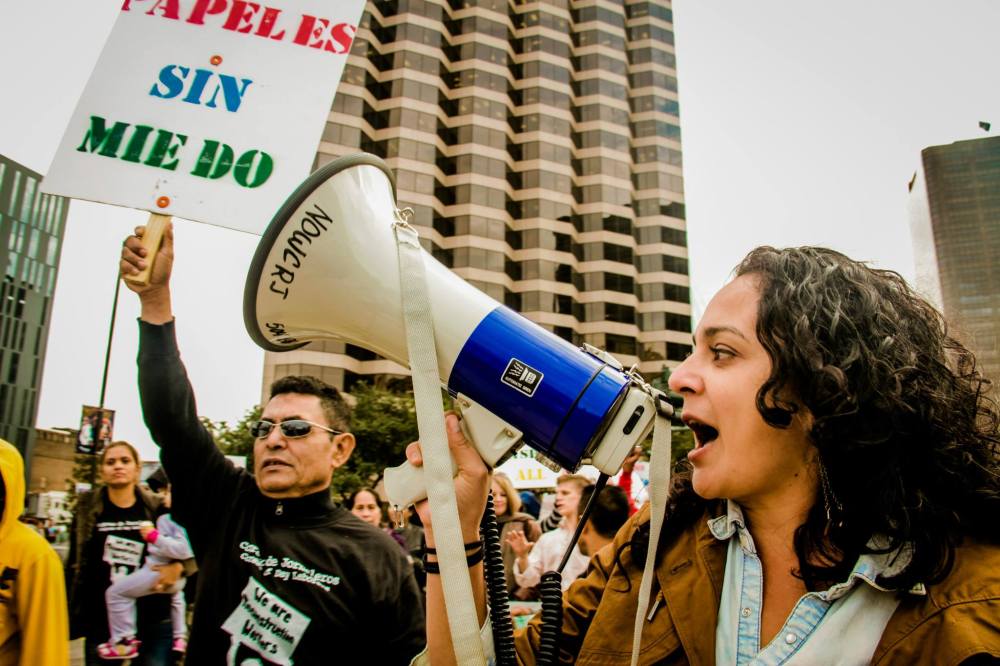
Sept. 15 marked the start of National Hispanic Heritage Month — or, as it is known in Spanish, Mes de la Herencia Hispana — a time when the United States pays tribute to the history, culture and contributions of past and present Hispanic Americans.
According to the 2010 Census, 50.5 million Americans identify as Hispanic — and that number is growing. Immigration has long been a part of America’s national history, and the role that immigrants have played — and still play — in building this country is one of the reasons “the American dream” is still shared around the world today. America is a place where new beginnings and new lives are possible.
Over the next month, msnbc.com will be profiling outstanding Hispanic activists who are making a difference in the fight for immigration reform and who are providing critical support services to undocumented communities.
%22In%20the%20political%20realm%2C%20undocumented%20people%20have%20risked%20a%20great%20deal%20to%20stop%20deportations%20…%20that%27s%20not%20fearful%2C%20that%27s%20courageous%2C%20and%20I%20think%20some%20elected%20officials%20should%20take%20note%20and%20match%20that%20courage.%22′
Name: Marisa Franco
City/State: Phoenix, Arizona
Occupation/Organization: Lead organizer of the #Not1More Deportation Campaign at the National Day Laborer Organizing Network
How did you get involved with immigration advocacy?
I’d lived outside of Arizona, organizing in different parts of the country on issues ranging from labor, economic justice and gentrification, but always kept an eye on Arizona. In 2010, when Gov. Jan Brewer signed SB1070 into law, and the community burst into action, there was a call for people to support, and I was very ready to answer. Since then, I’ve continued focusing on the issue. I firmly believe that places like Arizona will determine the direction of immigration policy in the country and that to win we’ve got to build a strong movement that’s willing to innovate.
Give us a sense of what your day looks like:
My routine is perhaps not having one. Everyday is a little different, depending on if we’re building up to an event, in action mode, or debriefing. In general, a day could involve a combination of conversations developing plans or updating people, driving calls to stop a deportation, strategizing on how to pass local legislation that separates police from immigration enforcement, or preparing for upcoming actions. Lots of meetings, diagrams on butcher paper, and airplanes. Because I don’t live and focus exclusively on Washington D.C., “national” for me just means a whole lot of “local” put together.
What is the biggest misconception about immigration reform/undocumented immigrants?
One of the greatest misconceptions about undocumented people is their portrayal as fearful, passive, or viewed as victims. I wouldn’t call someone who has left all they know, arrives in a completely foreign place and survives, passive. In the political realm, undocumented people have risked a great deal to stop deportations, often times risking their own deportation or risking their livelihood and housing. That’s not fearful, that’s courageous, and I think some elected officials should take note and match that courage.
What is your expectation of President Obama and Congress in regard to the border crisis? Compassion, dignity and afford people the due process they deserve. It’s an opportunity for the issue of immigration to be viewed and acted upon not solely as a domestic issue, but a global one that looks at the causes of migration and impact of U.S. foreign and economic policy. Not only for President Obama and Congress, but for all of us. What type of help is most needed on the ground and how can one get involved? Overall, we also need more space for people directly affected to speak their truth and participate. Often times in immigration advocacy, the value of citizenship is exalted, yet that doesn’t always translate to the creation of space for self-representation and increased forms of participation in particular of the most marginalized voices. If we can improve this, it can both lead to not only victories in winning policy change, but also culture, civic participation and make citizenship actually benefit all regardless of race, gender, sexual orientation, abilities, language, etc. Was there ever an instance when you felt defeated? What made you keep going? Change doesn’t happen overnight. And wins are not always easy to come by if seeking to change something where entrenched interests want to keep the status quo intact. So having a sense of the long haul keeps me going. I try not to have false expectations, while at the same time not allowing that to extinguish my willingness to dream big. Concretely, it means keeping close to community and our shared purpose while having a clear understanding of what we’re up against. When that doesn’t work, I just think of the line from my favorite ‘Chante (Vicente Fernandez) song: No Me Se Rajar! Stay in touch with Marisa on Twitter @marisa_franco.
Traci Lee
Alicia Maule Recommended


