








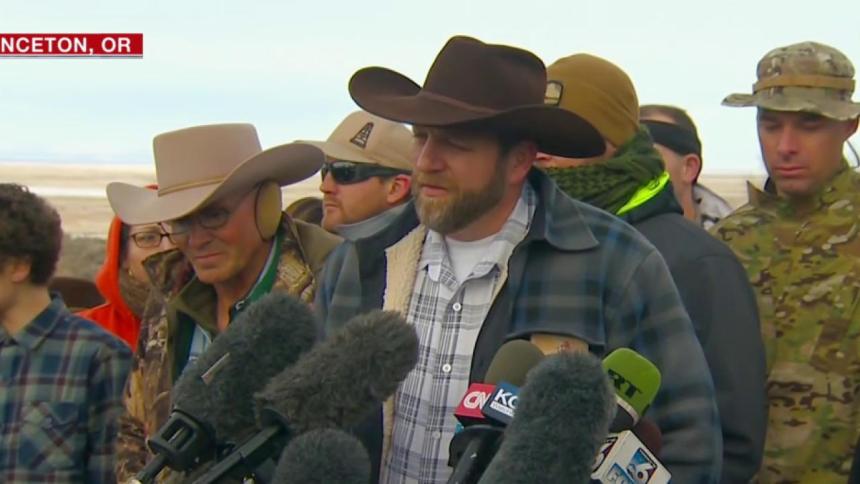
Armed anti-government protesters are dug in for a long stay on the federal land they seized in Oregon on Saturday. The group pledges to remain encamped in a federal building on the Malheur National Wildlife Refuge for as long as it takes for the government to give the land “back to the people.”
But this tense, unpredictable stand-off is about much more than a patch of sagebrush and bird habitat. It’s about federal control over some 300 million resource-rich acres across 13 Western states, and President Obama’s executive efforts to protect a record swath of this land from development.
It’s also a matter of momentum, following the surprise success of a 2014 stand-off in Nevada. In that confrontation, federal agents stood down rather than act on a court order to seize the cattle of rancher Cliven Bundy, who hasn’t paid his federal grazing fees since 1993.
Bundy owes more than $1 million, according to the Bureau of Land Management, but when the government tried to collect his cattle Bundy threatened to open fire. He became a folk hero on the right, protected by a band of armed demonstrators.
“The war has just begun,” Bundy’s son Ammon said at the time.
RELATED: Meet Ammon and Ryan Bundy, the activists leading the Oregon standoff
Now the younger Bundy is leading a new band of armed demonstrators — self-described members of “militias.” This is fundamentally a battle between the use of land and its preservation — with Obama on the side of the latter and most Republicans in support of the former.
Scholars are already comparing it to the Sage Brush Rebellions of 1970s and 1990s. In those range wars, conservatives wanted the land transferred back to private or state ownership, or at least opened up to oil, timber, and mineral grabs.
They lost: Courts nullified the legal arguments. Voters punished the politicians. National public opinion polls showed that a majority of Americans support federal land management. But the argument is back, spurred by Obama’s efforts to protect more than a million acres of federal land—more than any other president, according to the Wilderness Society.
Anything could happen in the days and weeks ahead, but here are the storylines to watch.
The potential for violence: Ammon Bundy told the “TODAY” show on Monday that his group has no intention of committing violence unless the government intervenes. But at the same time, he refuses to rule out violence if the building is raided.
“The only violence that, if it comes our way, will be because government is wanting their building back,” Ammon Bundy told Natalie Morales. “We’re putting nobody in harm’s way. We are not threatening anybody. We’re 30 miles out of the closest town.”
In a sign of the volatility of the situation, schools in the area are closed for a week and the wildlife refuge — where the demonstrators have taken over a building — is shuttered until further notice.
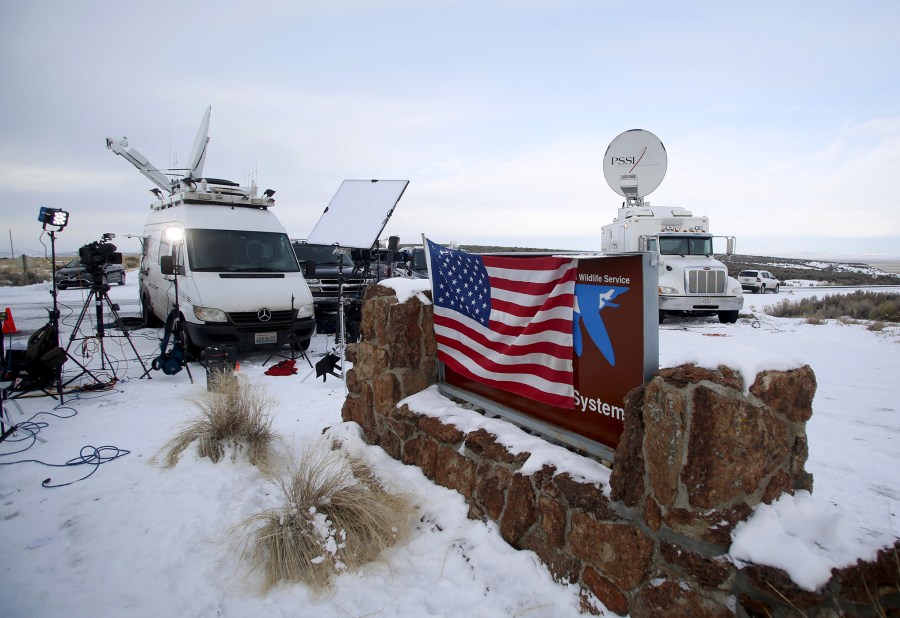
The local Bureau of Land Management office is also closed. These demonstrators are trying to “overthrow the local and federal government in hopes to spark a movement across the United States,” county sheriff David M. Ward said in a statement. Ammon, for his part, has put out a social media call for more supporters to help him hold the building.
The FBI says it is working with local authorities to “bring a peaceful resolution to the situation.” There’s been no word yet from the White House, but there will be mounting pressure to comment and perhaps equally strong pressure to retake the land.
The political reaction: Republican presidential candidate Ted Cruz on Monday became the first presidential candidate to comment on the stand-off, calling on Bundy and company to “stand down peaceably.”
“Every one of us has a constitutional right to protest, to speak our minds,” Cruz told reporters in Iowa. “But we don’t have a constitutional right to use force and violence and to threaten force and violence against others. So it is our hope that the protesters there will stand down peaceably, that there will not be a violent confrontation.”
None of the other Republican presidential candidates had commented on the Oregon stand-off as of Monday afternoon, but most expressed a previous opinion on Cliven Bundy’s protests in 2014. Bundy divided the candidates at the time, with front-runners Trump, Cruz and Carson generally supporting Bundy while Bush and Rubio opposed him.
“I like him, I like his spirit, his spunk and the people that are so loyal,” Donald Trump told FOX News in April 2014. He also characterized the federal response — which included sniper positions and 200 people — as “over the top.”
That same month retired neurosurgeon Ben Carson said the Bundys appear to be “honorable American citizens,” and their supporters “pretty upstanding people.” He also summoned a vision of a future where federal control has swelled into martial law. He called the stand-off “a brief glimpse of the totalitarian regime that awaits,” in an essay for the National Review. In a chat with The Washington Times, he elaborated: “The fact of the matter is if you look back through history, what our government is doing is not unprecedented by any stretch of the imagination, it always starts like this and freedom is not free and there may come a time when people have to actually stand up against the government.” As the first Bundy stand-off reached a climax, Cruz described the confrontation as “the unfortunate and tragic culmination of the path that President Obama has set the federal government on.” Two months later, in July of 2014, he tried to pass an amendment banning the federal government from owning more than half the land in a state, which is the case in Oregon — plus Nevada, Utah, Idaho, and Alaska. (The feds own about a fifth of the landmass in America.) RELATED: FBI seeks ‘peaceful’ end to armed standoff at Oregon federal building The Republican National Committee generally agrees, endorsing the transfer of federal land back to the states in a resolution passed in January of 2014 and still on the GOP’s website. “The Republican National Committee calls upon all national and state leaders and representatives to exert their utmost power and influence to urge the imminent transfer of public lands to all willing western states for the benefit of these western states and for the nation as a whole,” the resolution reads. The RNC was not immediately available for a comment on the latest stand-off, but if Cruz is any indicator, the Bundy’s should not expect a warm round of support. In the summer of 2015, former Florida Gov. Jeb Bush portrayed the elder Bundy as a scofflaw not a patriot. “He is breaking the law,” Bush told reporters at a campaign stop. “I think people, and the law ought to be enforced, and I’ll let the federal government authorizes figure out how to do that.” Florida Sen. Marco Rubio tends to agree. In Las Vegas in October, Rubio opposed the original Bundy stand-off, telling the local CBS affiliate: “No matter how worthy your cause may be, you cannot violate the law. If you don’t like the laws, we have a republic where you can change them, and in this instance, I’m not even sure what the change would be.” The name game: Are they terrorists, activists, criminals, militiamen, or all of the above? When Cliven Bundy and company faced down federal authorities in 2014, Nevada senator Harry Reid called the rancher and his supporters “domestic terrorists.” This time around, the social media conversation is generally mocking, calling the Bundy crew #YallQaeda. But Ammon Bundy says that his supporters are “militamen” simply interested in supporting the constitution.
Tony Dokoupil Recommended


