








Republicans have been predictably negative in their response to President Obama’s State of the Union speech Tuesday night, which laid out an ambitious array of progressive goals. But a closer look suggests that, on at least one major new proposal, the GOP could have trouble maintaining a united front, especially against a president whose party is firmly behind him.
On issue after issue, Obama signaled that he’s jettisoned his first-term strategy of conciliation and compromise, in favor of a more self-confident approach in which he asks the GOP to join him, but finds ways to move forward without them if he has to. And on gun violence and immigration reform, Obama appeared determined to press his public opinion advantage.
House Minority Leader Nancy Pelosi told msnbc’s Ed Schultz that the speech was “music to my ears.”
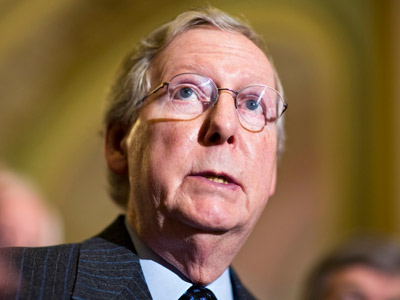
Republican leaders are panning the address, of course. In a typical response, delivered on the Senate floor Wednesday morning, Senate Minority Leader Mitch McConnell called it “another retread of lip service and liberalism.”
Speaker John Boehner took a similar tone. He told reporters Wednesday morning that he opposes a minimum wage hike—Obama wants it to go up to $9 per hour—because it would cost jobs (in reality, most research finds it would have little impact on job growth). “At a time when Americans are still asking the question ‘Where are the jobs?’ why would we want to make it harder for small employers to hire people?” Boehner asked.
But Boehner could have trouble uniting his caucus around that stance. Polls show raising the minimum wage is popular, and the last time Congress raised it, to $7.25 an hour in 2007, 82 House Republicans and all but three Republican senators voted for the measure. During his run for president, Mitt Romney at first said he supported the idea of indexing the minimum wage to inflation, before back-tracking after a conservative outcry.
The White House is signaling it intends to pressure the GOP on the issue. Obama spokesman Dan Pfeiffer responded to Boehner’s comments by asking in a tweet: “If the GOP is opposed to raising the minimum wage, what is their plan to ensure people who work full time don’t live in poverty?” Already, some Republicans strategists are nervous. “I worry that being too anti-minimum wage plays to the Republican negative stereotype,” GOP consultant Ed Rogers told TPM. “The commonsensical appeal of there being a minimum wage and having occasional raises is powerful. Plus, I think we could argue for some good policy, like a youth exception, if we did something other than just slammed the door.” On early childhood education—where Obama proposed “working with states to make high-quality preschool available to every child in America”—some Republicans may also be willing to listen. In a statement to msnbc.com, Rep. Don Young, an Alaska Republican who has been active on the issue in the past, called the idea “great in theory” but warned about potential costs. Given concerns over the deficit, the push isn’t likely to result in legislation any time soon. But backers of the plan say the goal is more modest: to move the conversation away from a debate over the value of pre-school, towards a discussion of how to make it more accessible. Climate change could be tougher. There’s been essentially no Republican support for cap-and-trade legislation in recent years. The office of Sen. John McCain, who Obama name-checked Tuesday night for pushing a climate bill back in 2003, did not respond to a request for comment from msnbc.com about the senator’s current stance on the issue.
Zachary Roth Recommended


