








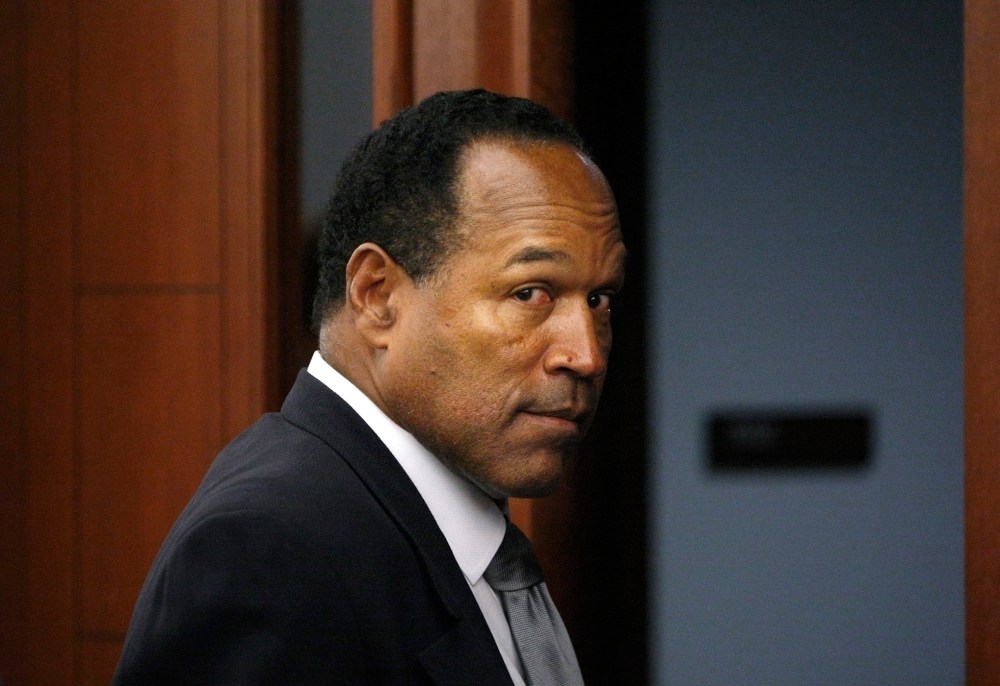
Earlier this year, the highly rated and critically acclaimed FX series “The People vs. O.J. Simpson” proved there was still a considerable amount of fascination with the so-called “Trial of the Century.” Now comes an even more expansive exploration of the case that captivated the nation just over 20 years ago — a multi-part documentary from ESPN Films titled “O.J.: Made In America.”
While the FX series successfully added complexity and nuance to its fictionalized portrayal of attorneys in the case, who had become caricatures over the years (namely Johnnie Cochran, Marcia Clark and Christopher Darden), “O.J.: Made in America” (which debuts on ABC and ESPN this June, and is also going to make an Oscar-qualifying week-long run in theaters) shifts the focus onto the the former football hero himself. By doing so, the filmmakers may have crafted the definitive account of this uniquely American story.
The nearly eight-hour opus, directed by Ezra Edelman, leaves virtually no stone unturned in the O.J. saga, and illuminates the magnetic and maddening man at the center of the story, whose race and fame were always the driving forces behind much of the media frenzy over the murder of his ex-wife Nicole Simpson and her friend Ron Goldman. The crime officially remains unsolved, but the overwhelming majority of the public believes O.J. Simpson committed it. And while the film does not seek to prove his guilt or innocence, it effectively provides more context for why the NFL Hall of Famer became the man he is — for better or worse.
RELATED: What does the obsession with OJ Simpson say about America?
Beginning with his early days as a campus icon at the University of Southern California in the late 1960s, “Made In America,” utilizing incredible stock footage and candid testimonials, portrays a Simpson who becomes, in the words of a childhood friend, “seduced by white society,” and who, in a longstanding desire to achieve a level of fame that transcended race, learned to calibrate his persona to please white Americans.
In 1968, at a crucial moment in black radical consciousness, a young Simpson was approached to join a boycott of the 1968 Olympics Games (a move Dr. Martin Luther King, Jr. supported) as a protest against racial injustice in the U.S. Simpson demurred, instead choosing to cater to the likes of FBI Director J. Edgar Hoover, while uttering a phrase for which has since become infamous: “I’m not black … I’m O.J.” The following year, Simpson expresses pride when a classmate pointedly thinks of him as set apart from the “n——” on the USC campus.
And while Simpson’s fetishistic appreciation of white culture, and more specifically white women, fueled him to a certain degree, it was also a selfish, almost gluttonous need for fame — and the perks, adulation and pervasiveness that comes along with it — that led him to behave self-destructively at times, tragically in others.
“I need that recognition,” Simpson says in archival footage. “I think what is driving O.J. Simpson is that need to be known, that need to be liked.”
Make no mistake about it — the filmmakers aren’t attempting to make audiences feel sorry for Simpson. But after viewing his long public descent as a pariah following his acquittal in 1995, there is no doubt that his life is a tragedy. But is the tragedy his or ours? Did American culture create O.J.? Did we enable him? As one his many media profilers Celia Farber says in the film: “The story is O.J. and us.”
‘Us’ could mean the media, which arguably turned a sensationalist corner with its rabid coverage of the case and never looked back. It could mean the city of Los Angeles, which was reeling from decades of biased police practices that culminated with the acquittal of the mostly white officers who beat the late Rodney King (and the less well known community service sentence for Korean grocer Soon Ja Du, who was caught on camera shooting a combative black customer in the back of the head 13 days after the King beating). It could mean the national audience for the entire spectacle, which was largely divided along racial lines and who more often than not lost sight of the fact that two people needlessly lost their lives and that the two very young children of Nicole and O.J. Simpson’s fate hung in the balance.
RELATED: Robert Shapiro admits trying on gloves in O.J. Simpson trial But of course, with a celebrity of Simpson’s caliber involved as a suspect, we now know with hindsight that a traditional trial never stood a chance (although black TIME writer Sylvester Monroe muses in the film that his mother once told him had Simpson been accused of murdering his first wife, who was African-American, “this would not be the trial of the century and his black a– would be in jail”). “Made in America” reminds audiences who may have no tangible memory of what made Simpson such a beloved star in the first place, what a revolutionary figure he actually was. Today, African-American sports stars moonlighting as ad pitchmen is par for the course, but in the 1960s and ’70s it was an outside-the-box concept. Simpson made the corporate world comfortable unlike any black athlete who proceeded him. “For us, O.J. was colorless,” says Frank Olson, former Hertz CEO, in the film, while Fred Levinson, a director of one of his legendary TV commercials, gushes the he “almost has white features.” Besides his record-breaking performances as a running back on the football field, the film effectively communicates that Simpson was that rare crossover figure whose aspirational persona appealed to both blacks and whites. And it is the ultimate irony that his murder trial forced him to embrace aspects of African-American culture that he has so assiduously avoided for much of his adult life. His apparent lifelong dream, forged during a difficult, impoverished childhood in the housing projects of San Francisco (with a closeted gay father), was to “erase race as a defining factor in his life.” But the series shows that he could never escape that reality, whether he was becoming the vessel for black grievances with the justice system or the butt of offensive, embarrassing rap videos and reality shows, which he gamely played a part in following his exoneration, to the dismay of many former supporters. There are many low points in this story, but one of the more evocative ones comes when Simpson is forced to stage scenes for the cameras to sell to the tabloids to help pay off his mounting debts. He has his agent film him removing an American flag off his Brentwood, Los Angeles property, while he feigns getting choked up. It’s both incredibly obnoxious, slightly sad and undeniably watchable — just like so much of the Simpson story — and yet now more than ever audiences may be asking themselves, who really is the guilty party — him or us?
Adam Howard Recommended


