








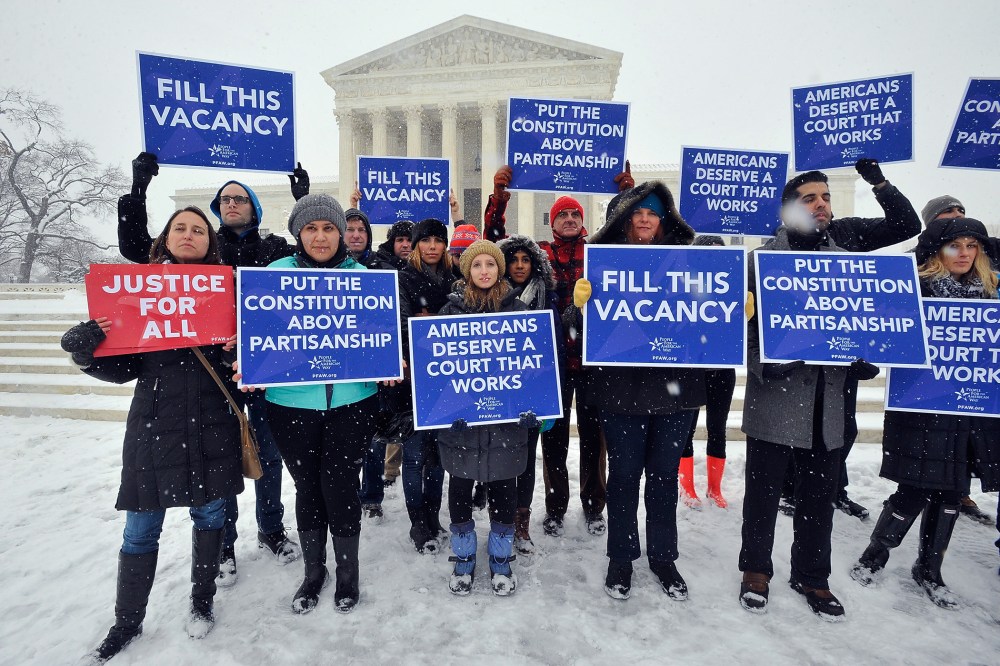
Supreme Court Justice Antonin Scalia’s death has set off a fiery debate in Washington over who gets to pick his replacement, a choice that will impact the American justice system for decades.
Under typical circumstances, this wouldn’t be such a big deal. But Scalia, the court’s most influential conservative, died in President Obama’s final year in office, in the middle of the court’s term, with the candidates to succeed him fighting through the early primary season.
That makes this high court vacancy particularly complicated — and divisive.
Here are some of the key issues underlying Obama’s big choice.
For the immediate future, the court now only has eight members, which means no tie-breaking votes.
If the court splits 4-4, then their decision is essentially negated, and the opinion of the previous federal appeals court stands — without making law for the rest of the country — University of Michigan law professor Samuel Bagenstos told NBC News.
RELATED: What happens to the big Supreme Court cases after Scalia’s death
Because the court has already heard arguments and voted on several cases — but has yet to publish the opinions — Scalia’s death has the effect of negating any of tie-breaking votes he made before he died.
“Unless a justice is sitting at the court at the time of argument and at the time the decision is issued, the justice’s vote doesn’t count,” Bagenstos said.
And that is no small matter. The court has heard or has agreed to hear cases involving the constitutionality of considering race in college admissions, how far states can go in restricting abortion, the viability of public sector unions, whether Obama can defer deportations of unauthorized immigrants and the balance between religious freedom and women’s access to contraception.
Right down the partisan divide.
Senate Democratic Leader Harry Reid and other top Democrats want their Republican colleagues, who control the Senate and wield enough votes to scuttle Obama’s nomination, to pledge to confirm a new nominee before the president leaves office.
But Republicans say there’s no way that will happen.
“What is less than zero? The chances of Obama successfully appointing a Supreme Court Justice to replace Scalia,” Conn Carroll, the communications director for Republican Sen. Mike Lee of Utah, who serves on the Judiciary Committee, posted on Twitter.
Obama ought to defer his nomination to the person who replaces him, Republicans argue.
“The American people should have a voice in the selection of their next Supreme Court Justice. Therefore, this vacancy should not be filled until we have a new President,” Senate Majority Leader Mitch McConnell said over the weekend.
Almost immediately after Scalia’s death became public, Obama announced his intention to nominate a successor himself.
He framed it as a question of keeping the American government operating as designed.
“These are responsibilities that I take seriously, as should everyone,” Obama said. “They are bigger than any one party. They are about our democracy. They are about the institution to which Justice Scalia dedicated his professional life, to make sure it functions as the beacon of justice that our founders envisioned.”
He didn’t name any preferences, or indicate when he would, other than to say there is plenty of time to make a nomination and for the Senate to confirm that person before he left office.
What do the presidential candidates say?
All but one of the the six Republican presidential candidates at Saturday’s GOP debate in South Carolina said Obama should either not nominate a justice and leave the decision for the next president, or the Senate should block any pick.
The only holdout was Jeb Bush, who said Obama “has every right” to nominate Scalia’s successor, and urged him to pick a consensus candidate.
RELATED: Rubio warns about the ‘look’ of a SCOTUS nominee
Democratic presidential candidate Hillary Clinton said on Sunday that Obama “was elected, he has the right to nominate another Supreme Court justice.”
Clinton, a former U.S. senator, also said lawmakers had a “constitutional responsibility” not to block a nominee for political reasons.
Her rival, Sen. Bernie Sanders of Vermont, agreed. “Let’s get on with it,” he said. What’s the precedent for nominating a justice in the last year of a presidency? Obama’s opponents say no such precedent exists. But that’s not necessarily the case — although the circumstances are extremely rare. Only seven times since 1900 has a president nominated a Supreme Court justice during a presidential election year. During that time, no president has chosen not to nominate a Supreme Court justice because of an impending election. And the Senate has little history of rejecting those late-term choices. Who are the key names on Obama’s the short list of potential nominees? Among the leading contenders, legal and political analysts say, are D.C. Circuit Judge Sri Srinivasan, Attorney General Loretta Lynch, Ninth Circuit Judge Paul Watford, U.S. Court of Appeals Judge Patricia Millett, and Merrick Garland, chief judge of the U.S. Court of Appeals for the D.C. Circuit. RELATED: New name emerges as top SCOTUS contender A leading Supreme Court researcher, Tom Goldstein, wrote a column Monday that put Lynch at the top of the list because she was recently vetted and approved by the Senate for her current job. How does the nomination and confirmation process work? There’s no way to predict how this situation will unfold. But in general, this is what happens: The president is empowered by the Constitution to nominate Supreme Court judges, with “advise and consent” of the Senate. That means a lengthy Senate confirmation process, although in rare cases, presidents have made “recess appointments” to without the approval of Congress, which expired at the end of the Congressional session. Since 1925, nominees have first been considered by the bipartisan Senate Judiciary Committee, which currently has 20 members — 11 Republicans and 9 Democrats. The nominee also traditionally does “courtesy calls” on Capitol Hill to meet with individual senators in advance of the hearing. The committee members then vote on the nominee. The vote then goes to the full Senate. To avoid filibusters, Supreme Court appointments still essentially require the consent of 60 senators to go forward. The current breakdown of the Senate is 54 Republicans, 44 Democrats and 2 independents, who caucus with the Democrats. This article originally appeared on NBCNews.com.
Jon Schuppe Recommended


