








More than 7 million people who didn’t have health insurance last year got coverage this year, a new government survey finds.
It’s the latest in a series of reports showing the Affordable Care Act is expanding the availability of coverage. Each report takes a slightly different approach. This one, conducted by the National Center for Health Statistics, compares the first three months of 2014 to the first quarter of 2015.
RELATED: Gallup finds America’s uninsured rate continues to fall
“In the first three months of 2015, 29 million persons of all ages (9.2 percent) were uninsured at the time of interview, 7 million fewer persons than in 2014,” the report reads.
“Among adults aged 18-64, the percentage uninsured decreased from 16.3 percent in 2014 to 13 percent in the first 3 months of 2015. There was a corresponding increase in private coverage, from 67.3 percent to 70.4 percent.”
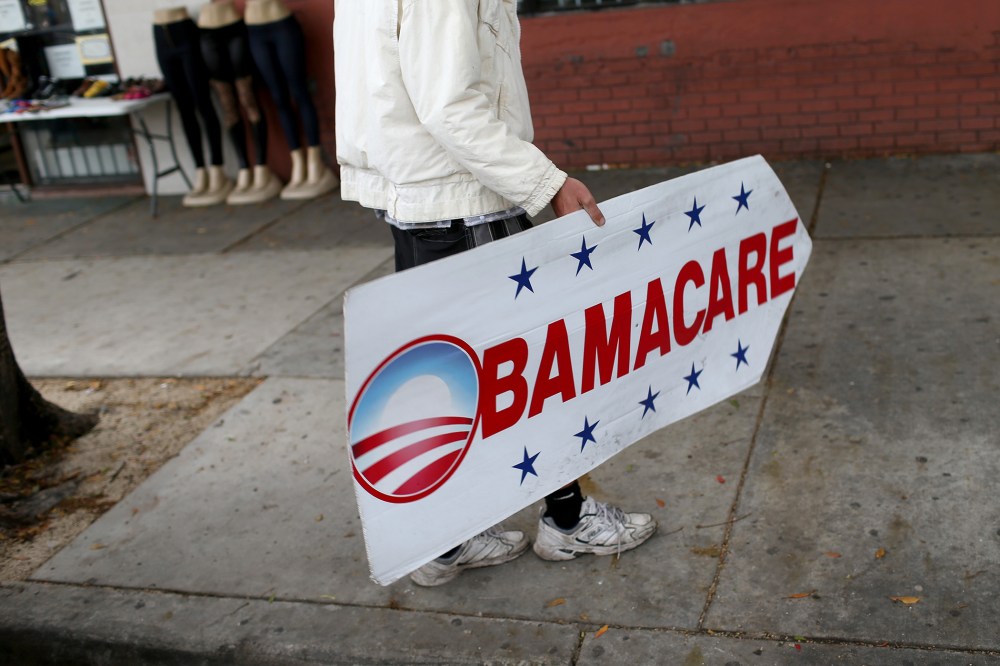
The ACA, known widely as Obamacare, takes several roads to getting more Americans covered by health insurance. It offers private health insurance via online marketplaces called exchanges, often with a very substantial federal subsidy to pay the premiums. It encourages states to expand their Medicaid programs and about half of the states have done so. And it imposes strict rules on health insurers that forbid them to drop sick, expensive clients and requiring them to accept even people with pre-existing conditions.
The Obama administration says nearly 11.7 million people signed up for health insurance under Obamacare in 2015.
The Rand Corporation research group used a different calculation earlier this year to estimate that nearly 17 million Americans have gained health insurance since 2013 — a different comparison than that used by the NCHS.
The law’s been challenged multiple times in the courts, surviving the latest suit earlier this year in the Supreme Court. Republicans in Congress say they will continue to work to dismantle it.
And some states remain strongly opposed to any cooperation, refusing to expand Medicaid and refusing to operate their own health insurance exchanges — leaving it to the federal government. A Gallup survey also published this week shows it’s resulted in large disparities in insurance coverage.
“Seven of the 10 states with the greatest reductions in uninsured rates have expanded Medicaid and established a state-based marketplace exchange or state-federal partnership, while two have implemented one or the other,” Gallup said in a statement.
Gallup and health consultant group Healthways used a random sample of 178,072 adults in 2013 and compared them to 88,667 adults through the first half of 2015. The results show that Texas is the only state where more than 20% of residents still lack health insurance — the rate is 20.8% there, but that’s still down from 27% in 2013. Former governor Rick Perry was an avowed foe of Obamacare, as is the current governor, Greg Abbott. RELATED: Over right’s objections, ‘Obamacare’ scores another win “Through the first half of 2015, there are now seven states with uninsured rates that are at or below 5 percent: Rhode Island, Massachusetts, Vermont, Minnesota, Iowa, Connecticut and Hawaii,” Gallup said. It found that Arkansas and Kentucky have the sharpest reductions in their uninsured rates. In Arkansas, 22.5% of people lacked health insurance in 2013. That’s now 9%. In North Dakota, 15% lacked health insurance in 2013. It’s now 6.9%. “Americans’ attitudes about the law known as “Obamacare” have become more positive in recent months, and now as many Americans approve of the law as disapprove, a shift from the last several years in which disapproval had consistently outweighed approval,” Gallup said. “This is happening as uninsured rates for most states have continued to decline.”Recommended



Maggie Fox