








Three months ago, John Errol Ferguson was executed for one of the worst mass murders in Florida’s history. After tricking his way into a woman’s home, he eventually bound, blindfolded and shot eight people. Six of them died. While under indictment for those crimes, Ferguson murdered two teenagers on their way to church.
Ferguson might have been executed earlier, but his attorneys, one of whom was later rewarded with a position of unparalleled influence in the U.S. government, argued Ferguson was mentally ill and dragged out the process for years.
What kind of person would defend a butcher with the blood of eight people on his hands?
It was Chief Justice John Roberts, who devoted 25 pro bono hours to Ferguson’s case when he was working in private practice. Later, when Roberts was nominated to the nation’s highest court, his work on the Ferguson case wasn’t seen by anyone as a hinderance. “A good lawyer like John Roberts may not share the client’s priorities, they might not share the client’s worldview, what they’re committed to is the application of rights under law,” says Charles Geyh, an expert on legal ethics and professor at the Indiana University School of Law.
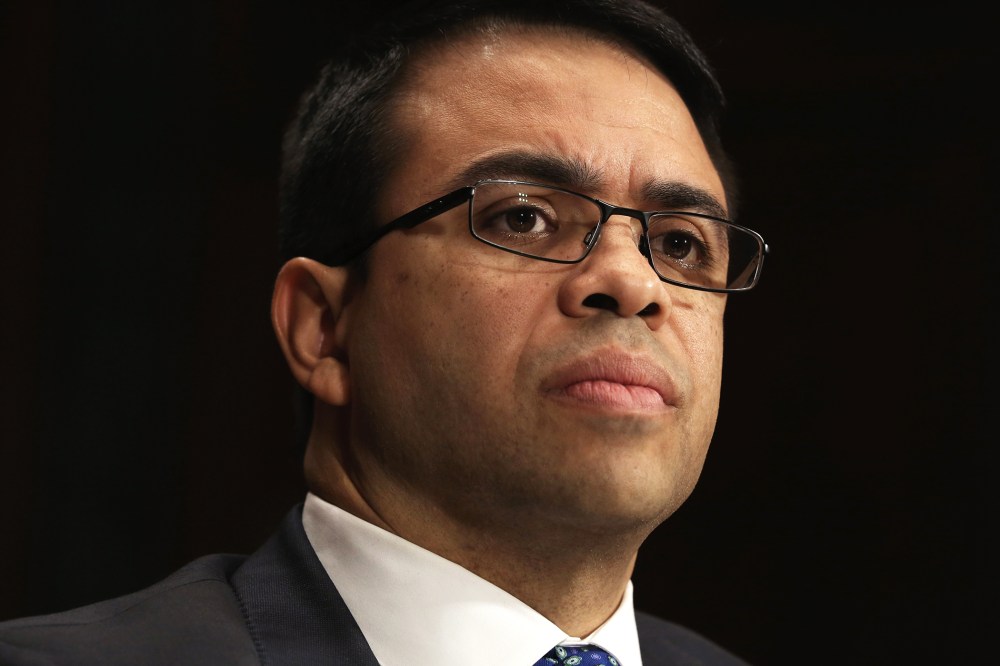
Not everyone is willing to extend that view to Debo Adegbile, President Obama’s nominee to head the civil rights division at the Department of Justice.
The child of a white mother and Nigerian father, Adegbile emerged from an impoverished upbringing in the South Bronx to becoming an experienced Supreme Court litigator as an attorney with the NAACP Legal Defense Fund. That’s part of the reason his nomination is being opposed by many conservatives. On matters of voting rights, affirmative action, and racial discrimination, Adegbile holds views that are broadly consistent with the Obama administration, the mainstream of the Democratic Party, and in many cases longstanding legal precedent. Conservatives view those positions as tantamount to, if not worse than, the discrimination that the policies are meant to resolve.
The issue that has stirred intense conservative opposition to Adegbile is the NAACP LDF’s successful defense of Mumia Abu-Jamal, a black radical who was convicted of murdering white police officer Daniel Faulkner in Philadelphia in 1982. He presided over the team that successfuly persuaded a federal court not to reinstate Abu-Jamal’s death sentence. The conservative campaign against Adegbile recalls an effort during Obama’s first term to attack Justice Department officials as terrorist sympathizers because they had successfully represented Gitmo detainees. That effort fizzled when a group of conservative attorneys signed a letter defending those officials as having done their part to ensure due process.
On Fox News, Adegbile has been called a “cop killer coddler.” The conservative Washington Times ran a caricature of Adegbile with the words “cop killer” that Wade Henderson, head of the Leadership Conference on Civil and Human Rights, said was “reminiscent of the racist iconography of late 19th century America.” Pennsylvania Republican Rep. Mike Fitzpatrick said the NAACP LDF’s representation of Abu-Jamal “made a mockery of the jury’s verdict and the court’s sentence.” Katie Pavlich, a columnist at the conservative website Townhall, wrote: “Through his extensive work at the NAACP [sic] and in arguments before the Supreme Court, Adegbile has made it clear he does not believe civil rights apply to whites.”
The NAACP LDF was founded by Thurgood Marshall to protect the rights of people of color in a country that, for much of its history, denied such rights. The only way to find that mission offensive would be to believe that people of color no longer face legal, social or institutional barriers to equality. There are few places where ongoing racial inequities are more stark than in the criminal justice system.
But it’s not only Abu-Jamal’s crime that has conservatives incensed about Adegbile’s nomination.
During his time in prison, Abu-Jamal has written several books and emerged as an intellectual hero to some who view him as a political prisoner, a martyr for opponents of the death penalty, and for many years a reliable culture war foil for Republicans seeking to paint liberals as soft-on-crime. The conservative attacks on Adegbile suggest the NAACP LDF defended Abu-Jamal not because they believed he didn’t receive a fair trial, but because they share his politics. Pavlich refers to Adegbile as “an unapologetic supporter” of Abu-Jamal.
“There’s actually a stronger case here to identify (Adgebile) with the client because there’s more discretion about how to represent in these post-conviction proceedings,” says Steve Lubet, an expert in legal ethics and a professor at Northwestern University School of Law. At the same time, he says, “when you’re challenging a sentence on appeal, you’re not endorsing the client, you’re trying to make sure the sentence is lawful and appropriate. Nobody benefits when sentences are imposed inappropriately, and the only way to make sure that doesn’t happen is to have everyone represented by capable lawyers.”
Asked about Abu-Jamal during his confirmation hearing, Adegbile said, “These are the hardest cases, but our commitment in the Constitution is to follow these rules even in the hardest cases.” Indeed the job of the civil rights division is to ensure all Americans’ civil and constitutional rights are being protected, no matter who they are. The NAACP LDF made two arguments in favor of Abu-Jamal’s appeal. The group filed an amicus brief supporting Abu-Jamal’s appeal of his conviction on the basis that there had been racial discrimination in the jury selection process. Abu-Jamal lost that appeal, but the NAACP LDF later represented him in an appeal on the grounds that the jury instructions were improper. A federal court agreed and commuted Abu-Jamal’s death sentence. In other words, the court agreed with the NAACP LDF that Abu-Jamal’s rights had been violated. The NAACP LDF’s representation of Abu-Jamal has led the Police Conference of New York and the International Union of Police Officers to oppose Adegbile’s nomination. Faulkner’s widow wrote a letter to the Senate Judiciary Committee saying that there must be “other far better choices” than someone who decided to “help a clearly guilty cop killer evade justice.” The most recent head of the DOJ civil rights division, now Secretary of Labor Thomas Perez, presided over an aggressive campaign against unconstitutional policing. Police organizations may fear that Adegbile would be even more aggressive. Yet Adegbile has drawn support from civil rights organizations and even prosecutors, including a former assistant U.S. Attorney. John Dixon, President of the National Organization of Black Law Enforcement Executives, wrote that “[t]he attacks on Mr. Adegbile’s character for upholding one’s constitutional rights are troubling. To take away one’s right to a proper defense because of the act committed, is against the constitutional oath that we as law enforcement officials have sworn to protect and defend.” Adegbile’s nomination could come up for a committee vote as early as this week. Adegbile is likely not the last attorney to be nominated by either party who will face scrutiny and opposition based on having represented a hated client. It’s a partisan game that Geyh, the Indiana University professor, said should stop. “A good lawyer cares about fair process under law, regardless of whether their client is popular or not, that’s why everyone hates lawyers,” Geyh said. “For the most part popular people don’t need the rule of law, because being popular protects them well enough. It’s unpopular people who need it.” This post has been updated to clarify the NAACP LDF’s involvement in Abu-Jamal’s post-conviction appeals process.
Adam Serwer Recommended


