








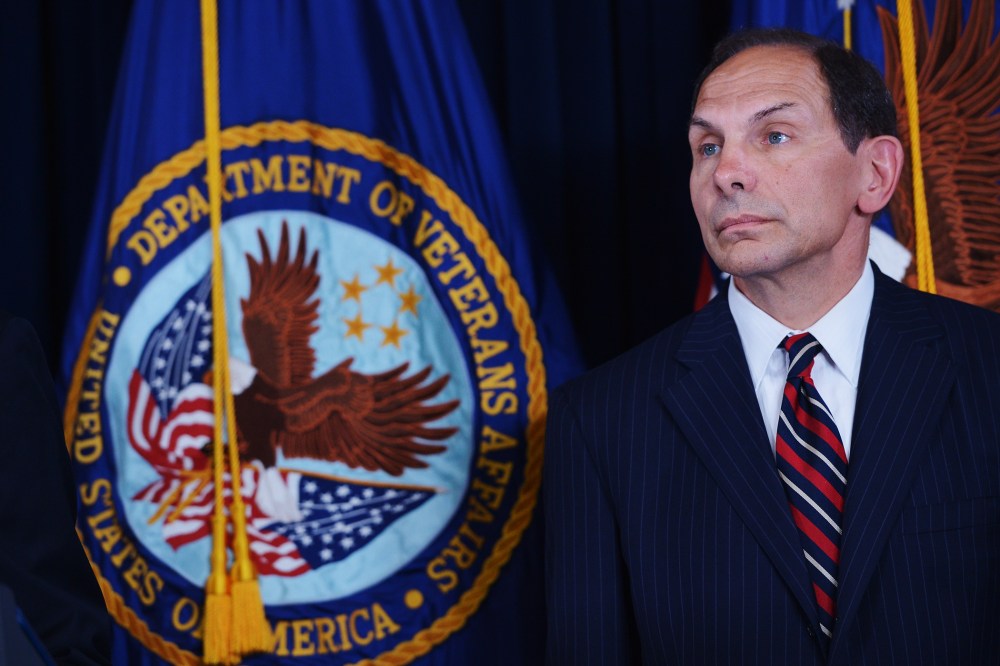
President Obama officially announced Monday that he will nominate Robert McDonald, a former business executive and West Point graduate, to be the new secretary of Veterans Affairs.
McDonald, Obama said Monday, “understands that grand plans are not enough, and what matters is the plans you put in place, and how you get the job done.”
In McDonald, Obama has a nominee unlikely to make waves during his confirmation process. McDonald retired in 2013 after spending more than 33 years at Proctor and Gamble, ending his tenure there as CEO amid investor concerns over profits, a problem that will not trouble him at Veterans Affairs. He also graduated near the top of his class at West Point in 1975, where he attended school with Acting VA Secretary Sloan Gibson, and spent five years in the Army with the 82nd Airborne Division.
Much has changed in the military and Veterans Affairs since 1980 — from the demographics of veterans seeking care to the types of services veterans of the nation’s most recent wars need. Whether his skills as head of a consumer products corporation will translate to problem solving at the VA, where there are nine million customers to keep satisfied, will soon become clear, but Obama and McDonald both vowed to do better.
“My life’s purpose has been to improve the lives of others,” McDonald said of his time in the Army and in corporate life. “We need to put caring for veterans at the center of everything we do … and we must focus all day, every day, on getting them the benefits they’ve earned.”
He has a lot of work ahead of him. On Friday, Acting VA Secretary Sloan Gibson and Deputy White House Chief of Staff Rob Nabors met with Obama to discuss what progress has been made at the VA. Nabors, who had been tasked with conducting a review of VA medical care, delivered a blistering report to Obama on “significant and chronic systemic failures that must be addressed by the leadership at VA.”
Obama also laid out what changes are already underway at the department, which were included in the report Nabors submitted Friday. In the report’s summary, Nabors pointed to “a corrosive culture” at the department that has hurt morale and caused health care to suffer. “The problems inherent within an agency with an extensive field structure are exacerbated by poor management and communication structures, distrust between some VA employees and management, a history of retaliation toward employees raising issues, and a lack of accountability across all grade levels,” it read.
Former Veterans Affairs Secretary Eric Shinseki resigned May 30, two days after a VA Inspector General report found widespread systemic failure to properly schedule and provide health care for veterans seeking care. That report found 1,700 veterans were waiting for care but were not on any official waiting list.
If confirmed, McDonald will take over the responsibility to fix a system that has been facing a crisis for over a decade. Joe Violante, National Legislative Director of Disabled Veterans of America, told msnbc that it has been clear since 2003 that there were not enough resources to meet the needs of the veterans who would be entering the VA system. A Bush administration task force, Violante said, “reported that if that mismatch wasn’t addressed there would be a crisis in access, and here we are 11 years later in the middle of that.” For McDonald to be effective, he’ll have to follow up on what Gibson has done during his month-long tenure. “I think Acting Secretary Gibson has stepped out there and done some important things that needed to be done, such as visiting VA facilities, going out and talking to his employees and to veterans. I think we’re heading in the right direction, and hopefully the new secretary will be able to keep up momentum,” Violante told msnbc. “DAV is looking forward to working with the nominee once he’s confirmed.” Anu Bhagwati, executive director of Service Women’s Action Network, said Monday that McDonald will have to consider the military’s increased diversity as he makes decisions on how to move forward. “Past leadership at VA has not engaged nearly enough women in policy discussions and hasn’t done nearly enough to remedy the problems facing women veterans,” Bhagwati said. “As active duty service women begin to transition out of the military, the burden to provide services to women veterans will only increase. When you add this to the overwhelming patient care challenges VA currently faces, Robert McDonald will have his hands full and will need to rely heavily on the counsel of women who have served.” The Senate has yet to confirm three female nominees to top positions at Veterans Affairs, and Obama urged that those nominees be confirmed. All three, he said, “have been waiting, and waiting, and waiting for a vote,” one for over a year. “We need them on the job now. Congress has to act and help us do right by our veterans,” he said. Negotiations between the House and Senate on how to pay for a bill that would add tens of billions of dollars to the VA budget began on June 24.
Meredith Clark
Meredith Clark is a freelance writer and editor. She was previously a senior news producer for "Patriot Act with Hasan Minhaj," a reporter with MSNBC.com, the digital politics and culture editor at Glamour and a senior news and politics editor at Refinery29. She has written for Vulture, Rolling Stone, Self, Marie Claire, Cosmopolitan, The Daily Beast and Bustle. Recommended


