








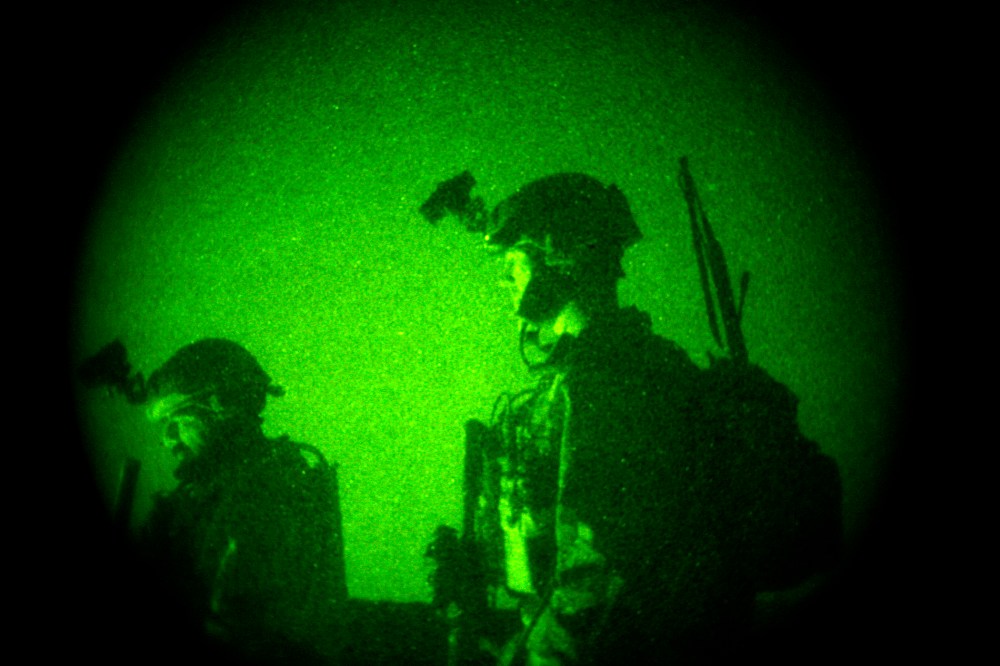
Spectacular operations carried out in the last three years have led to some of the president’s most touted successes. Monday the administration announced that special operations forces had captured Abu Khattala, long suspected of being one of the leaders of the September 11, 2012 attack on the U.S. consulate and CIA facility in Benghazi, Libya.
“Our nation’s memory is long, and our reach is far,” Attorney General Eric Holder said in his statement Tuesday announcing the charges against Khattala.
From the use of Navy SEAL snipers to rescue the crew of the Maersk Alabama from Somali pirates in 2009, to the raid on Osama bin Laden’s compound in Pakistan, to the capture of a suspect in the 1998 U.S. embassy bombings in Kenya and Tanzania, the Obama administration has taken great advantage of military capabilities developed over the past thirty years. The increasing efficiency of special operators has bolstered the president’s reputation and shielded the White House from a Republican foreign policy critique that attributes chaos from Ukraine to Iraq on Obama’s personal qualities.
“The capability that has been built up over the past 13 years is just incredible,” said Michael Leiter, former head of the CIA’s National Counterterrorism Center. “Special operations have always been good, but they’re at the highest performance in their history now, their ability to do operations globally, clandestinely, it’s just unparalleled.”
The development of that capability is not solely an Obama administration accomplishment. The failure of Operation Eagle Claw, the disastrous 1980 attempt to rescue American hostages in Iran, led to a concerted effort to train elite military forces who would be capable of executing risky and complex military operations. The profile, budget and presence of special operations forces have only grown since. The head of the U.S. Special Operations Command, Admiral William McRaven, told Congress in 2014 that he lead a force of more than 66,000 people operating in more than seventy countries, with a budget of over seven billion dollars.
“US reliance on special operations forces grew sharply after 9/11 under the Bush Administration. Remarkably, it continues to grow now,” said Steven Aftergood, head of the Project on Government Secrecy at the Federation of American Scientists. “While most defense and intelligence activities are drawing down, and their budgets are declining, investment in special operations is on the rise.”
Failed high profile military operations can grievously wound a presidency. President Jimmy Carter’s hopes of a second term were diminished by a botched effort to rescue Americans held hostage in the U.S. embassy in Iran in 1980 in which eight servicemembers were killed. Images of American servicemembers being dragged through the streets of Mogadishu in 1993 after a failed mission dashed public support for President Bill Clinton’s intervention in Somalia.
“The calamity at Desert One – the failed attempt in 1980 to rescue the hostages in Tehran – was the seminal event in the development of U.S. military capabilities to conduct these specialized commando operations,” said Paul Pillar, a former CIA analyst and a professor at Georgetown University. “Prior to that, the United States lagged behind some other countries, such as Israel or Germany (whose own seminal moment had come several years earlier, at the 1972 Munich Olympics) in these capabilities. Now, the U.S. capability is second to none.”
%22Special%20operations%20have%20always%20been%20good%2C%20but%20they%E2%80%99re%20at%20the%20highest%20performance%20in%20their%20history%20now%2C%20their%20ability%20to%20do%20operations%20globally%2C%20clandestinely%2C%20it%E2%80%99s%20just%20unparalleled.%22′
Those capabilities were honed over years of war in Iraq and Afghanistan in the aftermath of 9/11. “Ironically, though, [Former Defense Secretary Donald] Rumsfeld is now remembered for launching large, decade-long wars, but his main agenda on retaking the Pentagon helm was transformation of the military toward leaner, smaller, special forces combined with high-tech air power as opposed to major boots on the ground,” said Matthew Waxman, a former deputy secretary of defense in the Bush administration and law professor at Columbia University.
“I’m not sure this president is predisposed to employ special operations forces any more than his predecessor, though they both benefited from forces that have greatly evolved over the past several decades,” said Andrew Exum, led Army Rangers in Iraq and Afghanistan and later served as an advisor on Middle East policy at the Pentagon.
That evolution is not solely a military one. The raid that captured Abu Khattala was reportedly conducted by special operations forces in coordination with the FBI, an example of what Leiter says is the increased coordination between different arms of the U.S. government devoted to counter-terrorism.
“Interagency cooperation on this front, in my view, even over the past five years has improved tremendously,” Leiter said. “It’s basically seamless now.”
Yet even success comes with risks. Aftergood notes that while Congress has been empowered to oversee civilian intelligence agencies like the CIA, no similar oversight structure exists for special operations forces.
“The most relevant comparison is to oversight of CIA covert action. After years of frustration and non-cooperation, a well-developed system of congressional notification concerning covert action finally was put in place in the 1990s. The President is required by law to issue a written finding authorizing covert action, and the finding must be provided to the intelligence oversight committees,” said Aftergood. “A similarly well-articulated procedure for oversight of special operations does not seem to exist. Perhaps the time for it has come.” An aide to Senate intelligence committee chair Dianne Feinstein said she had been notified of the operation over the weekend. Nor does the tactical efficiency of special operations forces lead inevitably to strategic success, as the U.S. has yet to kill or capture its way to victory. Special operations forces were successful in their mid-2000s campaign against Al Qaeda in Iraq – one that drew accusations of torture from human rights groups – but the Islamic State in Iraq and the Levant, the extremist group that conquered large swaths of Iraqi territory in recent weeks, rose in its place. The U.S. is withdrawing from Afghanistan, leaving behind a government that may not be able to survive an undefeated Taliban. And though the public has yet to see another Desert One or Black Hawk Down incident, the risk is ever present. “We’ve had such a great record of success, people often expect success and perfection every time,” said Leiter. “They’re really good but you can still have tragedies and you can still lose people. It’s a very dangerous business.” The success of special operations forces may also blind policymakers to other options, or insulate both them and the American public at large from the human consequences of such operations and the way they are perceived by people in the countries where they take place. Journalist Jeremy Scahill wrote in his book Dirty Wars that he believes that through its reliance on lethal force through drone strikes and special operations, “the United States is helping to breed a new generation of enemies in Somalia, Yemen, Pakistan Afghanistan and throughout the Muslim world.” To his critics, Obama’s embrace of special operations forces looks exactly like the Bush-era “global war on terror” that he was supposed to have rejected. Even if an operation kills only its targets, the long-term consequences for the relationship between the U.S. and the country in question can suffer tremendously over their sovereignty being violated, as did relations between Pakistan and the U.S. following the raid that killed bin Laden. The Obama administration has maintained that it will act where a host country is “unable or unwilling” to do so. That appears to have been the case in Libya, where local authorities had identified Abu Khattala as a leader of the Benghazi attack as early as 2012. Caitlin Hayden, a spokesperson for the National Security Council, said she wouldn’t “get into the specifics concerning our diplomatic communications” but that the raid had been conducted “unilaterally.” “The United States has long made clear to successive Libyan governments our interest in bringing to justice the perpetrators of the September 2012 attack on our diplomatic facilities in Benghazi, which resulted in the death of Ambassador Chris Stevens and three other U.S. officials,” said Hayden. “It should have come as no surprise to the Libyan government that we would take advantage of an opportunity to bring Abu Khattala to face justice.”
Adam Serwer Recommended


