








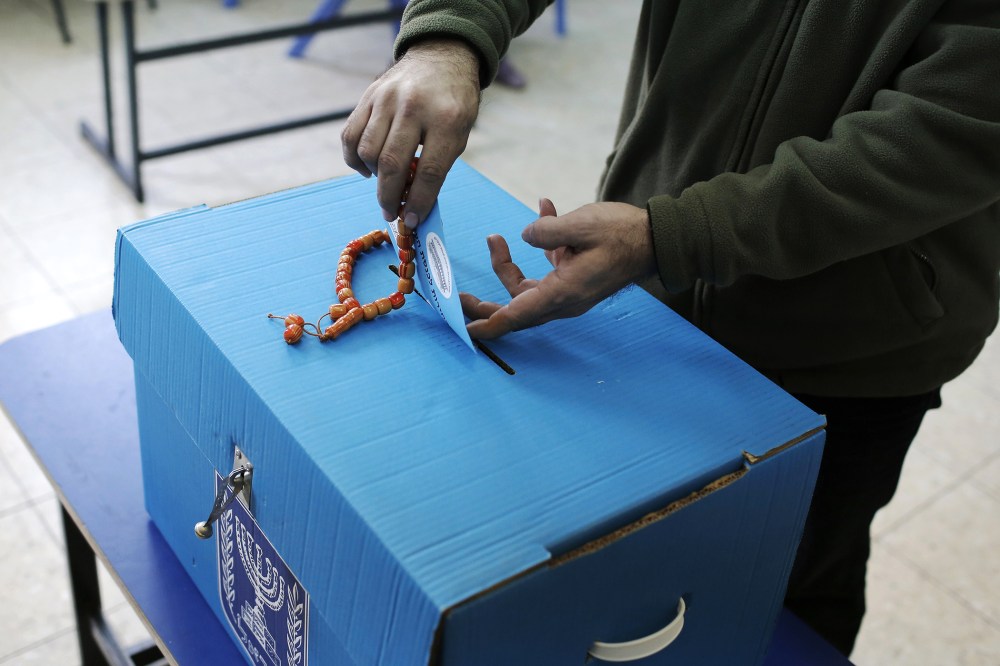
ISRAEL — Despite 11th hour fear-mongering from Prime Minister Benjamin Netanyahu, Israeli Arabs came out to the polls in droves, giving representatives from their historically marginalized community unprecedented wins in parliament, and making a new Arab party the country’s third largest.
With 99% of the votes counted Wednesday morning, the Joint Arab List won a historic 14 seats in the Knesset, Israel’s parliament. Only Netanyahu’s Likud party, with an estimated 30 seats, and his primary opposition, the center left Zionist Union, have more representation.
The new Arab party, which championed equality for Israel’s 1.4 million Arab citizens, motivated more Arab voters to turn out to the polls than they have in decades. This year 70% of eligible Arab voters cast their ballot, compared to just 56% in the last election of 2013, and 53% in 2009.
Roughly 20% of Israelis are Arabs, most of whom are Muslim. But election participation has been low, with many convinced their elected officials were incapable of making their voices heard in a parliament dominated by right-wing politicians focused on the country’s Jewish majority.

On the eve of election, Netanyahu — desperate to keep traditional Likud voters from being picked off by smaller right-wing opponents — announced that, if reelected, he would block the creation of a Palestinian state.
As voting was underway Tuesday, he unleashed a tirade on Facebook, telling his supporters to get to the polls to counter Arab voters who were being bused in by liberals.
“The rule of the right is in danger,” Netanyahu said in the video posted just hours before polls closed. “Arab voters are coming in droves to the ballot boxes. Left-wing organizations bring them in buses,” he claimed. The comments smacked of racism and were repudiated by Netanyahu’s opponents and members of the Israeli media.
But Arab voters were undeterred, and unsurprised.
“What he said definitely caused more Arabs to vote,” said Manar Biny, a 22-year-old resident of Jaffa, a majority Arab neighborhood on the southern outskirts of Tel Aviv. Peace was her primary concern in this election. “Unfortunately there’s racism on both sides,” Biny said.
And for many, Netanyahu’s comments suggesting he will no longer participate in decades of U.S. diplomacy aimed at creating a Palestinian state, were expected. “No one thought there would be a Palestinian state under his watch,” said Reut Mor, spokeswoman for the Joint Arab List. “All Netanyahu can do is keep things as they are, or slowly make things worse. But no one expected Netanyahu to create a state.”
The Arab list’s striking success owes itself to the unification of four major Arab parties, including a Jewish-Arab party, an Islamist party, and a communist-nationalist party.
Until this election, Arab voters had complained about the fragmentation of their political parties, and their ineffectiveness in the Knesset.
Related: Republicans congratulate Netanyahu on election victory Ironically, what finally brought them together was not the Arab public’s cry for unification, but an electoral maneuver that observers believe was meant to stifle the Arab parties’parliamentary influence. When the Knesset passed a law last March raising the electoral threshold for parties to enter parliament from 2% to 3.5%, many expected the legislation to threaten the ability of Arab parties to gain any Knesset seats. Yet the law inspired the fractious Arab parties to join together in order to surpass the 3.5% threshold of roughly 4 seats. “They didn’t unite because they love each other, they united to surpass the threshold,” said Mordechai Kedar, of Bar Ilan University’s Center for Strategic Studies. On their way home from their polling station in the mixed Arab-Jewish city of Jaffa, Salim and Hannan Hassan looked hopeful. Both had voted for the Joint Arab List, and both felt optimistic that this time, their vote would count. “The fact that they came together as one is great for us,”said 47-year-old Salim Hassan. “What’s most important to me is equality and working against hatred. I want to be able to get on a bus and not feel that Jews are afraid of me speaking Arabic.” Now with an unprecedented number of seats in parliament, Arab Israelis are optimistic that their concerns for peace and equality will have more champions in the Israeli government. “This gives them more of a mandate, more power,” said Arab Israeli voter Rami Abdo, who owns a bike shop in Jaffa. “It doesn’t matter what Bibi says. There will be a Palestinian state.”
Yardena Schwartz Recommended


