








The National Dialogue Quartet in Tunisia was awarded the Nobel Peace Prize Friday for promoting democracy in the most successful shakeup of the 2011 Arab Spring.
The prize was awarded to the group “for its decisive contribution to the building of a pluralistic democracy in Tunisia” after the so-called Jasmine Revolution.

The Quartet was formed in 2013 and is formed of four elements: the Tunisian General Labor Union, its Confederation of Industry, Trade and Handicrafts, its Human Rights League and the and the Tunisian Order of Lawyers.
Tunisian protesters triggered uprisings across the Arab world in 2011, but it is the only country in the region to painstakingly build a democracy.
Announcing the prize, the Norwegian Nobel Committee said the Quartet “established an alternative, peaceful political process at a time when the country was on the brink of civil war,” and was “instrumental in enabling Tunisia, in the space of a few years, to establish a constitutional system of government.”
RELATED: Prime minister of Norway: We can make poverty history
Its formation guaranteed “fundamental rights for the entire population, irrespective of gender, political conviction or religious belief,” the committee said.
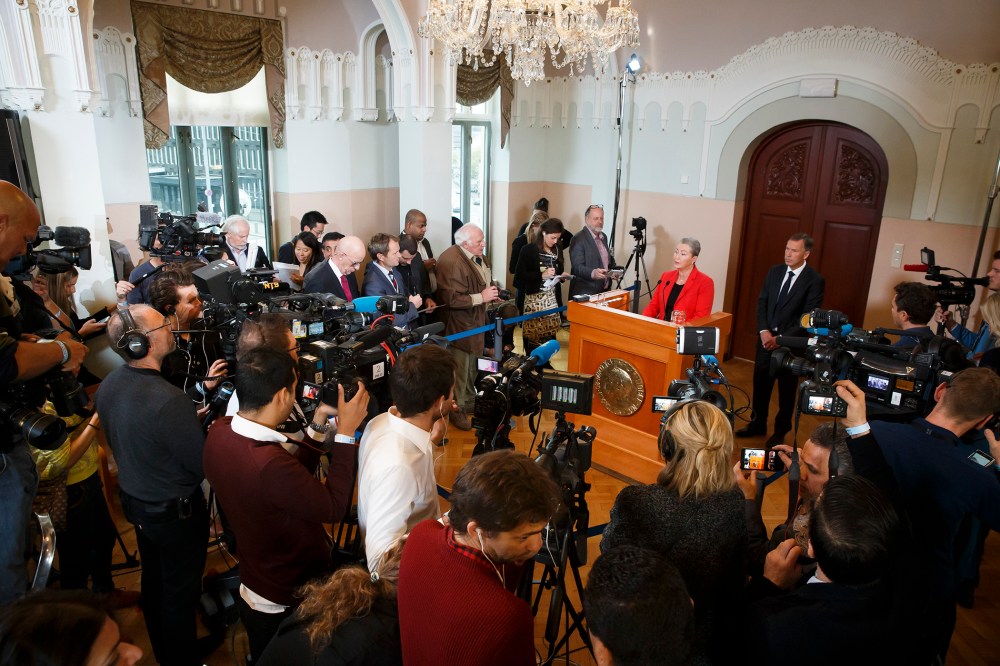
The prize was announced at a press conference in Oslo’s Norwegian Nobel Institute.
Kaci Kullman Five, head of the committee, told reporters: “More than anything, the prize is intended as an encouragement to the Tunisian people, who despite major challenges have laid the groundwork for a national fraternity which the committee hopes will serve as an example to be followed by other countries.”
Houcine Abassi, secretary general of the UGTT union, said he was “overwhelmed” by the award, telling The Associated Press: “It’s a prize that crowns more than two years of efforts deployed by the quartet when the country was in danger on all fronts.” “I am happy,” he added. While Tunisia has been much less violent than neighboring Libya or Syria, its transition to democracy has been marred by occasional violence, notably from Islamic extremists. An attack in June on a beach resort in Sousse left 38 dead, mostly British tourists. Another in March killed 22 people at the country’s leading museum, the Bardo in Tunis — also primarily tourists. This article first appeared on NBCNews.com.
Alexander Smith Recommended


