








It’s one of the risks of a long and busy life: the threat that society will change its mind about your most important work. That happened to Nancy Reagan, the former first lady who died on Sunday at 94.
President Ronald Reagan’s wife and closest adviser defined the drug panic of the 1980s, coining the phrase “Just Say No” and supporting her husband’s rampaging war on drugs. She often singled out marijuana as a special scourge, accusing dealers of taking “the dream from every child’s heart.”
But such positions have since slipped into disrepute in recent years, rejected even by many fellow Republicans. Nearly half the country has tried marijuana, meanwhile, and legal sales are booming in four states and counting. Criminal justice reform, including reducing sentences for nonviolent drug convictions, has been a point of discussion on both sides of the 2016 presidential campaign.
RELATED: The personal politics of drug addiction
Nancy Reagan never publicly recanted or so much as commented on her starring role in the drug war. But with a look back at the origins of her and her husband’s hardline policies, it’s possible to trace the arc of one of America’s most famous failures.
Ronald Reagan, eyeing a challenge to President Jimmy Carter, seemed to know that an attack on marijuana would tap into a growing displeasure with wayward teens, slack productivity and a society of apathetic Carter voters.
So in a major radio address in 1979 Reagan revealed what “science now knows,” including the dubious “scientific facts” that smoking dope leads to cancer, sterility and “irreversible effects on the mental processes.”
Never mind that the National Academy of Sciences had endorsed the idea of decriminalizing marijuana, finding “no convincing evidence” of its harmful effects.
The drug became an enemy of promise, the explanation for everything. Why is your teenager refusing to cut the lawn? Marijuana. Why is your industry falling behind Japan’s? Marijuana. Why do you have to lock your door at night? Hard drugs—which start with marijuana.
Nancy Reagan emerged as the most effective carrier of her husband’s message. She focused on almost nothing else during his presidency, beginning with an informal press conference aboard Air Force One in early 1982.
She told the press that drugs had become an epidemic. Then she made her first stop in a cross-country swing, an open meeting of Straight Inc., a youth rehabilitation program in Florida.
“I’m so proud of you,” she told a gathering of a thousand parents and kids.
Her voice cracked, her eyes filled with tears.
“How many of you started first on pot?”
Most hands went up.
“Do you think pot or the whole drug scene is glamorized a bit in the movies?”
Most hands went up.
“Should pot be legalized?”
Jeers filled the auditorium.
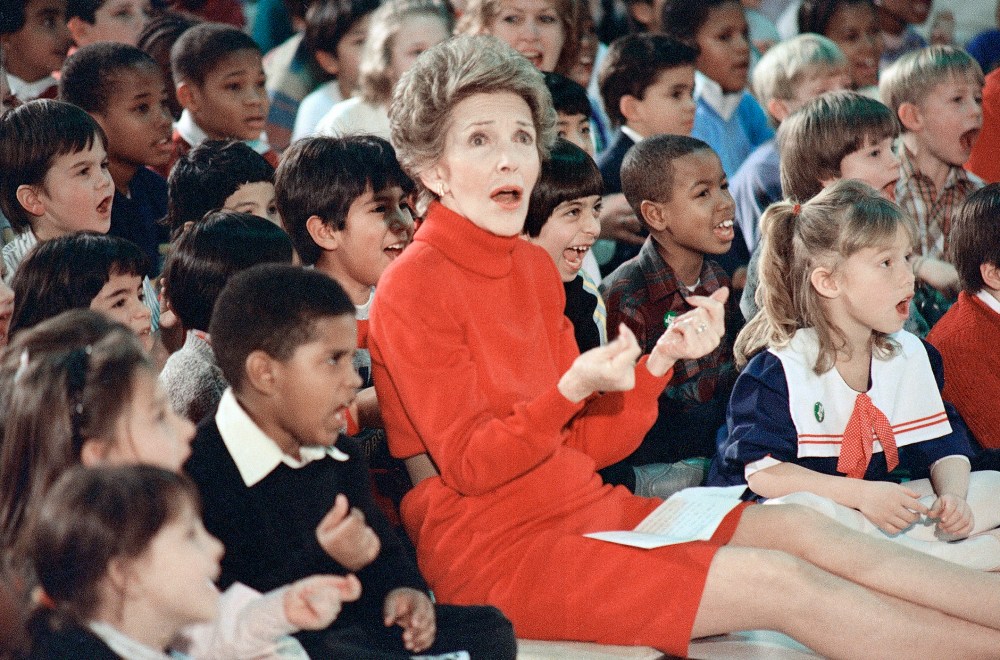
Later on the same tour, during a visit to an elementary school in Oakland, California, she coined her famous phrase. An elementary school student asked her what he should do if anyone ever offered him pot.
“Just say no!” she said.
Experts pounced. The slogan was one of the most unsophisticated anti-drug messages of all time. It suggested that drugs are evil, but you can quit them at any time.
Yet the phrase served a purpose. It created what Nancy proudly called “an atmosphere of intolerance.” Other politicians compared drug dealers to vampires, murderers and traitors. And people began to associate pot with waste and dropouts.
RELATED: Bernie Sanders: I’d be open to legalizing marijuana The pot problem suddenly felt ubiquitous. Telltale signs of marijuana use included teens “keeping late hours,” “schoolwork suddenly gone bad” and being “furtive about phone calls,” according to Parents, Peers and Pot, the Reagan administration’s most popular pamphlet. Some versions added “not doing chores,” “forgetful of family occasions (birthdays, etc.)” and “not cutting grass.” The first lady echoed these risk factors at every turn. “Children [who smoke pot] get very laid back and cool,” she advised. “They undergo a personality change, become combative, secretive, unable to get along with the family.” In June 1982, Ronald Reagan appeared in the White House garden to officially declare a war on drugs. “We’re taking down the surrender flag that has flown over so many drug efforts; we’re running up a battle flag. We can fight the drug problem, and we can win. And that is exactly what we intend to do,” he said. Marijuana was the only drug to merit specific mention. Before long, the War on Drugs began to sound like a comic-book battle between good and evil, which is why the absolute best gauge of the Reagan era is when the War on Drugs actually became a comic-book battle between good and evil. In 1983 DC Comics, the publisher of Superman and Batman, produced a special issue of its “New Teen Titans” series, a superhero story aimed at elementary-school readers. The Titans battled a “Plague!” of drug pushers “who couldn’t care less if kids died using their garbage.” The gang clobbered the skulls of a remorseless drug ring. But they were too late! Three kids overdosed and died before the Titans could save them. In every death, pot was a gateway to the underworld. Speedy, the battling bowman in the story, was himself once a pot-smoking teen who had since wised up. “They said pot had no bad side effects. That was before they did further research.” On the back page of the comic, Ernest J. Keebler, the noted Dutch American political scientist, cookie maker and magical elf, made a patriotic case for drug-free living. “When the Founding Fathers wrote the Declaration of Independence in 1776, they were announcing to the world that America would be free from the control of another nation,” Dr. Keebler wrote. “When we make a declaration to stay away from drugs, we are saying to others and to ourselves, that we are in control of our own lives.” But it was Nancy Reagan who set the tone. “Picture yourself in a battle,” she wrote in a letter on White House stationery on the inside front cover of the comic book. “In fact, it is one of the most important battles our nation has ever fought.” in 2016, the nation no longer agrees.
Tony Dokoupil Recommended


