








Legislators seeking to reform the National Security Agency may not have the votes to get their plan through Congress. But their opponents are running out of reasons to justify some of the agency’s activities.
Testifying before the Senate, the president’s surveillance policy review board said Tuesday that U.S. surveillance policy should be reformed and the NSA’s data collection should be reined in.
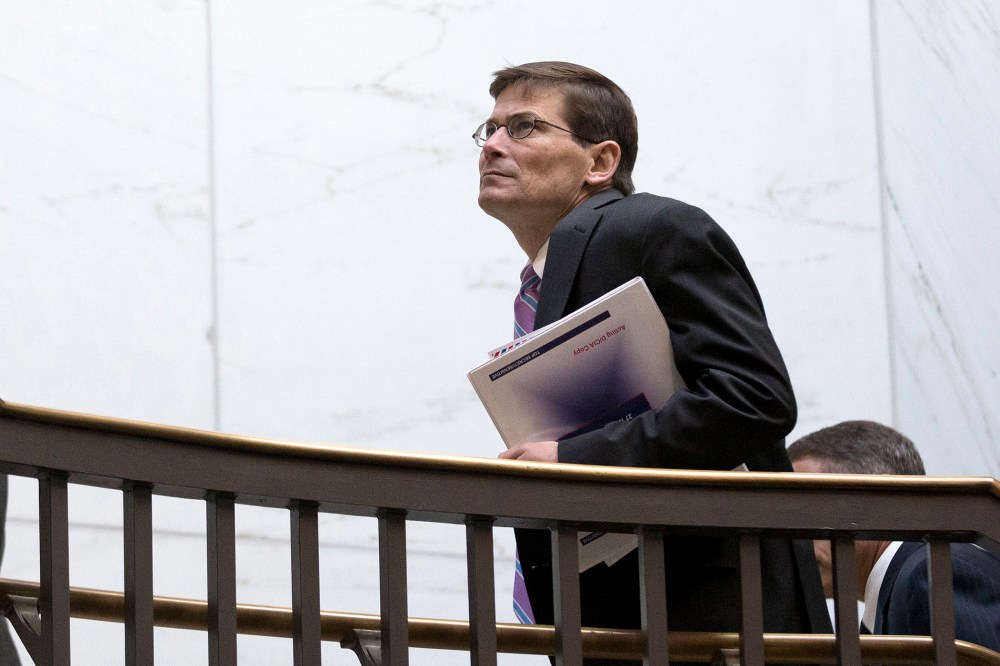
“We do not believe we’re going to add a substantial burden to the government with what we’re suggesting,” said Michael Morrel, a member of the review panel who once served as acting director of the CIA. The review panel has recommended that the law governing the NSA’s bulk telephone metadata collection program be altered so that private companies retain the data, which would be accessible to the NSA’s analysts only through a court order.

Nevertheless, supporters of the NSA’s surveillance powers tried to reframe the review panel’s recent report calling for an overhaul of national security law as supporting their belief that the authorities should remain unchanged. But as the hearing went on, panel members reiterated their conclusion that the NSA’s collection of Americans’ phone records had not been essential to fighting terrorism, said that the 9/11 attacks could have been stopped by information sharing between federal agencies rather than bulk metadata collection, and reaffirmed that a higher legal standard should be required for collecting phone records. They even rebuffed the administration’s argument that collecting records showing the date, duration, and numbers party to phone calls was not invasive.
“There is quite a bit of content in metadata,” said Morell. “There’s not a sharp distinction between metadata and content.”
Asked by the committee chairman, Vermont Democratic Senator Patrick Leahy, whether the NSA’s telephone metadata program could have prevented 9/11, former Bill Clinton and George W. Bush-era counterterrorism official Richard Clarke said the attacks could have been prevented with information the government already had.
“I think it’s impossible to go back and reconstruct history,” said Clarke, but he noted that had the relevant intelligence been shared with the FBI, the bureau could have acquired the relevant communications records without the NSA’s bulk metadata collection. “They didn’t because they were unaware of the information that existed elsewhere in the government at the time.”
South Carolina Republican Senator Lindsey Graham tried to tie the NSA’s bulk collection of Americans’ domestic call records to the 2011 Fort Hood shooting, citing the fact that the convicted shooter, Nidal Malik Hasan, had communicated with extremist preacher Anwar Al-Awlaki while the latter was overseas. Al-Awlaki was killed in a U.S. drone strike in Yemen that same year.
When one of the panel members pointed out that the NSA could have sought those records under a different section of the Patriot Act, Graham, an attorney, legislator, and sitting member of the Senate Judiciary Committee, said “most Americans could care less about the titles.” Graham left the hearing moments later.
Graham’s colleague, Texas Republican Senator Ted Cruz, who appears to be wavering on whether or not to support changes to the law, asked why the NSA was spying on innocent Americans rather than uncovering communications between the suspects in the 2013 bombing of the Boston marathon and extremist groups overseas. Morell told Cruz there were no overseas communications between the suspects and extremist groups to be intercepted.
Later on, Alabama Republican Senator Jeff Sessions suggested one of the panel members, Chicago Law Professor Geoffrey Stone, couldn’t answer questions about surveillance policy objectively because of his ties to the ACLU, even though the conclusions of the panel were unanimous. “Mr. Stone, I’m glad to hear your comment but you’re at the [advisory] board at ACLU, I believe,” Sessions said when Stone moved to answer a legal question Sessions had asked. “Did you support the ACLU lawsuit against the government raising many issues concerning this?” Supporters of keeping current surveillance law as is latched onto a December op-ed by Morell in the Washington Post arguing that the media had overstated the reports’ conclusion that the NSA’s domestic call data program hadn’t been “essential” to thwarting terrorist attacks. But he nevertheless reiterated his support of the panel report, which calls for the program to be overhauled by keeping the data in private hands and requiring a court order for government officials to access it. The NSA’s supporters in Congress aren’t the only ones unhappy with the panel’s proposed changes. Telecommunications firms are not eager to serve as data repositories for the government. California Democratic Senator Dianne Feinstein released a letter Tuesday from John D. Bates, a federal judge who serves on the foreign intelligence surveillance court, which approves government requests for surveillance on suspected foreign targets, warning against some of the review panel’s proposed reforms. Though careful to state that the letter should not be construed as “support or opposition to particular introduced bills,” the letter essentially argues against the changes being considered in Congress because they would increase the FISA court’s workload and “substantially hamper the work of the courts without providing any countervailing benefit.” President Barack Obama is set to weigh in on proposed changes to national security law and surveillance policy Friday. Though intelligence officials have defended the NSA’s surveillance programs as necessary, the president himself has yet to stake out a position on current fight in Congress. “We’ve seen this movie before, we know how it ends,” Utah Republican Senator Mike Lee said of the NSA’s data collection. “[The data] will eventually be abused, it will be manipulated for partisan or otherwise nefarious purposes and we can’t let that happen.”
Adam Serwer Recommended


