








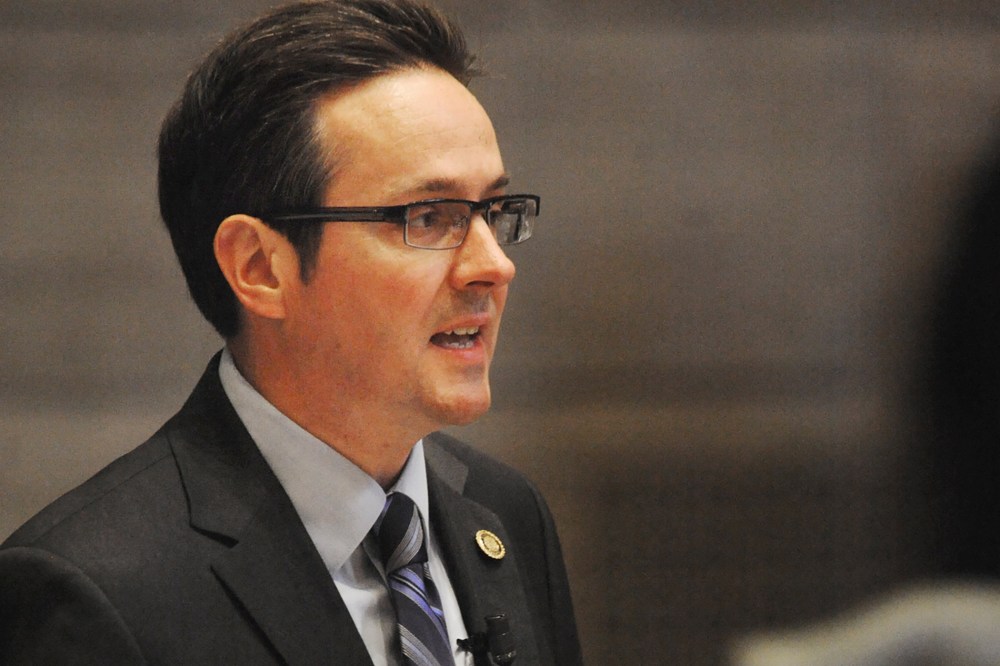
A Missouri state senator accused of interfering with academic freedom by trying to block a University of Missouri graduate student’s study at an abortion clinic defended the move in an interview with MSNBC. In contrast, he also said he wants to prosecute professors at the school, claiming they violated journalists’ First Amendment rights by blocking access to student protesters.
“I would never oppose unbiased academic research,” said Sen. Kurt Schaefer, a Republican who, in addition to chairing the Senate appropriations committee, is currently running for state attorney general. “I don’t believe for a second this is unbiased academic research.” Both the university and the graduate student authoring the study have stood behind the work, which looks at the impact of Missouri’s 72-hour waiting period for abortion, and which they say is not funded by the state.
RELATED: Dems, GOP set stage for major Planned Parenthood showdown
Schaefer, who opposes abortion rights, claims the abortion study violates a state ban on taxpayer funding for abortion, citing a consent form abortion patients are offered as part of the survey. The top of that form reads, “The purpose of this study is to better understand why a significant number of women sign the 72-hour consent form to have an abortion, but then never return to the clinic to have the abortion procedure,” referring to a 2014 law that puts Missouri’s waiting period for abortion among the country’s longest.
But Schaefer pointed to a line on the form asking about the benefits of being in the study: “The information that you provide may help Planned Parenthood of the St. Louis Region and Southwest Missouri improve its services to better meet the needs of women seeking abortions.” That, Schaefer said, rendered the survey of 200 abortion patients “more of a marketing project.” Schaefer also cited the fact that the doctoral student’s adviser is on the board of the local Planned Parenthood affiliate as “a built-in conflict of interest.”
A%20Kansas%20City%20Star%20columnist%20…%20labeled%20Schaefer%20%E2%80%9Cthe%20scariest%20person%20in%20Missouri%20government.%E2%80%9D’
On Oct. 30, Schaefer sent a letter requesting more information about the study, as part of his work chairing a committee known as the Interim Committee for the Sanctity of Life. The committee was formed to investigate Planned Parenthood for, in his words, “selling baby body parts.” The reference was to secretly recorded videos released over the summer by an anti-abortion group, featuring Planned Parenthood employees discussing reimbursement costs for fetal tissue donation for the purpose of medical research.
None of the videos were filmed in Missouri. After an investigation, the current attorney general, a Democrat, cleared the Missouri affiliates of wrongdoing. “I just don’t think that’s a thorough investigation,” Schaefer responded. He said he is not convinced Planned Parenthood isn’t “selling baby body parts.”
Missouri state Rep. Stacey Newman, a pro-choice legislator who serves as a minority member on the joint House committee investigating Planned Parenthood, told MSNBC that Schaefer’s inquiries are “a witch hunt to come up with something that energizes their base in the next election.”
Newman also accused Schaefer of making “verbal threats” that led to the chancellor of the university stripping the local Planned Parenthood affiliate of the hospital credentials a doctor needed to provide abortions in Columbia, Missouri. Jonathan Butler, the graduate student whose hunger strike helped trigger the resignations of the University of Missouri’s president and chancellor, cited the Planned Parenthood move, along with concerns about racial injustice on campus, in his letter announcing his strike.
The inquiry into the Planned Parenthood study drew national attention because of protests at the university’s campus, which led this week to the resignation of University of Missouri System President Tim Wolfe. Two university employees, administrator Janna Basler and communications professor Melissa Click, were caught on video with the protesters, furiously seeking to block access to two student journalists who were trying to photograph the protests on the university’s quad, sparking a debate about the First Amendment and press freedom.
RELATED: #BlackOnCampus continues national discussion on race sparked by Mizzou Click has apologized and been removed from her courtesy appointment at the journalism school; Basler has been placed on administrative leave. But Schaefer, a former prosecutor, told MSNBC he would take it a step further — he wants them to be criminally prosecuted for assault, among other charges. As appropriations chair, he said, “I’m the one who has to convince my colleagues to fund the university. I will tell you my job has gotten a lot harder” in the wake of the protests, which are led by black students who have charged the administration with ignoring racism on campus. A Kansas City Star columnist accused Schaefer of making “a hard, screeching turn to the right” to court statewide voters in his attorney general bid, and labeled him “the scariest person in Missouri government.” When he was first running in 2008, Schaefer’s tone on abortion was significantly more conciliatory. “I think the issue of abortion has been settled in this state,” he told public radio reporter Jason Rosenbaum, in a video posted on YouTube. “I think we’ve met a balance. I think it’s always going to be a divisive issue but I think that we’ve reached a point in the state where we are at least at a workable point so we can get past the issue and and get to the more important issues of economic sustainability, environmental issues, all those other things we need to divert our attention to. I support the status quo.” Asked about those comments Thursday, Schaefer said, “I have always been pro-life …. My position has not changed.”
Irin Carmon Recommended


