








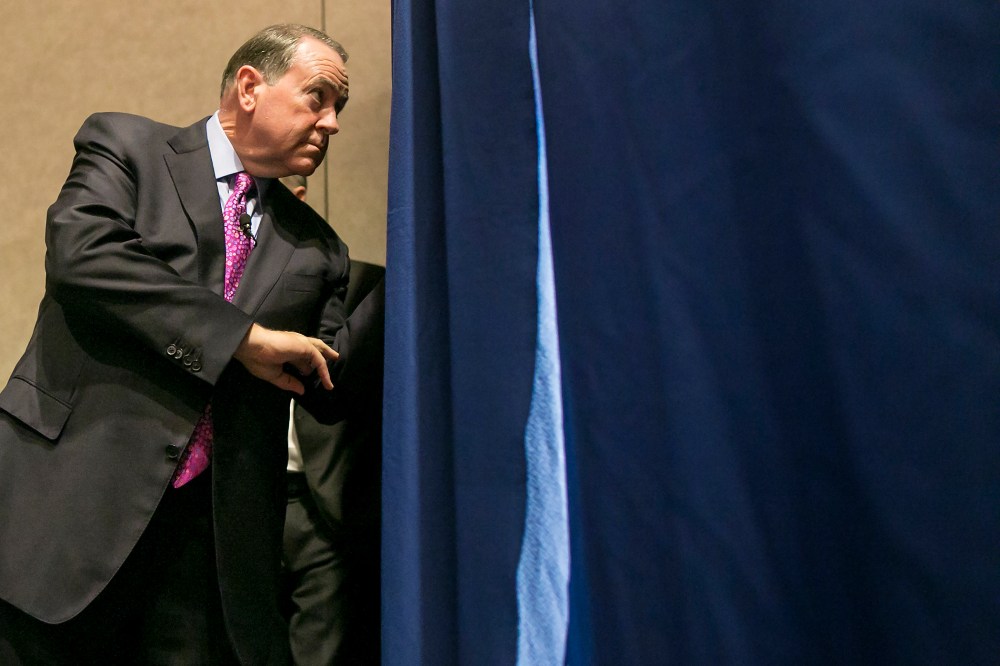
“When I was a young pastor in my 20s, I stood in front of what had been an all-white church — this was well over 30 years ago — and I welcomed the first African-American member to that church. I had death threats, there were people who said they’d leave the church, but instead I held my ground and I said ‘If he goes, I go.’”
That’s the start of a one-minute campaign video, entitled “Reconciliation,” that was released by former Arkansas Gov. Mike Huckabee’s campaign on Thursday. The clip is from a past appearance on “Meet the Press,” and it’s followed by footage of the Republican and former Fox News host leading the 40th anniversary commemoration of the integration of Little Rock High School in 1997 with members of the Little Rock Nine (along with then-president and former Arkansas Gov. Bill Clinton).
The web video touts the 48% of the black vote the Huckabee campaign boasts he won when he ran for election to a full term as governor in 1998. Some experts believe the real figure is closer to 20%, though even that would be high for a Republican post-Dwight Eisenhower (Gerald Ford got 17% of the black vote in 1976).
Huckabee’s campaign says he can replicate his success with black Arkansans as a national candidate.
“Gov. Huckabee has been working for, fighting for and serving alongside African-Americans since he was a child,” said Huckabee senior communications adviser Hogan Gidley by email Thursday. “He’s built lifelong relationships within the African-American community, many of whom were Clinton Democrats that ended up going door-to-door campaigning for Gov. Huckabee.”
RELATED: How Donald Trump shrank the GOP field
“No amount of poll-tested pandering can supplant his sincere commitment and connection to that community,” Gidley said. “His record of giving opportunities to people of color and enacting policies that empowered all people is a record of what he has actually done, not just what he promises to do.”
Huckabee plans to take his message to South Carolina this weekend, addressing “Faith and Freedom Sunday” at predominantly black Rock Hill Missionary Baptist Church in Manning, Huckabee’s appearance comes the day after a planned rally 63 miles away at the state capitol, by members of the Ku Klux Klan. The timing could help Huckabee offer a welcome contrast to the ugliest form of racial politics.
“I applaud any candidate who is reaching out to African-Americans,” said Rick Wade, who ran Barack Obama’s South Carolina campaign in 2008 and served as a senior adviser to the 2012 campaign. “And certainly the church has historically been an important platform to reach African-Americans.”
But Wade added that, reaching African-Americans has to be about more than rhetoric. “It has to be about action,” he said. “I would like to know what Mike Huckabee agenda is, to create jobs, to increase access to healthcare. So it’s got to go beyond the rhetoric.”
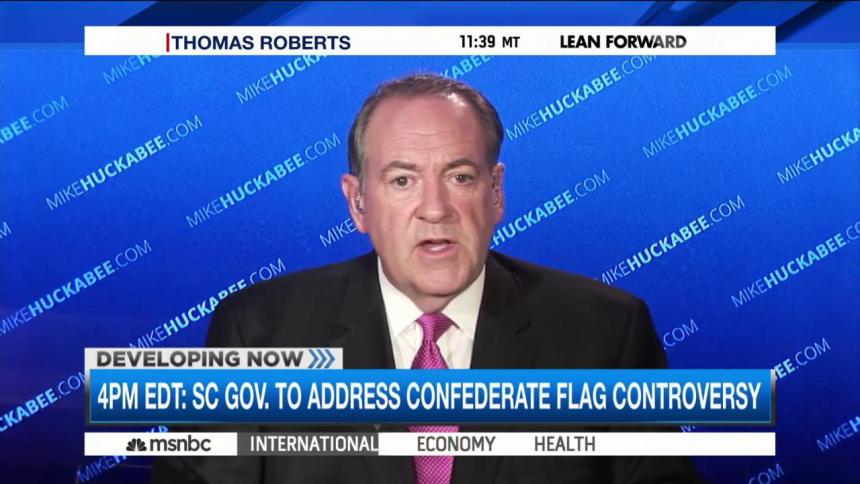
Huckabee’s menu of issues sound familiar for a Republican candidate. His campaign flaunts his record of balancing budgets, cutting taxes, improving roads and bringing jobs to Arkansas. But his aggressive courting of black voters is a strategy more Republicans are trying, including Kentucky Sen. Rand Paul, who has turned up at Howard University and in Ferguson, Missouri, talking criminal justice reform. Even Chris Christie, who boasts about his 20% share of the black vote in his re-election, has jumped on the bandwagon, though his approval ratings have since nosedived.
Huckabee mounted a similar push for black voter support in 2008, championing criminal justice reform, and arguing that the country could better use the money it spends disproportionately locking up black men to fund education. Issues revolving around the criminal justice system, from prisons to police interactions with black citizens, are poised to resonate again in 2016, with both Democratic and Republican candidates already embracing them, Huckabee among them.
“Gov. Huckabee believes local officials and stakeholders should make law enforcement decisions that are the most sensible for their own communities,” Gidley said. “He greatly expanded drug courts and community corrections for non-violent drug offenders rather than prison” when he was governor.
An uphill climb
Michael Steele, who became the Republican National Committee’s first black chairman in 2009, says he first met the then-governor when Huckabee invited him to Arkansas in 2003 when he was the newly elected lieutenant governor of Maryland.
“We met at the governor’s mansion, and we talked and just got to know each other,” Steele said. “He made that effort with me as an African-American who had just been elected statewide. He reached out to me. That told me a lot about him.”
“The one thing I can say about Mike,” Steele said, “is that he has been very authentic and consistent in that effort to reach out and build relationships” with black elected officials and civic leaders both inside and outside of Arkansas.
Still, whoever the Republican nominee is will face a candidate with even deeper relationships with African-American leaders and voters, given the surname of the likely Democratic nominee: Hillary Clinton. Even the runner-up in Democratic polls, Vermont Sen. Bernie Sanders, can brag about his history of civil rights activism, including participating in the March on Washington.
Republicans, meanwhile, are a long way from being the party of Lincoln, having morphed since the civil rights era into the party of Barry Goldwater, Richard Nixon’s “southern strategy” and more recently, the party of racial provocateur Donald Trump.
RELATED: Walker crows about crushing unions as Big Labor prepares to pounce
“The problem is that to so much of black and brown America, Trump reinforces the narrative that’s already there about the Republican Party,” said Democratic pollster Cornell Belcher, who is a veteran of both Obama presidential campaigns.
Belcher pointed out that Republicans already find themselves on the opposite side of black and Latino Americans on issues ranging from the minimum wage and Obamacare to Social Security privatization. “Policies aside,” he said, “the number one barrier is the cultural stuff; the part of the African-American psyche that remembers the southern strategy and understands that this is still a party where people say ‘you lie,’ to the face of the first black president.”
“Huckabee’s problem will be that he and other Republicans have been tearing down the most popular figure in black America for the last six, seven years,” Belcher said. “Too many times, the Trumps of the world have used dog whistle politics, and the Huckabees of the world have been silent on it. The fact is that Republicans have gone after Barack Obama in a way that most African-Americans feel they have never gone after an American president before.”
That includes Huckabee, said Belcher. The former governor has even attacked the Obamas’ parenting and musical tastes. Gidley dismisses the concerns regarding the president. “Are you suggesting that Republicans shouldn’t oppose bad policies for all Americans because the President is black?” he asked. %E2%80%9CHuckabee%E2%80%99s%20problem%20will%20be%20that%20he%20and%20other%20Republicans%20have%20been%20tearing%20down%20the%20most%20popular%20figure%20in%20black%20America%20for%20the%20last%20six%2C%20seven%20years.%E2%80%9D’ “Isn’t the definition of racism treating someone differently because of his or her race?” Gidley continues. “Go back and watch the governor’s comments about the election of the first black president back in November of 2008. He, like many Americans, was hopeful. However, the African-American community has been getting punched in the gut by this horrible economy that is leaving millions of families struggling to pay for necessities. In fact, the average income for the African-American family has dropped since Obama was sworn in. No matter the audience, Gov. Huckabee addresses the anxieties, frustrations, and aspirations facing hardworking Americans who are struggling to get ahead.” Steele sees a harder slog for his party with black voters than Gidley does. “I’ve always said black voter are very sophisticated voters and at the end of the day they can parse through the crazy and the noise,” said Steele, calling it a “legitimate point” to ask why black voters would support anyone in the GOP given the rhetoric and the tone of the current party. “What I ask is that they look at the candidates individually,” he said of black voters heading into 2016, “because the eventual nominee will get to put their imprimatur on the party.” Steele said what’s most important is that the Republican candidates explain to black voters, “Where do you stand with me and mine, with my community? Are you prepared to legitimately address voting rights, incarceration that has hurt black families disproportionately?” “There is a link historically between the Republican party and African-Americans,” Steele said, “but how do you plan to take that link into the future? That’s what I’m waiting to hear from all these folks.” RELATED: Trump on Clinton: She lied about me! Despite the uphill climb for Republicans, Belcher agrees with Wade that candidates like Huckabee and Paul making their pitches for African-American support is a good thing both for the Republican Party and for the country. “I’m a hardcore Democrat,” Belcher said. “But when I take off my Democratic hat and put on my American hat, I think it’s a really good thing. As a black man I’m happy that they are at least making an effort, because the black community is better served when both parties are competing for their vote.” Hard, but not impossible Belcher said it’s “not far fetched” that a Republican could improve on the dismal showing with black voters in elections over the last 20-plus years, including Mitt Romney’s 6% in 2012 and John McCain’s 4%, particularly with no African-American candidate on the ballot. He pointed out that George W. Bush got 11% of the African-American vote in 2004; with black voters providing his likely winning margin in Ohio, putting him over the top. Still, Belcher said cultural issues like same-sex marriage, which boosted Bush with black evangelicals – and which are driving the Huckabee campaign today (he has called labeling gay marriage a civil right “an insult to African-Americans,”) have lost much of their political resonance since then. “The cultural piece that I would argue helped George Bush in 2004 has so dramatically shifted, in a way that would never be possible for a pollster to predict,” Belcher said of gay marriage in particular. “And even if it’s not as broadly acceptable in the African-American community as the white community, it’s not an issue that triggers a decisive vote in the African-American community today. When the president went out there on it he disempowered it as a voting issue for black people.” Another issue that has lost its luster in mainstream Republican circles is the Confederate flag, which Huckabee brashly declared to be South Carolina’s own business during the 2008 primary. As he prepares to return to that state on Sunday, he only slightly adjusted his tune. “He doesn’t own one. He doesn’t fly one. He doesn’t wave one,” Gidley said of the Confederate battle flag. “He grew up in the South and he understands deep feelings on both sides of the issue. But he has applauded Gov. Haley, the South Carolina House and South Carolina Senate for handling the issue at the state level – where it belongs.”
Joy-Ann Reid
Joy-Ann Reid is host of “The ReidOut” at 7 p.m. ET on MSNBC. “The ReidOut” features one-on-one conversations with politicians and newsmakers while addressing provocative political issues both inside and outside of the beltway. Recommended


