








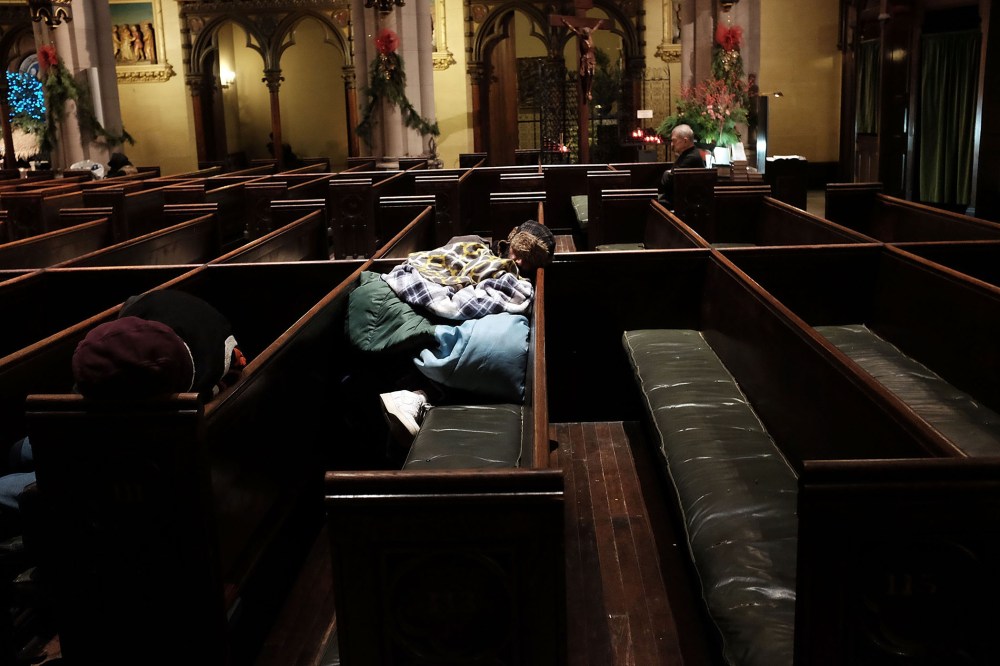
Stairs are for climbing or descending, but for Marvin Bolton they also are a place to rest, eat and sleep.
The 61-year-old homeless man with a graying goatee spends most of his evenings and nights in the stairwell of a building in New York’s St. Nicholas housing project, sitting on the steps or reclining on the cement landing on the ninth-floor of the 14-story building. Sometimes he does both, laying a piece of cardboard on a step to sit on, then putting a newspaper down on another step where he can place his elbow and rest his nearly toothless head in his hand, surrounded by dirty white walls and bathed in bright florescent light.
All his earthly possessions are within reach: a toothbrush, his cellphone, a couple shirts and a few pairs of pants, three coats, a hat and gloves and a suitcase.
The stairwell is sometimes noisy and is home to the occasional cockroach, but it’s a warm refuge from New York’s cruel winter. Marvin avoids homeless shelters because he thinks they’re unsafe and unhealthy. They also stress him out, making the cravings for the crack cocaine and heroin that have landed him in jail many times over the last 40 years even more intense.
RELATED: Geography of Poverty: A journey through forgotten America
Marvin is just one of 60,000 homeless people in the city and, as a single black man with a drug problem, in many ways typifies them. But by refusing to take advantage of the city’s shelter system, he’s also one of the city’s most vulnerable residents.
“Life is hard because of the things that I have to go through, just trying to survive, you know, trying to put food on the table so to speak,” he says. “Winter makes a lot of things rough for me… It’s too cold. I don’t have the proper gear… Being out here, I can get sick from this type of weather. I’m taking a lot of chances, you know?”
Introspective, but not one to dwell on the negative, Marvin has spent his first winter without a real roof over his head developing a strategy for survival: He layers pants and sweaters to combat the cold, tells time by whether certain stores are open or not and checks the weather report at a laundromat, so he doesn’t get caught out in a storm.
He often spends entire days on the go. Until recently, that meant pushing a shopping cart that he referred to as “the Cadillac” around an area extending roughly 30 square blocks in central Harlem, clomping along on a bad ankle and singing as he scavenged for items in garbage bins that he could resell to supplement his $720 monthly Supplemental Security Income payment. But after his cart was stolen in mid-March, he has a much harder time collecting cast-off items.
From those conversations emerged nine life lessons, hard-won epiphanies from Marvin’s journey that shed light on what you can’t know about survival when you have a home:
1. There is a day things finally catch up with you
Rose Dunn, 64, Marvin’s only sibling, remembers her younger brother, nicknamed Beanie, as someone who brought home high marks in school. He also was an overachiever when it came to basketball, baseball and even bicycle racing, and a talented artist and musician who was their mother’s favorite, she says.
Because their father was not often home, their mom, Emma,often worked two jobs – as an administrator in the garment district and as a receptionist for a book publishing company. Despite her long hours, their home in the St. Nicholas Houses – just across the street from the stairwell that Marvin now calls home — was run with love and a firm hand.
Dunn will never forget the day in 1973 when everything changed.
“I got off the train from work,” she said. “I hadn’t even gotten to 131st Street when people that knew me from the projects said, ‘Rose, I think they just picked up Beanie.’ I was thinking, ‘Who picked him up?’ and finally someone said, ‘He just sold some narcotics to an undercover cop and they busted him.’”
Dunn had an idea that her brother had been selling drugs, but said that the family was still shocked. They had not known how serious things had become.
“It all started because my father drifted away from home,” she said. “We used to come home to hot meals and do our homework. But as we got older and noticed the drifting of my father and saw how that meant our mom had to get a second job, Marvin wanted to help out. I guess the quick money was out on the streets and eventually we noticed Beanie making money and people knocking on the door at all hours of the night and we figured out what he was into.”
Forty years later, Marvin willingly acknowledges that his decision to get involved with drugs is the biggest reason he no longer has a home.
2. You never sleep soundly
As the temperature drops and night falls, Marvin sets up camp in the ninth-floor stairwell.
Even as he gets himself situated and relaxes for the first time all day, Marvin remains attentive, listening for police officers who periodically patrol the building and may ask him to move along.
He often heads out in the early evening to search the garbage bins of nearby residents in search of items he can either resell or give to his neighbors, which he must find before the garbage is picked up in the morning. Sometimes, he doesn’t get back until 1 or 2 a.m.
“I think I do more walking than sleeping,” he said. “I’m up most of the night, you know. But I get some type of rest.”
3. People will feed and clothe you
Between Harlem’s Salem United Methodist Church and the Metropolitan Baptist Church, Marvin can enjoy a warm midday meal each day and pick up some groceries and clothes weekly.
The meal at one of the churches is often Marvin’s only hot meal except for the coffee and pastries offered in the morning at his drug treatment program, where he receives methadone that keeps his craving for heroin in check. The churches also provide bathrooms, where Marvin can clean up a bit for the day.
4. Still, you need to be charming
Building tenants unlock the door for Marvin so that he can access the stairwell where he sleeps, often in response to text messages. Others check on Marvin to offer him a pillow and blanket at night or a warm plate of food. And old friends give him odd jobs or offer him a few dollars to help him get by.
“Even though he has his difficulties and hardships, he’s still an asset to the community in his own way,” friend and neighbor Bernard B. said. “Sometimes I’ll be coming in, me and my wife, with groceries and he will help me and I help him the way I can help him. It’s not like he’s looking at me as a way of living.”
For his part, Marvin does whatever he can to help his neighbors, including bringing them usable household items he scavenges and perishable groceries he receives.
5. You can make money from other people’s garbage
Collecting bottles and cans and cashing them in is a daily source of income for Marvin. He is always keeping his eyes open for the best prizes, such as shoes, containers, televisions, house fans — anything in decent shape that he can clean up, repair and resell. He uses newspaper instead of paper towels and a hose connected to the building to clean the items and glue or tape borrowed from friends for repairs. The pizza shop and the hair salon are just two of Marvin’s regular networking and selling spots — places where people know him and will buy. Throughout Harlem, Marvin has created a customer base he can count on to put a bit of change in his pocket. Those who don’t buy his goods might offer odd jobs, such as taking out their trash, shoveling snow or sending him out to run errands. 6. You can get stuck in one place, even when you don’t have one According to Marvin’s only daughter, a 38-year-old teacher who spoke with NBC News on the condition she not be identified by name, a lot of what contributes to Marvin’s inability to stay off drugs and out of trouble is his location — the St. Nicholas Houses. “I truly believe in my heart that my father wants to change, but I used to get angry because I said, ‘if you want to change, why do you hang with the same people in the same environment?’” she said. “Now I believe that maybe he doesn’t even know how to change and he comes to this area, the St. Nicholas projects, because that’s all he really knows — he grew up there, he comes back to it because that’s where my grandparents lived. … So it’s not his fault. … He has friends there and he feels like he needs to be somewhere where he knows people, so he goes back.” 7. You can be locked up without walls Marvin’s own words on his addiction to heroin and crack cocaine: 8. There is only so much your family can do “He’s my brother, but he’s somewhat of a stranger because that’s not the Marvin I grew up with,” said Rose Dunn. “He has kept pushing us away. He will say, ‘I won’t come around you because I know what I do and that it will hurt you.’ I have to accept that because I can’t afford to have that in my life.” Dunn tried to help him by enrolling him in a transitional house through a church she attends in New Jersey. Marvin was fitted with donated Armani shoes and clothes. He received spiritual guidance, performed community service and attended cultural events with the group. Then Dunn got a call one night saying that Marvin had been expelled for drug use. She has previously offered clothing, furnishings and money to her brother but has gotten to a point where she can no longer trust him. “I would send him money when he was doing good, but then I would hear from my niece that he hasn’t changed,” she said. “Then he called me one day when I knew he was going to use the money for drugs and said he’s short (on cash) and I said I’m not going to pay. I will always love you as your big sister but I will never support you when it comes to that.” Now she settles for sending supportive and encouraging text messages to her brother. His daughter has struggled with whether or not to give Marvin money as well, but has decided that she must do what she can for her dad, especially knowing how much he tries to do for others, including attempting to share his money with her when he has it. “I can’t worry what he will do with money I give to him, he’s an adult. I don’t want to be that kind of controlling person who says you can’t do certain things with what I give you, so if my dad needs twenty dollars I’ll give it to him because that’s my dad.” She wishes she could do more, like offer her dad a place to stay. But as a single mother, she says couldn’t manage that. “Sometimes you make one wrong move and it has a lasting effect, but I want my dad to know that no matter what, I’ll be there as much as I can be and I will love him no matter what,” she said. 9. Here’s what you hold on to, even without a bedroom Marvin says his three dearest possessions aren’t things: This article originally appeared on NBCNews.com.
Tracy Jarrett Recommended


