








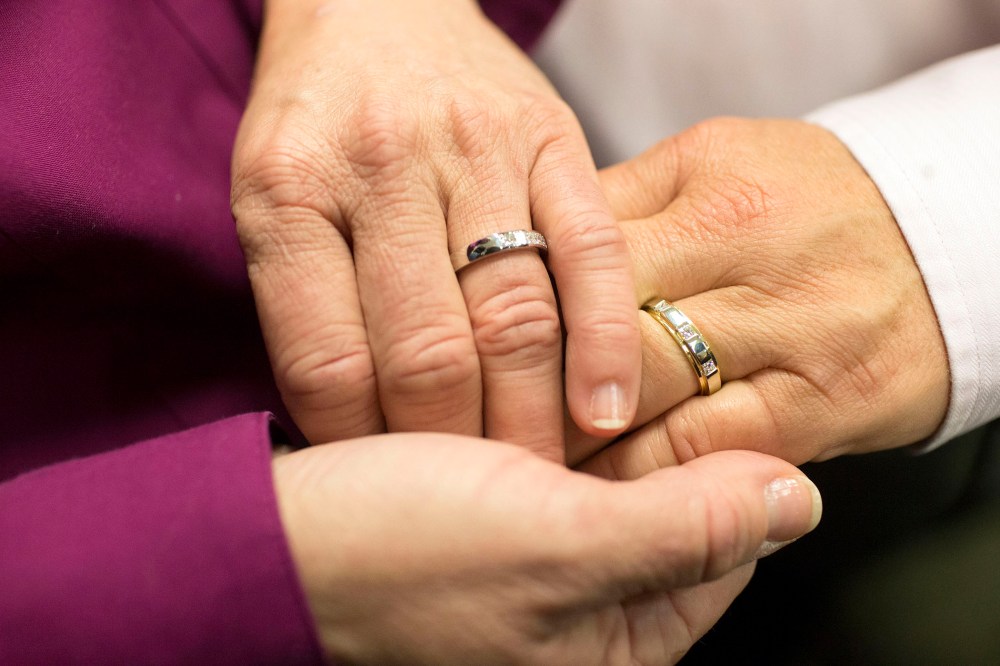
Tradition, child rearing, and the principle of majority rules dominated oral arguments Wednesday, as a three-judge panel of the 6th Circuit Court of Appeals considered the constitutionality of four separate same-sex marriage bans.
The marathon hearing covered the most ground to date, with six different challenges to bans in Kentucky, Michigan, Ohio, and Tennessee, all argued back-to-back. (Two suits in Ohio and two in Kentucky were consolidated for the purpose of Wednesday’s proceedings.) Plaintiffs in Ohio and Tennessee are seeking recognition of their out-of-state marriages, while those challenging bans in Kentucky and Michigan are fighting for the right to marry in those states.
Michigan’s solicitor general, Aaron Lindstrom, kicked off the day’s arguments, offering three “rational bases” for why the government should be allowed to regulate marriage: promoting procreation, honoring the will of the people, and protecting children from the possibility that same-sex couples make worse parents than heterosexual ones.
“The state doesn’t have an interest in regulating friendships, [it] doesn’t regulate how many people can be in a friendship, or how long a friendship has to exist. The thing that changes, and the reason the state has an interest in marriage, is because marriage is linked to children,” said Lindstrom. “It’s rational for the state to have an interest in promoting marriage so that it will be more likely that a child will have both a mother and a father, and will have the benefits of having both a mother and father.”
The Michigan suit was brought by two women, April DeBoer and Jayne Rowse, who are together raising three adopted children. Because Michigan’s marriage laws are entwined with its adoption code, the two were unable to jointly adopt or adopt each other’s children — a process known as second-parent adoption. Neither woman has full legal rights to all three of her kids.
The panel seemed relatively unreceptive to Lindstrom’s child rearing argument.
“I thought there was a lot of evidence offered in the trial in Michigan that indicated, in fact, that the outcome on children was reasonably benign, given what they know at this point,” said Martha Daughtrey, a President Clinton appointee. Pointing to the number of states that have already legalized same-sex marriage — 19, plus the District of Columbia — Daughtrey added, “It doesn’t look like the sky has fallen in.”
Where Lindstrom was more successful was in his argument that voters had a right to determine what the definition of marriage should be. Nearly 60% of voters approved Michigan’s same-sex marriage ban in 2004.
“Maybe there’s something I’m missing, but I would have thought that the best way to get respect and dignity is through the democratic process,” said Judge Jeffrey S. Sutton, a President George W. Bush appointee. Judge Deborah L. Cook, another Bush appointee, also seemed to be leaning toward the voters.
Later in the day, lawyers from both Kentucky and Tennessee defended their same-sex marriage bans on the grounds that states had an economic interest in encouraging married couples to have children, something only opposite-sex couples can “naturally” do. “Stable birth rates,” argued Kentucky officials in their brief, support “long-term economic stability.”
Children also factored heavily into arguments from Ohio’s case, Henry v. Himes, which was filed by Gerhardstein & Branch and joined by Lambda Legal.
“Married same-sex couples are having children in and adopting children from Ohio, and the state should not be stacking the deck against those children by refusing to recognize the marriages of their parents,” Susan Sommer, Director of Constitutional Litigation for Lambda Legal, in a statement. “The Sixth Circuit should join the avalanche of federal circuit and district courts around the country ruling that depriving same-sex couples and their families of the protections and dignity that come with marriage is flat out unconstitutional.”
Wednesday’s hearing comes amid a wave of judicial triumphs for marriage equality, unleashed by the Supreme Court’s decision last year to invalidate the federal Defense of Marriage Act (DOMA), a law that prevented the U.S. government from recognizing legally valid same-sex marriages. Since that ruling in United States v. Windsor, no federal district judge has upheld a ban on same-sex nuptials – a trend that now looks to be continuing at the appellate level. Earlier this summer, the 10th Circuit Court of Appeals issued dual rulings that found same-sex marriage bans unconstitutional in both Utah, and Oklahoma. And last week, the 4th Circuit Court followed suit, siding with thousands of same-sex couples who wish to either marry, or have their out-of-state marriages recognized in the Commonwealth of Virginia.
Both Utah, and Oklahoma officials have filed appeals with the U.S. Supreme Court, meaning that the justices will have at least two requests next term to consider the issue of marriage equality once more. The DOMA ruling, while broad in its interpretation, dealt only with the constitutionality of a single federal law. And in another high-profile lawsuit from last year, the high court declined to offer an opinion on the legality of California’s same-sex marriage ban, known as Proposition 8, finding instead that the proponents lacked standing to defend it. Observers largely agree that marriage equality’s stunning winning streak will be difficult for the Supreme Court to ignore for long. Justice Ruth Bader Ginsburg recently said as much, when she told Mark Sherman of the Associated Press that “if a case is properly before the court, they will take it.” But many predict a loss could come from the 6th Circuit, where the panel skews to the right. Among the three, the swing is widely expected to be Judge Sutton, whose record – while conservative – includes a surprising deciding vote that upheld Obamacare in the 6th Circuit. Even more influential than the ideological makeup of this panel, however, may be the decisions from other circuit court panels and district judges that have come before. “Those decisions are not binding on the 6th Circuit,” stressed Marc Spindelman, a law professor at Ohio State University. “But the consensus among judges that Windsor not only states that DOMA is unconstitutional, but also stands for broader equality is a principle that one can expect would impress itself on these judges.” Disappointing as a marriage equality loss would be, some LGBT advocates could still picture a silver lining. If there’s a split among the circuit courts, that could spur the Supreme Court to take up a case and rule on the issue once and for all. “I think that having a decision that’s contrary to the other decisions propels the whole case of marriage equality to the Supreme Court, which will ultimately make a decision,” said Ian James, executive director of FreedomOhio. “We’re also cognizant that the Supreme Court doesn’t always rule the way everyone would like.” Despite the uncertainty, there is a kind of finality that hangs in the air with each marriage equality case, one that elicits either optimism or dread depending on where you fall in the debate. Hundreds rallied in downtown Cincinnati near the federal courthouse Wednesday, while opponents took to prayer. “We’re praying for people caught up in homosexuality,” Phil Burress, head of Citizens for Community Values, told The Columbus Dispatch. “We’re praying for (judges) to do the right thing.” This story was updated at 7:15 p.m. EST.
Emma Margolin
Emma Margolin is a reporter at MSNBC.com. Recommended


