








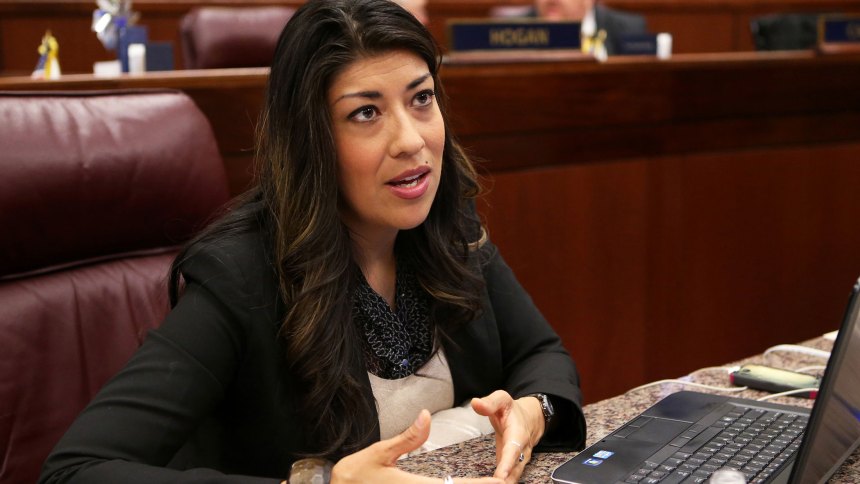
LAS VEGAS, Nev. — “I don’t have the background of a typical politician, right?” Lucy Flores told a crowd of Democratic activists as she accepted the party’s nomination for lieutenant governor of Nevada in June.
It’s a line you’ve heard before: Candidates love to brag about how they didn’t grow up like those “typical” politicians. But there’s no other way to describe Flores, a Latina rising star who was born into an impoverished family of 13 children, whose mother abandoned her in grade school, who fell in with a gang, who was sentenced to a youth prison, who dropped out of high school and who became a lawyer and a state legislator– all by age 31.
Flores, now 34, isn’t running from her troubled past; she’s running on it. Her early struggles — and the way she’s overcome them – are the centerpiece of her campaign.
“There are Lucys in every town across this state,” she told activists. “That’s why my focus is on making sure that this is a state that works for every Nevadan, not just the privileged few.”
Flores isn’t the only one betting big on her life story either. Nevada Democrats are looking to her underdog tale to lead their entire party in a challenging year.
Republican Gov. Brian Sandoval is running virtually unopposed and may challenge Sen. Harry Reid in 2016. Because the lieutenant governor would take over if Sandoval wins, Reid and Sandoval are each throwing their full weight behind strong candidates for that office — Flores for the Democrats and Mark Hutchison, a state senator and successful attorney, for the GOP. This proxy fight makes the Flores-Hutchison matchup one of the most closely watched races of the year in the West.
“Lucy is the water that lifts all the boats in the Democratic Party,” Derek Washington, a progressive activist and former chairman of the Nevada Stonewall Democrats, said. “The entire ticket all the way down depends on Lucy.”
Nationally, Hispanic and women’s activists see Flores as a potential superstar for the Democratic Party, whose elected leaders have so far failed to match the youth and diversity of its voters.
Her candidacy would help resolve an uncomfortable paradox for Democrats: Even as they pin their electoral future on Hispanic voters, the party has few Latino political stars of its own to counter Nevada’s Sandoval, New Mexico governor Susana Martinez, and Senators Ted Cruz and Marco Rubio on the GOP side.
Some political observers interpreted the White House’s recent decision to tap San Antonio Mayor Julian Castro to join the cabinet as an attempt to boost Castro’s national résumé ahead of a possible role as Hillary Clinton’s running mate. But the move was also a tacit admission that Castro’s prospects of moving up in deep-red Texas were remote and that Democrats had almost no viable Latino prospects without him.
In this context, Flores’s campaign is a potential breakthrough. Should she assume the governorship, either by filling a vacancy or winning outright in 2018, she would instantly become the most high profile Hispanic Democrat in the U.S. There’s no telling how far she could go from there.
“I’m ready, I’m qualified [to be governor],” Flores told a meeting of LGBT Democrats in June. “And I don’t want to say the D-word, but I would do a damn good job, let me tell you.”
Open book
Even before she threw her hat in the ring for lieutenant governor, Flores’s willingness to lend her personal biography to even the most contentious policy debates had put her on the national radar.
In 2013, she testified in support of a bill expanding school health programs. As she explained from the witness table, her school’s failure to teach sex education had a direct impact on her family.
“I had six other sisters … all of them became pregnant in their teens – all of them,” Flores said. “One of them was 14 years old when she got pregnant with twins.”
Then, with a nervous laugh, Flores told her colleagues something she had never admitted to anyone.
“Since I’m sharing so much this session, I might as well keep going,” she said. “I always said that I was the only one who didn’t have kids in their teenage years. That’s because at 16, I got an abortion.”
%22Demographically%2C%20she%E2%80%99s%20perfect%3A%20Young%2C%20dynamic%2C%20Hispanic.%22′
Her eyes welled up and her voice caught as she described how she had convinced her father to pay the $200 cost for the procedure. She didn’t want to end up like her sisters, Flores told him.
“I don’t regret it,” she said. “I don’t regret it because I am here making a difference, at least in my mind, for many other young ladies and letting them know that there are options and they can do things to not be in the situation I was in, but to prevent.”
News of Flores’s testimony spread in the state and around the country, bringing with it a torrent of abuse via phone, e-mail, and text messages, including death threats. The “absolutely horrific” response, as Flores described it to msnbc, led her to question whether “perhaps, the sharing has just gone too far.”
But just as anti-abortion activists were appalled by her testimony, pro-choice groups rallied around Flores. A feminist blogger in Las Vegas started a hashtag on Twitter, #FierceFlores, that ended up becoming her nickname among supporters. Some women reached out to her to share similar stories they had been unwilling to talk about before. When Flores announced her candidacy for lieutenant governor, EMILY’s List gave its enthusiastic endorsement.
Now her only regret is her ankle tattoo, a rose next to her last name that she carefully concealed with pantsuits early in her career. The design is hardly embarrassing by today’s standards, but Flores had it done as a teenager. It’s not who she is today, she said.
From big house to the state house
Flores began telling her story in public at an awards ceremony while a student at the University of Southern California. The remarks are still on the school’s website and “USCGRAD” is still on her SUV’s vanity plate.
But no matter how many times she discusses her past, the pain is never far from the surface. Describing it to msnbc, she still gets choked up recalling a particular slight or an unexpected helping hand when she needed it most.
Flores was born in Los Angeles, but northeast Las Vegas is all she remembers. Her father, a mariachi singer, moved the family to Nevada when Flores was a toddler after two of her older brothers were killed in gang-related violence. At first she took to the new environment, earning good grades throughout elementary school. But her mother left the family when Flores was 9, and things began spinning out of control.
“She decided that she really didn’t want to be a mom anymore,” Flores told msnbc. “That was the part that was most difficult for me.”
By adolescence Flores was failing classes and immersing herself in gang culture, which served as a “dysfunctional form of family” as she puts it now. Egged on by older friends, she began committing petty crimes, mostly theft. She started running away from home, stealing basic necessities that allowed her to stay away for longer stretches.
Inevitably, the law caught up. Flores and a friend were on their way to steal beer from a convenience store when police signaled her to pull over. The car she was driving was a stolen vehicle. Flores was already on probation thanks to multiple arrests. She hit the gas.
“I led them on a bit of a low speed chase through half of a neighborhood that I currently represent,” she recalled.
Flores spent much of the next year in a juvenile detention center where inmates learned the harsh regimented lifestyle many would later take to prison. There was a superstition inside the facility that if you looked back as you left, you’d return one day. On the van ride home, Flores, then 15, says she stared at the seat ahead of her with such burning intensity that her eyes watered.
It was a turning point, but a fragile one. Flores was determined to change with no idea what change would even look like. Fortunately, she had help in her parole officer, a tough talking middle-aged woman named Leslie Camp who wore a pair of golden handcuffs around her neck.
“I recognized she had a lot of familial issues,” Camp, who still keeps in touch with Flores, told msnbc. “She basically needed some mentoring and direction, but she had a good heart.”
Things didn’t turn around immediately, and Flores refuses to mythologize herself as someone who hit rock bottom, had a revelation, and became a model citizen overnight.
There were more run-ins with the law and personal crises along the way. At one point her mother, briefly back in Flores’s life, called the police on her during a dispute and attempted to revoke her parole. Camp successfully urged a judge to release Flores instead, an act of loyalty that convinced her to finally break from her old ways.
It would be years before Flores began to reach her potential, however.
She dropped out of high school at 17 to take a job at a doctor’s office, a move that felt like a major step up at the time. Later, she became a receptionist at a local women’s prison, where she awkwardly ran into an inmate who had been one of her old delinquent friends. Finally, after earning a spot as an office manager for an accounting firm in Los Angeles, she hit a ceiling when higher-up positions required a degree. So she returned to Las Vegas, earned a GED, enrolled in her local community college, and received a scholarship to USC. Inspired by her own early legal woes, she decided to pursue a career in law.
“Growing up, I’d had all these interactions with the law,” Flores said. “I’d always tell myself ‘I could be my own lawyer.’”
%22Our%20young%20women%20can%20be%20able%20to%20actually%20look%20at%20the%20governor%E2%80%99s%20mansion%20and%20see%20that%20there%20is%20a%20woman%20%E2%80%93%20a%20woman%20of%20color%20%E2%80%93%20who%20was%20actually%20able%20to%20come%20from%20District%2028%20and%20become%20the%20governor%20of%20Nevada.%22′
At the University of Nevada-Las Vegas, she helped found a clinic to challenge wrongful convictions, an issue that led her to lobby the state legislature for new reforms. That, in turn, inspired her to run for state Assembly. By 2011, she was representing the same neighborhood that had nearly wrecked her as a child.
Leading by example
Flores paused the interview at one point to add a caveat to her story: No topic in her personal life is taboo as long as it has a clear connection to government policy.
“There’s definitely other things that I have not disclosed,” she said. “I’ve never talked about my life, or anything I’ve gone through, or the decisions that I’ve made, just for the purpose of talking about them. They’ve always been for the purpose of trying to achieve something.”
It’s a philosophy that’s defined Flores’s tenure in the Assembly. She’s offered herself up in debate after debate as a kind of real world after-school special, vividly describing how different laws might have affected her in her darkest moments. Her abortion testimony is the most well known example, but it’s hardly the only one aimed at highlighting what she calls the “systemic challenges” families like her own face.
On some topics, like education, it’s an easy leap to make. Flores recounts how, as a teenager, she didn’t even know the building down the street from her was a community college, let alone that higher education was an option for anyone in her corner of North Las Vegas. Today, she points to her work on a measure requiring all high school juniors take a college aptitude test in order to help normalize the prospect of higher education in low-income communities. She’s also butted heads with leaders of both parties over funding levels for education. Other issues are more painful. After introducing a bill that would allow domestic violence victims to break their lease, Flores testified how she had to move repeatedly in her early 20s to escape an ex-boyfriend who stalked and beat her. Sandoval signed the measure into law last year over objections from Assembly Republicans and landlords. It didn’t take long before her unique approach to governing began to catch the eye of state and national Democrats. In the last presidential race, Obama’s re-election team relied so heavily on Flores as a Hispanic surrogate that she ended up hospitalized for dehydration during a particularly grueling summer stretch. ‘Demographically, she’s perfect’ As a young Latina, a single woman and an urban professional, Flores embodies – perhaps more than any politician in the country — the electoral coalition Democrats are relying on to carry them into the 21st century. It’s a coalition that’s turned out to vote more reliably in presidential years, however, leaving Democrats vulnerable in midterm races. Democratic leaders are hoping Flores’ barrier-breaking profile will motivate the base to hit the polls this November at higher rates — not just in her race but in contests around the state. “Demographically, she’s perfect: Young, dynamic, Hispanic,” Harry Reid said of Flores shortly before her campaign began. Few states have been as transformed politically by the growing Latino electorate as Nevada, which is rapidly losing its status as a swing state. Reid himself has attributed his own 2010 re-election to Latino voters, who turned out in heavier than expected numbers with a boost from the state’s labor-powered Democratic machine. Flores was one of six Hispanic freshmen elected to the state assembly that year. One of the first groups to endorse Flores was the Latino Victory Project, a new super PAC co-founded by actress Eva Longoria to help cultivate Latino political leaders. Political observers expect Flores to soak up donations from a growing Hispanic donor base around the country hungry for promising candidates. “When I think of Lucy Flores the words that comes to mind are orgullo and futuro,” Cristobal Alex, president of LVP, told msnbc. Pride and future. The emergence of Hispanic politicians is key to adding Hispanic voters, Alex said. Even though Hispanic voters heavily favored President Obama and other Democrats in 2012, he noted, “More Latinos stayed at home on election day than voted.” Why? “They don’t see themselves on the ballot.” Flores started her own super PAC devoted to boosting Hispanic candidates in Nevada and doesn’t shy away from positioning herself as a transformational “first.” Her debut television ad is a Spanish-language spot tied to the World Cup in which a group of small boys fantasize about becoming the next Lionel Messi while a Latina girl says she wants to be the next Lucy Flores. At her meeting with LGBT Democrats, Flores described the effect she could have as governor one day. “Our young women can be able to actually look at the governor’s mansion and see that there is a woman — a woman of color — who was actually able to come from District 28 and become the governor of Nevada,” she said. At the same time, it’s not hard to find voters uneasy with the state’s rapidly changing demographics. Speaking at a candidate forum for seniors, Flores politely disagreed with a man railing against “illegal criminal aliens” and kept a straight face as a woman suggested forming a “National Association for the Advancement of White People” to rival the NAACP. “We have to have some protection now that we’re a minority so we don’t get run over,” the woman said. Underdog Democrats are enthusiastic about Flores, but she has her work cut out for her. “I think Mark Hutchison’s the favorite and Lucy knows I think that,” said Jon Ralston, the dean of the Nevada political press corps, at a briefing for Democratic women Flores attended two days after her primary win. Ralston laid out his main reasons: a Republican-leaning year and “unlimited funds” from Sandoval’s donor network. He predicted Republicans would attack Flores as young, inexperienced and beholden to national interests — lines of attack that he said have some potential. He noted she has a reputation for not playing well with others. A few days after Ralston’s remarks, Flores parted ways with a top staffer, Pete Hackeman, over what an advisor described to msnbc as “personality differences.” Still, Flores is competitive in the private polls Ralston has seen and Democrats have a powerful turnout machine. And then there’s Flores’s biography. “I do think it’s interesting that some people on the Republican side think it will be great to use Lucy Flores’ background, ‘Oh she was in a gang, she committed crimes, she had an abortion,’” Ralston said. “If they tried to do [that] this race will boomerang on them so fast.” That scenario is of genuine concern to Republicans. On paper, Flores sounds like an opposition researcher’s dream, touching on any number of culture war flashpoints. But if a less-than-sensitive critic decides to take up the issue, it could produce an explosive rallying effect. “I don’t think it would be wise for anyone to get into the mud about (Flores’s) former life,” Robert Uithoven, a GOP strategist in Reno, told msnbc. And while her rival, Hutchison, seems highly unlikely to make that mistake himself, “it’s always hard to predict what noise will find its way there from independent groups,” Uithoven said. As Flores tells supporters in meetings, a poll by a prominent Democratic firm found that respondents became much more inclined to vote for her – even giving her a lead over Hutchison — after they were told an unsparing version of her story that included her decision to have an abortion. Flores has also made some concessions to the center to boost her campaign, most prominently when she came out against a ballot referendum that would raise taxes on businesses to fund schools, arguing instead for broader tax reform to achieve the same goal. For Angie Sullivan, an education activist who teaches kindergarten in a poverty-stricken North Las Vegas school not far from the one Flores attended, the decision to oppose the ballot measure smacked of politics. At a recent forum, Sullivan’s voice quavered as she asked Flores how she planned to fund the school system in a way that would close the yawning racial gaps her students suffered from every year. Flores called the issue an “urgent crisis” and promised repeatedly to make it her top priority as lieutenant governor, but restated her opposition to the margin tax. Afterwards, the two embraced. Sullivan may be disappointed in her position, but she believes it will be worth it if it helps elect a candidate who knows firsthand what it’s like to be one of her students. “The thing is it’s awful,” Sullivan said later, describing the many barriers to success her kids face. “Then you sit in a room with someone like Lucy and you think ‘Well, that’s all true – but there is a Lucy.’” Correction: A previous version of this story incorrectly stated that Flores testified in support of expanding school health programs in 2012, when it was actually 2013.
Benjy Sarlin Recommended


