








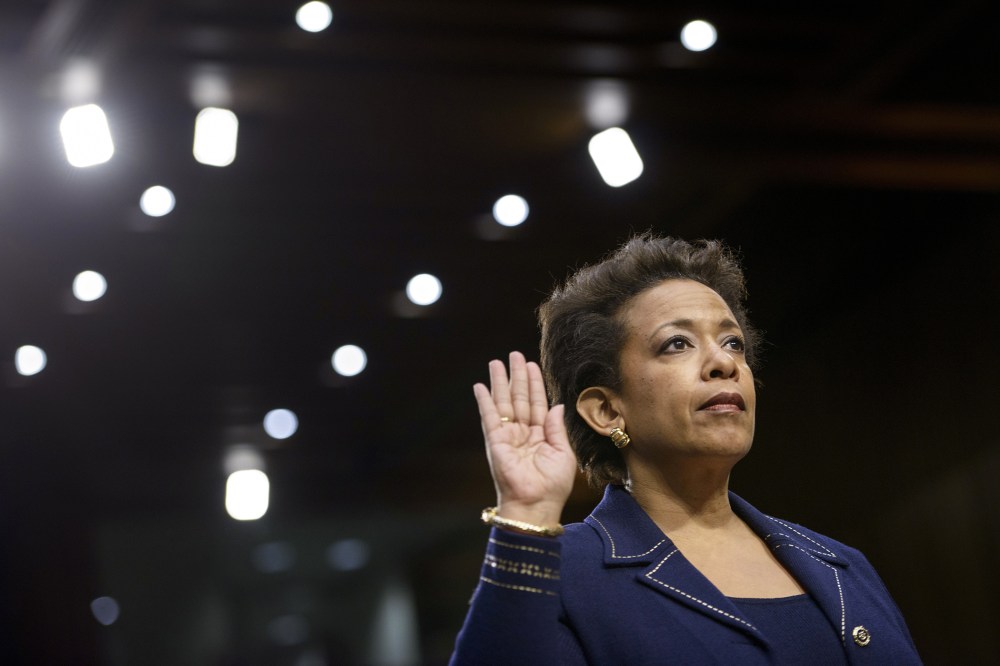
After a lengthy confirmation hearing process, the Senate Judiciary Committee voted 12-8 Thursday to advance the nomination of Loretta Lynch to be U.S. attorney general. The full Senate will likely vote on her nomination next month.
RELATED: Could Loretta Lynch move things forward?
Three Republicans joined all the Democrats on the committee in endorsing Lynch as America’s next top law enforcement officer. Those included Utah Sen. Orrin Hatch, South Carolina Sen. Lindsey Graham and Arizona Sen. Jeff Flake. Most of the other Republicans on the committee expressed concern ahead of the vote Thursday over Lynch’s support of President Obama’s sweeping executive action that would grant deportation relief to more than 4 million undocumented immigrants in the U.S.
If confirmed by Congress, Lynch will be the first female African-American attorney general in the nation’s history. Several Democrats on the committee remarked on the historic significance of that achievement, and criticized Republican opponents for standing in the way.
“What we are required to do in our generation is to stand behind those elements and moments in history where were can further the cause of civil rights,” said Democratic Sen. Dick Durbin of Illinois. “To say that she is unqualified or doesn’t deserve a vote because she agrees with the president’s executive order is fundamentally unfair.”
“This is an historic nomination for a country with the record on issues of race that our country has,” echoed Democratic Sen. Sheldon Whitehouse of Rhode Island. “To now be presented with the first female African-American attorney general nominee in our history is not nothing. It is significant. It is significant in our history, and how we react to it is also significant in our history.”
Most Republican lawmakers on the committee, however, focused solely on Lynch’s position regarding Obama’s immigration policy, and warned she would serve as a rubber stamp for boundless executive authority.
“I came into the hearing with high hopes. I must say, however, that the answers Ms. Lynch gave in this hearing room, in my judgment, render her unsuitable for the office,” said Texas Sen. Ted Cruz, a potential Republican nominee for president. “Throughout the course of the hearing, Ms. Lynch consistently refused to acknowledge any limitation whatsoever on the authority of the President of the United States.”
While that view largely dominated the GOP wing of the committee — including its chairman, Sen. Chuck Grassley of Iowa — some Republicans broke rank.
“I’ve always felt that it’s my position here to try to determine if somebody’s qualified for the position, not if I agree with every position that they take,” said Republican Sen. Jeff Flake. “I think she is eminently qualified.”
RELATED: Lynch to Congress: I’m no Holder Thursday’s vote comes 110 days after Obama nominated Lynch, currently the top prosecutor in Brooklyn, to succeed Attorney General Eric Holder. Last month, the Senate Judiciary Committee questioned her for eight hours during an all-day hearing. “I’ve been here 40 years and no attorney general — no attorney general — has ever had to wait this long for a vote,” complained Vermont Sen. Pat Leahy, the committee’s top Democrat, ahead of Thursday’s vote. Though the hearing produced no witnesses to oppose Lynch’s nomination, it has largely turned into a proxy war over the president’s immigration action. Lynch testified in January that she believed Obama’s executive order was legal, but has also said she would honor an injunction placed on the order’s implementation by a federal judge. “The courts are the right place for this to be resolved,” said Sen. Lindsey Graham, one of the Republicans on the committee who voted for Lynch Thursday. “She’s qualified by any reasonable standard. I’m sorry the Senate has become so dysfunctional. I’m sorry the president has created this mess. But I’m not going to add to it.”
Emma Margolin
Emma Margolin is a reporter at MSNBC.com. Recommended


