








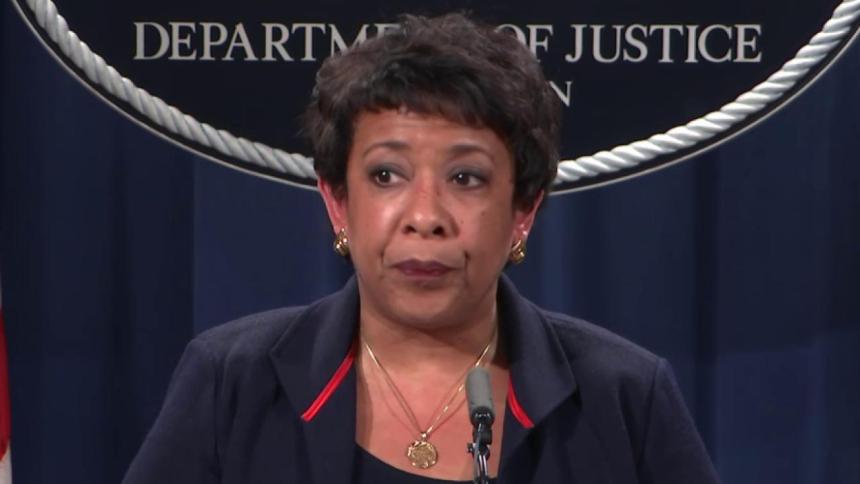
The Department of Justice filed a federal lawsuit against the city of Ferguson, Missouri, Wednesday after the city council rejected an agreement that would bring policing in the city in line with the Constitution.
The lawsuit, filed in U.S. District Court, alleges a pattern or practice of law enforcement conduct that violates the First, Fourth and 14th Amendments of the Constitution and federal civil rights law.
The legal action is a stark break from what had appeared to be good faith efforts by both city leaders and the DOJ to address widely condemned racially biased practices by the city’s police department and municipal court. Those practices were uncovered by federal investigators following the killing of unarmed African-American teenager Michael Brown Jr. by a former Ferguson police officer.
After 26 weeks of negotiations, the city and the DOJ agreed on a set of mandates and reforms known as a consent decree. All that was left to make the agreement binding was for the Ferguson City Council to approve it. But on Tuesday night, the council called for a wide restructuring of the agreement. The revisions, among other things, would require no mandate for payment of additional salary to police officers or jail staff, a cap on federal monitoring fees at $1 million and extended deadlines for the tentative agreement.
“Their decision leaves us no further choice,” Attorney General Loretta Lynch said Wednesday at a press conference announcing the department’s lawsuit. “We intend to aggressively prosecute this case, and I have no doubt that we will prevail.”
The city of Ferguson has been embroiled in controversy since Brown’s killing in August 2014 by former police officer Darren Wilson. A St. Louis grand jury later declined to indict Wilson in Brown’s death. The Justice Department also declined to file federal civil rights charges against Wilson. But during an investigation into the police department and municipal courts sparked by allegations of widespread misconduct and abuse, the Justice Department found a pattern of discriminatory practices.
In March 2015, following its months-long investigation, the Justice Department released a scathing report revealing widespread constitutional violations and a pattern of racial bias by the city’s police department and municipal courts. Federal investigators found that police routinely stopped and arrested black residents without cause, used unreasonable force and that the courts essentially used warrants, fines and fees issued to black people to balance the city’s budget.
“Our investigation uncovered a community in distress, in which residents felt alienated from their own police force,” Lynch said on Wednesday night. “The Ferguson Police Department’s violations were expansive and deliberate … These violations were not only egregious – they were routine. They were encouraged by the city in the interest of raising revenue. They were driven, at least in part, by racial bias and occurred disproportionately against African-American residents. And they were profoundly and fundamentally unconstitutional.”
The consent decree was an option to help the city avoid a lawsuit. The agreement would also mean the installation of a federal monitor within the police department as part of a tedious and costly federal oversight plan.
The cost of the proposed reforms could be as high as $3.7 million in the first year. That high cost, estimated by the city itself, sparked some speculation locally that city leaders inflated the price tag to give them a platform to reject the agreement, according to local news reports.
Ferguson Mayor James Knowles has said he wanted to make sure any decree would be both successful and affordable. Yet, critics, including the NAACP, have said the cost concerns are little more than a ploy. Sherrilyn Ifill, president of the NAACP Legal Defense Fund, said local and state officials have used claims of insufficient funding to “elude legal mandates since time immemorial, including desegregation in the South, eliminating bias in hiring and training, improving prison conditions, and countless other civil rights advancements.”
One of the city’s negotiators of the agreement, City Councilman Wesley Bell, said he remains hopeful that the city will be able to avoid a lengthy and costly court battle with the DOJ. “The council wants to get this done,” Bell told the St. Louis Post-Dispatch. “We did not get into these negotiations to turn around and have a lawsuit.” Yet Tuesday’s vote to restructure major parts of the 131-page consent decree did just that, triggering such a lawsuit. “The residents of Ferguson have waited nearly a year for their city to adopt an agreement that would protect their rights and keep them safe. They have waited nearly a year for their police department to accept rules that would ensure their constitutional rights and that thousands of other police departments follow every day,” Lynch said. “They have waited nearly a year for their municipal courts to commit to basic, reasonable rules and standards. But as our report made clear, the residents of Ferguson have suffered the deprivation of their constitutional rights – the rights guaranteed to all Americans – for decades. They have waited decades for justice. They should not be forced to wait any longer.” The federal complaint alleges that from October 2012 to October 2014, African-Americans were more than twice as likely to be searched, to receive a citation or to be arrested than their white counterparts. Between 2010 and August 2014 blacks accounted for 88% of the people police officers reported using force on. And while African-Americans make up 67% of the city’s population, they were 95% of people charged with simple “manner of walking in roadway charges.” In addition they made up 94% of failure to comply charges, 92% of resisting arrest charges and 92% of disturbing the peace charges. Principal Deputy Assistant Attorney General Vanita Gupta said the police and court practices uncovered in Ferguson “violate the Constitution, erode trust and undermine public safety.” “As shown by our lawsuit today, the Justice Department will continue to vigorously enforce the law to ensure that Ferguson implements long-overdue reforms necessary to create constitutional, effective and accountable policing,” she said.
Trymaine Lee
Trymaine Lee is an NBC News correspondent. Recommended


