








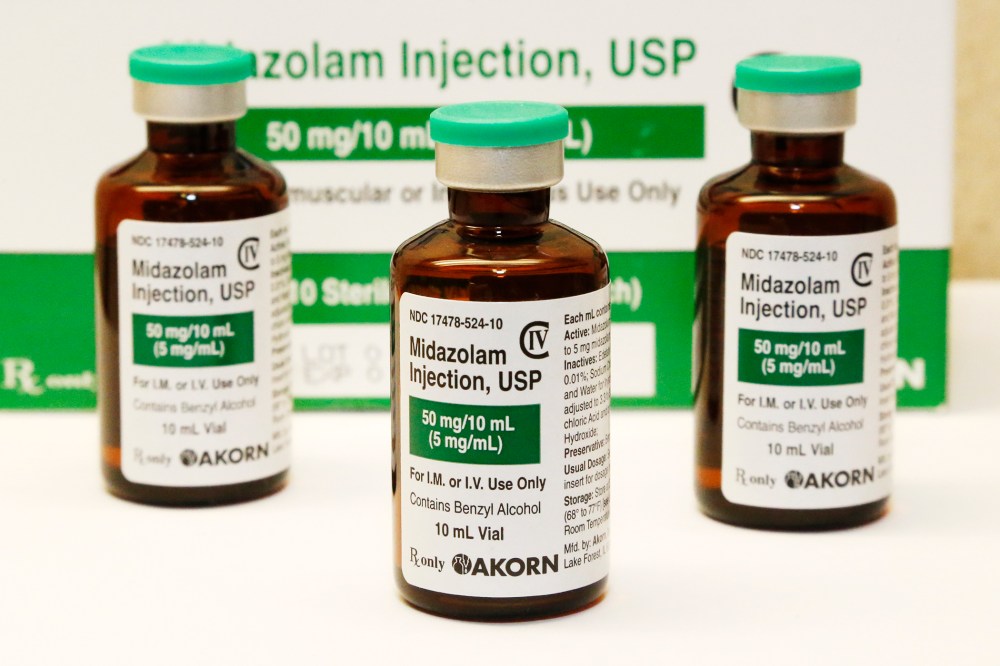
A federal judge temporarily stopped executions in Mississippi on Tuesday at the request of two death row inmates who say the state’s lethal injection protocol is “chemical torture.”
The state Executioner’s Office immediately filed an appeal of U.S. District Judge Henry Wingate’s temporary injunction declaring that the state can’t use pentobarbital or midazolam — both of them deployed to render prisoners unconscious — in its three-drug lethal cocktail.
Wingate didn’t file an explanation for his ruling. The Supreme Court in June upheld the legality of midazolam but didn’t address pentobarbital.
RELATED: Connecticut Supreme Court overturns death penalty
Lawyers for the inmates, Richard Jordan and Ricky Chase, argued that the state Corrections Department won’t disclose the source of the raw powder it uses to compound pentobarbital, meaning its purity and potency can’t be guaranteed. In any event, they said, pentobarbital doesn’t meet the state’s own standard of an “ultra short-acting barbiturate or other similar drug.”
If the inmate isn’t sufficiently anesthetized, they argued, “the chemical paralytic agent and potassium chloride used as the second and third drugs will cause conscious suffocation and intense internal burning.”
Mississippi subsequently said it would use midazolam instead of pentobarbital, but Wingate’s order indicated he didn’t find that acceptable, either.
Mississippi, like several other states, has had difficulty conducting executions because of a nationwide shortage of pentobarbital and legally acceptable substitutes. Manufacturers have stopped selling pentobarbital and one of the substitutes, sodium thiopental, for use in executions on ethical grounds.
RELATED: Opinion: Oklahoma should not execute Richard Glossip In January, Ohio scrapped its new combination of midazolam and hydromorphone after an inmate appeared to gasp for air during the 26 minutes it took him to die. Jordan, 68, who was scheduled to executed Thursday, is the oldest inmate on Mississippi’s Death Row. He was convicted of capital murder in the kidnapping of a Harrison County woman in 1976. Chase, 45, was sentenced to death in 1990 for the killing of an elderly Copiah County man in 1989. He has lost several court rulings that he is too mentally incapacitated to understand why he is to be executed.
M. Johnson Recommended


