








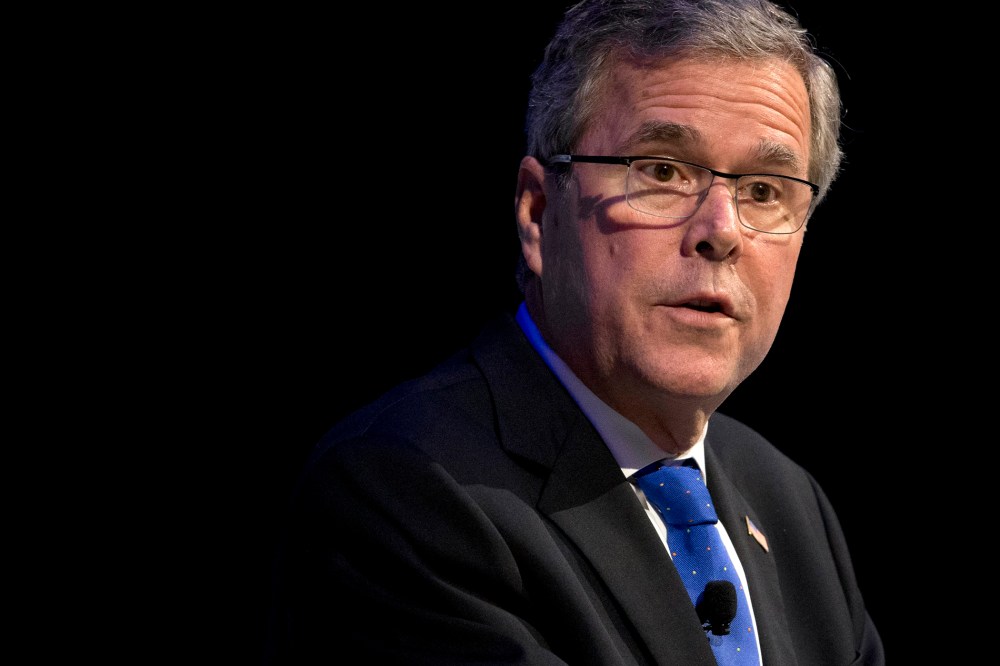
DETROIT — In his first major speech of the 2016 cycle, Republican Jeb Bush said he would tackle income inequality, poverty and education as part of a broad campaign to restore Americans’ “right to rise.”
“The opportunity gap is the defining issue of our time,” he said. “More Americans are stuck at their income levels than ever before. It’s very hard for people to go from the bottom rungs of the economy to the top or even the middle. This should alarm you. It has alarmed me.”
Bush’s staff billed the speech, delivered at a meeting of the Detroit Economic Club, as the first in a series in which he would lay out his vision for the country.
The address, at the Detroit Economic Club, was decidedly light on policy specifics. The former two-term Florida governor complained that social programs penalize recipients for making higher incomes, for example, but left it an open questions as to whether the answer was less generous programs that would discourage enrollment or more generous ones to transition people to work without fear of losing benefits.
“Instead of a safety net to cushion our occasional falls, they have built a spider web that traps people in perpetual dependence,” he said.
RELATED: Jeb Bush talks tax cuts and Mitt Romney in msnbc interview
Despite the relatively vague prescriptions, Bush’s account of what ailed America hinted how he would distinguish himself from the rest of the GOP field. In one notable passage, he stressed that Americans who felt they were struggling to get ahead were not imagining things.
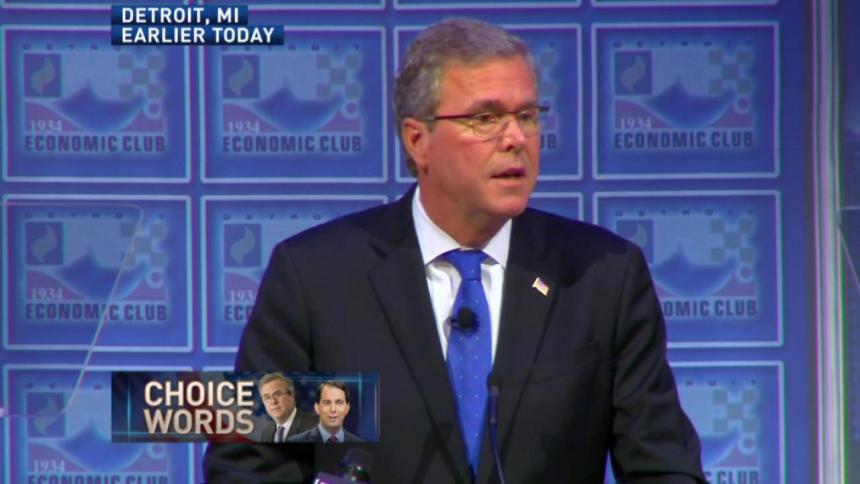
“Something is holding them back,” he said. “Not a lack of ambition, not a lack of hope, not because they’re lazy or see themselves as victims, something else. Something that’s an artificial weight.”
Such lines were a rhetorical break from other potential candidates like Wisconsin Gov. Scott Walker, who recently called social programs a “hammock.” Bush’s comments also recalled — and rebutted — Mitt Romney’s infamous “47%” tape, in which the 2012 Republican nominee complained that Democratic voters “believe they are victims.”
At every turn, Bush, the son and brother of former presidents, stressed that his solutions would focus on reducing the federal government’s reach and devolving power back to states, cities, and private competition. He twice brought up his support for Uber, the online car sharing service that’s clashed with taxi services over regulations.
“[Washington] is a company town and the company is government,” he said. “It’s all they know.”
RELATED: ‘Ominous’ signs for Jeb Bush
While Bush’s delivery was relatively low energy, he lit up during a Q&A afterwards, where he discussed topics from his family’s role in the campaign to immigration reform, often sprinkling jokes into his answers.
Asked about vaccinations, an issue that’s tripped up possible 2016 rivals Chris Christie and Rand Paul this week, Bush told the audience that “parents ought to make sure their children are vaccinated.”
Early in his speech, Bush addressed another elephant in the room: his last name. Already, opponents on the left and right alike have tried to tie him to the more unpopular elements of his father and brother’s administration’s, which include President George H.W. Bush’s tax increases and President George W. Bush’s struggles abroad in Iraq and at home confronting a financial collapse.
“I’m pretty proud … of 41 and 43,” he said. “I know that’s hard for the political world to accept.”
He elaborated on the topic during the question and answers portion, saying it would require “self awareness” to navigate and that “if I’m going to be successful, I’m going to have to do it on my own.” He described his “great frustration” over immigration reform’s death in Congress last year, warning that more immigrants were needed to offset America’s low birth rates and grow the economy. “This should be the lowest hanging fruit, to be honest, with you because this is a huge opportunity,” Bush said. Bush has not shied away from his support for reform, including a path to legal status for undocumented immigrants — a stand that puts him firmly at odds with others in the likely GOP field. But he added that improved border security and enforcement was needed, too, and he criticized President Obama’s executive actions to block deportations. RELATED: Jeb Bush snags top Mitt Romney Iowa strategist David Kochel One place where Bush’s position on immigration could be a problem: Iowa. His aides announced shortly before his speech that he would attend an agriculture conference in Iowa in April, the latest indication that he plans to compete hard in the first-in-the-nation caucus. His likely campaign manager, David Kochel, helmed Romney’s 2008 and 2012 Iowa efforts. Some Republicans have warned Bush to skip the state out of fear the party’s rightward lean – the last two caucus winners were hardline social conservatives Rick Santorum and Mike Huckabee – will bog him down in fights over immigration and education. While early, the most recent Des Moines Register poll put Bush towards the back of the GOP pack and found many Iowa Republicans wary of his positions. Bush is still in the first stages of building a policy platform, but he met recently with leading lights of the self-described “reform conservatism” movement that concedes the party needs a more direct prescription for issues like wage stagnation. One popular cause in the movement, for example, is expanding middle class tax credits, an idea another potential 2016 GOP rival, Florida Sen. Marco Rubio, is exploring. But critics on the right want to focus on cutting taxes for wealthy investors as well, or instituting an even more regressive flat tax, or they object on principle to Americans getting money back from income taxes at all (the “47%” Romney famously derided). Already some likely candidates, including Huckabee, have mocked the idea “income inequality” is even a problem. Louisiana governor Bobby Jindal fired a direct shot at the reformicons as well in a Politico magazine op-ed this week accusing them of offering “Obamacare lite” by proposing replacements that still raised revenue to subsidize insurance coverage. Expect these fights to resurface throughout the race.
Benjy Sarlin Recommended


